
Two Minutes Of Darkness And What They Reveal
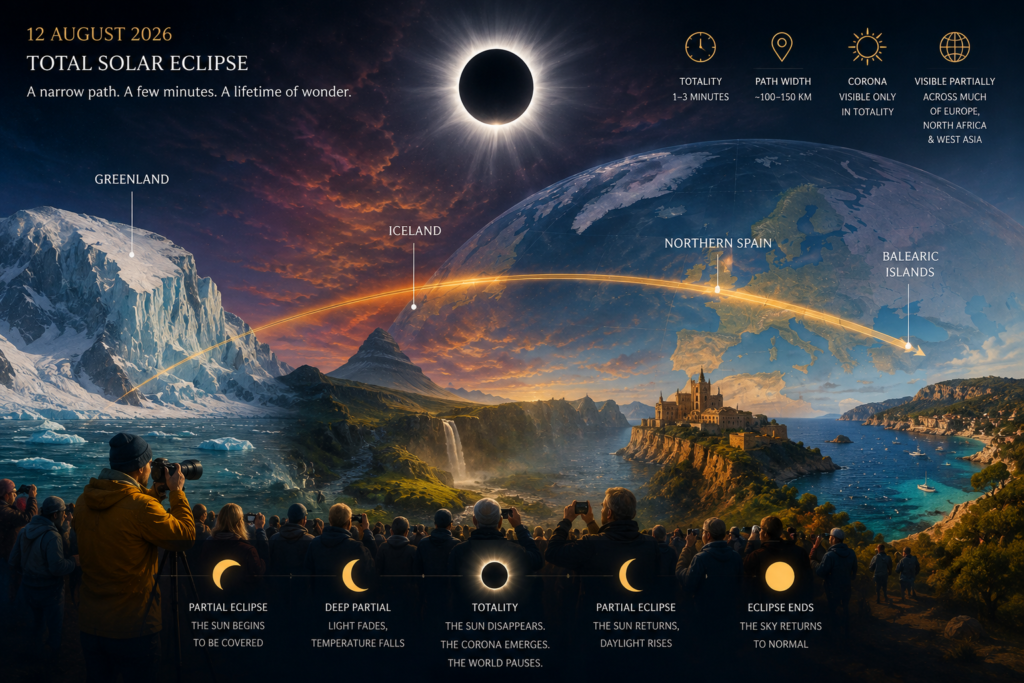
For most observers, the 2026 solar eclipse will compress a lifetime of celestial curiosity into two or three minutes. Daylight will fade, temperatures will fall, and the world will pause under the Moon’s shadow.
Those minutes reveal the precise clockwork of orbital mechanics, the geographical contingency of being in the right place, and the intensity of human desire to witness a sky that briefly rearranges itself.
What Makes A Total Solar Eclipse Different?
A solar eclipse occurs when the Moon passes between Earth and the Sun. Most of the time this alignment is imperfect, and we see only a partial eclipse: the Moon covers part of the Sun’s disk, dimming the light but never extinguishing day.
A total solar eclipse is different in kind, not just in degree. It happens when three conditions coincide:
- The Sun, Moon, and Earth line up almost perfectly.
- The eclipse occurs near the Moon’s closest point to Earth, so its apparent size in the sky is large enough to cover the Sun completely.
- You are located within the central shadow, the umbra, cast on Earth’s surface.
When this occurs, the bright photosphere of the Sun is completely blocked. Only the ethereal corona—the Sun’s outer atmosphere—remains visible, a pale, structured halo extending beyond the hidden disk.
Because we are so used to the Sun’s overwhelming brightness, nothing in everyday life prepares us for totality. Partial eclipses are interesting; only total eclipses reveal the corona, plunge the landscape into sudden twilight, and transform the sky into something wholly unfamiliar.
The Geometry Of Shadows: Umbra, Penumbra, And The Narrow Path Of Totality
At the heart of totality is shadow geometry.
- The umbra is the Moon’s central, darkest shadow where the Sun is entirely blocked. Standing inside it, you experience totality.
- The penumbra is the outer, lighter shadow where the Moon covers only part of the Sun, creating a partial eclipse.
Because the Moon is small compared with Earth and relatively close to us, the umbra tapers to a narrow cone. When this cone reaches Earth, it paints a thin track—often around a hundred or so kilometers wide—across the surface.
This is why the path of totality for the 2026 solar eclipse will be a very narrow corridor. Vast regions will see a partial eclipse in the penumbra, but only those standing within this strip will witness the Sun completely vanish.
Totality is rare from any one place not because eclipses are rare globally, but because this umbral footprint is small and moves with each event. The Earth rotates, the Moon orbits, and each alignment slides the shadow to a different location.
Glossary Of Key Eclipse Terms
| Term | Meaning In The Context Of The 2026 Solar Eclipse |
|---|---|
| Totality | Short interval (minutes) when the Sun is fully covered along the narrow path of the umbra. |
| Umbra | Central dark shadow of the Moon; crosses Greenland, Iceland, northern Spain, and the Balearic Islands. |
| Penumbra | Outer shadow where the eclipse is partial; much wider region of visibility beyond the central path. |
| Corona | Faint outer atmosphere of the Sun visible only when the photosphere is fully blocked during totality. |
| Path Of Totality | Ground track of the umbra; a narrow corridor that defines where full darkness is seen. |
Why This Eclipse Is So Special: The 12 August 2026 Path
The 2026 solar eclipse is special not only because it is total, but because of where its corridor of totality falls.
On 12 August 2026, the Moon’s umbra first touches Earth over the Arctic, then sweeps across Greenland, crosses the North Atlantic, passes directly over Iceland, then continues to northern Spain, including parts of the Balearic Islands, before heading back over the Atlantic.
A few features stand out:
- The path crosses only a handful of populated places. Much of its journey is over remote ocean and sparsely inhabited high latitudes.
- Iceland and northern Spain sit fortuitously along this narrow corridor, becoming prime land-based vantage points.
- For these regions, totality will last only a few minutes, yet offers an extraordinary spectacle at accessible latitudes.
In other words, this is not a global event in any experiential sense. It is a profoundly local phenomenon moving over a specific, slender ribbon of Earth. The rest of the world must be content with a partial eclipse—or with images relayed from within the shadow.
Why Iceland And Northern Spain? Geography, Climate, And Chance
The presence of Iceland and northern Spain under the 2026 path is not a reward for their beauty or culture. It is simply where the orbital geometry intersects the rotating Earth on that particular day.
Yet geography and climate turn this alignment into an opportunity.
- Iceland sits in the North Atlantic, along the route where the Moon’s shadow moves from Greenland toward Europe. Its latitude places it under the umbra during local daytime. The island’s open landscapes and long horizons can offer dramatic views of the approaching shadow.
- Northern Spain, including regions like Galicia and Castile and León, lies further south where the path of totality arcs over continental Europe before leaving land again. Compared with Iceland’s changeable weather, parts of Spain may offer drier, clearer summer skies.
The Balearic Islands extend this opportunity into the Mediterranean, letting the umbra briefly touch an archipelago with broad sea horizons.
Geography decides where the shadow passes; climate conditions influence how well we can see it. In 2026, that coupling favors a small collection of landmasses, making Iceland and northern Spain unusually privileged.
Two Minutes That Transform The Landscape: Sensory And Ecological Effects
What actually happens during those few minutes of totality along the 2026 path?
Observers stationed in Greenland’s ice, Iceland’s volcanic fields, or Spain’s hillsides will likely share some common experiences:
- Light: The Sun dims in stages as the partial phase progresses, then plunges suddenly into deep twilight at totality. Colors flatten; the landscape takes on a metallic or dusky tone.
- Temperature: Without the Sun’s direct rays, the air cools perceptibly. On open terrain, a brief chill passes through crowds.
- Sky: Stars and bright planets emerge. The Sun becomes a black circle ringed by the corona, whose streamers and structures are visible only because the photosphere is gone.
- Horizon: A 360° band of orange and pink encircles the horizon—a distant ring of daylight beyond the umbra.
- Animals And Insects: Birds may quiet or roost, insects change their calls, and some animals behave as if dusk has abruptly arrived.
Totality for the 2026 solar eclipse will last only a few minutes at most locations along the path. But the psychological intensity is disproportionate to the clock: the familiar world is briefly rendered strange, then quickly restored.
The Birth And Growth Of Eclipse Tourism
For many, those minutes justify journeys across continents. In recent decades, eclipse tourism has emerged as a distinct form of travel, and the 2026 solar eclipse will continue this trend.
Why do people travel so far for such a short event?
- A total solar eclipse is both predictable and rare from any one location, creating a sense of urgency.
- The experience is inherently communal: strangers gather along the same corridor of totality, sharing silence and awe.
- It offers a clear project for curiosity: planning, learning about orbital mechanics, and engaging with geography and climate.
For the 2026 path, tours and independent travelers are likely to concentrate in Iceland and northern Spain, the few regions where robust infrastructure meets the umbral corridor. The underlying motivation is simple: to stand, however briefly, inside a cosmic alignment rather than merely read about it.
The Hardest Part: Not Finding The Eclipse, But Finding Clear Skies
The route of the 2026 solar eclipse is known with exquisite precision years in advance. The main uncertainty is not where the eclipse will be, but whether clouds will let us see it.
This is why experienced eclipse chasers often say that the hardest part is not reaching the path of totality; it is reaching a place under that path with a reasonable chance of clear skies.
- High-latitude locations like Greenland and Iceland can be prone to cloud cover and rapidly changing weather, especially near coasts.
- Northern Spain and the Balearic Islands may offer more stable summer conditions in some regions, though no location is guaranteed.
Planning for the 2026 event therefore becomes an exercise in probability and flexibility. Some will prioritize landscapes and culture, accepting a higher cloud risk. Others will study historical sky conditions and reserve the option to move along the path on short notice.
The eclipse itself is inevitable; visibility is contingent. That tension is part of its allure.
What The 2026 Eclipse Leaves Behind After The Light Returns
When the Moon’s umbra leaves Greenland, Iceland, Spain, and the Balearic Islands, daylight will return quickly. People will pack tripods, fold chairs, and rejoin ordinary time.
Yet something remains. For those who witness totality, the 2026 solar eclipse may leave a sharpened sense of how fragile and precise our vantage point is—astronomically, geographically, and existentially. It reminds us that we inhabit a world where immense cosmic motions sometimes intersect with the scale of human attention.
Whether you plan to travel into that narrow corridor of totality or simply to understand it from afar, the event offers more than spectacle. It is an invitation to align conscious curiosity with the quiet, ongoing rhythms of the cosmos.
If you wish to explore more perspectives that weave science, geography, and reflection into daily insight, you can get started with thenoetik as a companion for your own journeys of understanding.
Frequently Asked Questions
Where can you see the path of totality for the August 2026 solar eclipse?
The path of totality for the 12 August 2026 eclipse traverses a specific corridor across Greenland, western Iceland, and northern Spain, concluding in the Balearic Islands. Only observers located within this narrow track will witness the Sun fully obscured by the Moon, while surrounding regions in Europe and North Africa see a partial eclipse.
Why are Iceland and northern Spain considered the best locations for viewing the 2026 eclipse?
Iceland and northern Spain are prime locations because they provide the most accessible land and established infrastructure within the narrow path of totality. These regions sit close to the center of the Moon’s shadow, offering longer durations of darkness compared to the path’s edges, while providing diverse landscapes for astronomical photography and observation.
How many minutes of darkness will occur during the 12 August 2026 event?
Observers can expect between one and three minutes of totality, depending on their exact proximity to the central line of the Moon’s shadow. Sites positioned directly in the middle of the path will enjoy the longest period of darkness, whereas locations near the outer edges will experience significantly shorter windows of total solar coverage.
What is the difference between the umbra and penumbra during a solar eclipse?
The umbra is the Moon’s innermost, darkest shadow where the Sun is completely blocked, creating the rare phenomenon of totality. The penumbra is the outer, lighter shadow where only a portion of the Sun is covered. Your geographical position in one or the other determines whether you experience total darkness or a partial eclipse.
How does orbital geometry affect the duration of the 2026 solar eclipse?
The 12 August 2026 eclipse features a very narrow corridor of totality due to the specific alignment of the Moon and Earth in their orbits. Because the Moon’s central shadow barely touches the Earth’s surface at high latitudes, the window of darkness is limited to just a few minutes, highlighting the precise clockwork and rarity of celestial mechanics.
Further Reading & Authoritative Sources
Authoritative Sources
- European solar eclipses – ESA (including 12 August 2026 total solar eclipse) — European Space Agency article describing upcoming European solar eclipses, with specific information about the total solar eclipse on 12 August 2026 over Greenland, Iceland, Spain, and Portugal.