
Last updated: September 25, 2026
When the critic stepped into MoMA’s Wall Hangings show and found textiles swelling off their hooks and drifting into the gallery air, the familiar softness of fabric suddenly read as something more unruly and architectural.
In 1969, one New York critic walked into MoMA’s exhibition Wall Hangings and wrote with disbelief that the works “refuse to stay on the wall at all.” Textiles looped into the room, knotted masses hovered at eye level, and woven forms crowded the air like unfamiliar architecture. The basic question landed in print as it had in the gallery: was this tapestry, or was this sculpture?
What Is Considered Fiber Art?
Fiber art is generally considered any artistic practice that treats fiber—thread, yarn, rope, cloth, felt, woven or knotted structures—as its primary medium, where the material and its construction are central to the work’s meaning. It spans flat textiles and monumental installations, but always foregrounds fiber itself as the language of the piece.
Historically, this kind of work sat in a corner of textile art history labeled “decorative arts” or “women’s craft”: tapestries, embroidery, lace, quilting. According to the AWARE Archives’ discussion of textile art, the transformation of fiber into fabric had long been seen as a basic cultural “fund” for human societies, yet was rarely granted the prestige of painting or stone sculpture (AWARE, Textile Art).
For centuries, fiber work meant surfaces: the rug underfoot, the tapestry on the wall, the tablecloth or the garment. The radical move in the 1960s–70s was to ask what happens when those same techniques and materials abandon utility, escape the rectangle, and occupy space like bodies or buildings.
From Decoration and Domestic Work to Artistic Margin
For most of history, textiles were central to wealth and status yet subtly downgraded as “decoration” or domestic work. Courts commissioned grand tapestries; households depended on cloth for survival. But the people who spun, wove, stitched, and darned—often women—rarely appeared in the pantheon of “great artists”.
In European contexts, tapestry and embroidery lived in palaces and churches, yet were classified as applied arts. They illustrated stories rather than claimed authorship. The loom sat in workshops or domestic interiors, not in academies.
By the 19th century, as art history professionalized, this division hardened. As AWARE notes, art history debated its own origins while continuing to treat the transformation of fiber into fabric as a fundamental human skill rather than a site of “genius” (AWARE, Textile Art). The hierarchy was clear:
- Fine art: painting, sculpture, architecture – public, male-coded, autonomous
- Craft / decorative art: textiles, ceramics, furniture – domestic, feminized, utilitarian
Because spinning, sewing, and weaving were bound to unpaid domestic labor and “women’s work”, the objects that emerged from them were seen as extensions of duty rather than vehicles of authorship.
So when we ask when fiber becomes sculpture, we’re really also asking: when do we start listening to the hands that have always been working with it?
The 1960s–70s Rupture: When Fiber Left the Wall
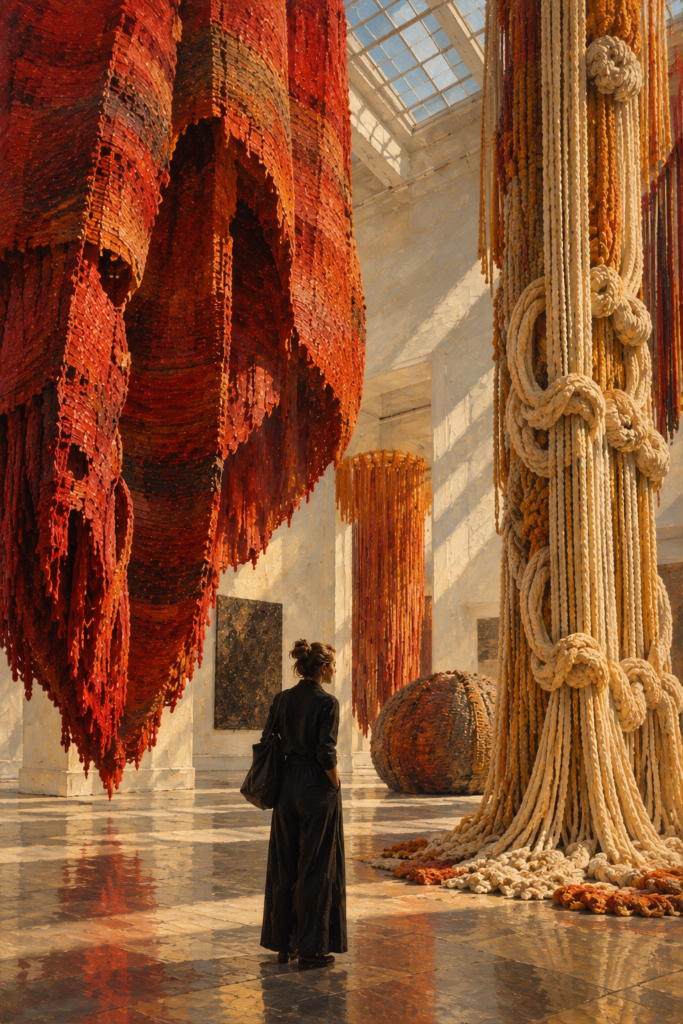
The rupture of the 1960s–70s occurred when artists began to treat fiber as an active, spatial medium. Thread, rope, wool, knots, and woven structures swelled into three-dimensional forms, sagged from ceilings, spanned entire rooms, and interacted with viewers’ bodies and movement.
One vector of this transformation was the Polish textile movement. In postwar Poland, artists working with tapestry pushed beyond flat wall hangings into heavily textured, relief-like and eventually fully spatial works. Within the constraints of state-approved media, fiber offered a field for experimentation: abstraction, scale, and unconventional forms could unfold under the guise of “textile”.
In practice, this meant abstraction was often literally woven into recognizably “safe” formats. A work might be submitted as a tapestry to an official exhibition, described in neutral terms of craft or folklore, while its internal structure pursued bold nonfigurative forms. Geometric weaves, irregular surfaces, and hanging structures that slipped away from narrative imagery could be defended as technical exploration. The label on the wall said “tapestry”; the experience in the gallery was closer to sculpture and abstract painting smuggled into a permitted category.
Because textiles were associated with tradition, utility, and national heritage, they attracted less ideological scrutiny than overtly experimental painting. Artists used that margin to test how far fiber could bend, bulge, and drop into the viewer’s space before it stopped reading as mere fabric and started to feel like a new sculptural language.
Another was Nouvelle Tapisserie (New Tapestry), an international shift in the 1960s that treated tapestry as an independent artistic form. Artists associated with this movement broke the rectangle, thickened the surface into relief, and allowed works to protrude into the room, dangle, twist, and cluster. Tapestry started to behave like sculpture.
Several formal changes distinguished this new fiber art movement from traditional tapestry:
- Scale: works grew to room-height, sometimes filling entire galleries.
- Dimensionality: surfaces bulged, knotted masses hung in mid-air, pieces rested on the floor as freestanding forms.
- Installation: instead of being attached to a wall, works were suspended, clustered, or arranged architecturally.
- Loss of utility: weaving abandoned any function as blanket, rug, or insulation; it became intentionally impractical.
This is the moment when fiber decisively “left the wall” and began to demand the same spatial attention traditionally reserved for stone or metal sculpture.
Table: From Traditional Tapestry to Sculptural Fiber
| Aspect | Traditional Tapestry / Textile | 1960s–70s Sculptural Fiber Art |
|---|---|---|
| Primary Role | Decorative, utilitarian | Autonomous artwork |
| Typical Format | Flat rectangle on wall | Hanging, freestanding, spatial |
| Relationship to Space | Background surface | Occupies and shapes space |
| Association | Domestic, “women’s work” | Experimental, avant-garde |
| Art-Historical Category | Decorative arts | Contested: craft vs. sculpture |
Portraits in Fiber: Abakanowicz, Hicks, Muñoz
Each of the key artists often cited in this history found a different way to let fiber behave like sculpture. Their work shows that the shift was not stylistic fashion but a deeper rethinking of what materials could do.
Magdalena Abakanowicz and the Soft Monument
Magdalena Abakanowicz, working from Poland, created vast, suspended fiber sculptures later dubbed “Abakans”. These were hanging bodies of woven and stitched matter that curved, bulged, opened like cavities, and cast deep shadows.
“Abakanowicz stated that she sought the “total obliteration of the utilitarian function of tapestry” and demonstrated the capacity of fiber to produce forms that were soft yet structured and complex.” — Editors of the Encyclopaedia Britannica (entry on Magdalena Abakanowicz), Encyclopaedia Britannica editors
In stripping tapestry of every trace of blanket or wall-covering, she helped make clear that fiber sculpture could be monumental and conceptually rigorous, not merely ornamental.
Sheila Hicks and the Architecture of Thread
Sheila Hicks pushed fiber in another direction: color-saturated bundles, cords, and cascades that converse with architecture. Her practice grew out of deep study of global weaving traditions, yet her large-scale installations disobey any single tradition.
In some works, cords are stacked into soft columns; in others, bundles of thread pour from mezzanines or cling to facades. Hicks treats thread almost like a structural unit, yet never hides its softness.
Aurèlia Muñoz and Spatial Knotting
Aurèlia Muñoz, in Spain, became known for monumental macramé and suspended woven forms. Using knots—an ancient, domestic technique—she generated hanging structures that create semi-enclosed volumes and porous walls.
Muñoz shifted macramé from decorative fringe to spatial articulation. Her works define zones in a gallery, cast latticed shadows, and invite viewers to move around and under them as if they were lightweight architecture.
Art, Craft, and Gendered Labor
The line between art and craft has never been purely formal; it has been drawn along lines of gender, class, and labor. Fiber work makes this visible with unusual clarity.
For centuries, textiles were produced by anonymous or collective labor, often by women or marginalized workers, in domestic or workshop settings. The activities involved—spinning, weaving, mending—were framed as duties, not choices. That history clung to the medium even when artists in the 20th century used weaving or embroidery in conceptually sophisticated ways.
So when 1960s–70s fiber artists presented monumental works, the reception was filtered through this bias:
- “Too close to decoration”: critics often saw fiber’s surface richness as suspect, insufficiently austere compared to metal or minimalist sculpture.
- “Too crafty”: visible technique, repetition, and manual labor suggested “skill” instead of “idea” in a period obsessed with conceptualism.
- “Too feminine”: because textiles were associated with women’s domestic work, they were treated as secondary—interesting as gender commentary, perhaps, but not as central to sculptural innovation.
At the same time, some artists and feminists embraced this coding deliberately, reclaiming “women’s work” as a site of resistance. Fiber art’s position at this charged intersection meant it was never evaluated on formal grounds alone.
Why Fiber Art Was Marginalized
Fiber art of the 1960s–70s emerged alongside Pop, Minimalism, Conceptual art, and land art. In this crowded field, fiber’s quiet revolution struggled to be heard.
Several forces constrained its visibility:
- Institutional categories: Museums and art schools divided collections and departments into “painting and sculpture” versus “decorative arts” or “crafts”. Fiber usually fell into the latter, with smaller budgets and less critical attention.
- Market dynamics: Monumental fiber works were labor-intensive, hard to maintain, and difficult to resell. A bronze sculpture promised durability and status; a massive wool installation looked vulnerable and impractical to collectors.
- Critical priorities: Theorists focused on language, dematerialization, and industrial materials. Thread and knotting seemed retrograde or overly sensuous in a moment enamored with industrial coolness.
Even when fiber artists were innovating formally—scaling up, working in three dimensions, engaging architecture—the combination of medium, gendered associations, and institutional structures kept them at the margins of the canonical story of 20th-century sculpture.
Why This History Still Threads Through Our Present
Understanding how fiber art became sculpture touches how we value labor that happens in kitchens and workshops, how we listen to materials associated with care and maintenance, and how we write or erase certain makers from cultural memory.
When a museum today rehangs its collection to place a monumental woven work beside steel and stone, it is not being trendy. It is correcting a story in which textiles were always present but rarely allowed to speak.
To notice that a knotted rope can be both a macramé plant hanger and a sculptural boundary is to notice that our own classifications—about people, work, or value—are more flexible than they seem.
Frequently Asked Questions
What technical distinctions separate fiber sculpture from utilitarian textile design?
Fiber sculpture begins when familiar materials—wool, sisal, industrial felt—stop serving a task and stand in a room as independent forms. Instead of lying flat on a table or clinging to a wall, they build volume, weight, and sometimes enclosure. You encounter them with your whole body, adjusting your path and sense of scale, rather than only with your eye along a surface.
Which landmark exhibitions catalyzed the institutional recognition of fiber as a sculptural medium?
The 1969 MoMA exhibition Wall Hangings was a turning point, bringing twenty-eight artists into a major modern art museum under a title that already challenged the boundary between textile and sculpture.
The International Tapestry Biennials in Lausanne reinforced this shift by rewarding ambitious, experimental works that used weaving and knotting for spatial and conceptual exploration. Together, they gave “off-the-loom” practices institutional visibility and a shared language.
How does the term “soft sculpture” differ from the broader category of fiber art?
“Soft sculpture” is a wide umbrella for any three-dimensional work made from pliable materials—stuffed fabric, rubber, vinyl, padding—used to unsettle the hardness we expect from monuments.
Fiber art sits inside this territory but keeps the internal logic of textile construction at its core: twist, spin, weave, knot, felt. The form’s strength and presence come from accumulated strands and tensioned stitches rather than from a mold or cast.
What role did internal armatures play in the evolution of three-dimensional textile works?
Early large-scale fiber works often relied on the density of knotting and the weight of the fiber itself to hold shape, proving that seemingly fragile materials could sustain complex structures.
As ambitions grew, hidden armatures of wood or steel became more common, allowing taller, more sprawling forms without sagging or collapse. The shift made it possible for fiber pieces to share the physical scale of traditional monumental sculpture while keeping their tactile, flexible skins.
Authoritative Sources