
Halloween is our annual rehearsal with death.
For one night, doorbells ring like tiny gongs, children wander the streets as ghosts and skeletons, and front yards bloom with improvised graveyards. It looks like pure play: candy, costumes, and plastic bones. Yet beneath that playful theater sits a serious human question:
If someone dies, are they really gone from the world of the living — or do we keep them socially present through story, ritual, and imagination?
Anthropologists sometimes talk about continuing bonds with the dead: the way relationships outlast biological death. Halloween is one modern, Western way of staging those bonds. Día de Muertos in Mexico, Toraja practices in Sulawesi, and Japan’s Obon are others. They are not versions of Halloween and share no historical lineage with it, but they all work on the same problem: how to inhabit a world in which love outlives the body.
Halloween, seen through the anthropological history of Halloween and global cultural traditions of the dead, sits exactly on that edge.
Layers Under the Mask: Samhain, All Hallows, and Modern Halloween
Picture Halloween as a reused manuscript. Under the bright ink of plastic pumpkins and horror films, older lines show through: Gaelic seasonal ritual, Christian liturgy, immigrant custom, and mass-market entertainment written one atop another.
The deepest widely discussed layer is the Gaelic festival of Samhain. In parts of Ireland and Britain, Samhain marked the turn from harvest to winter. Many accounts, including work by historians such as Ronald Hutton and Nicholas Rogers, describe it as a time when the boundary between the human world and the world of spirits or the dead thinned. Fire, food, and disguises managed that porousness: you honored some beings, misdirected others, and tried to stay on good terms with whatever crossed over.
This is where seasonal ideas about the boundary between worlds enter the story of Halloween. When nights lengthen and crops are gathered, practical anxieties about survival fuse with images of what lies beyond life. A time of ecological transition becomes a time to imagine other transitions too.
Christianity added its own layer. All Saints’ Day honors all holy ones, named and unnamed. All Souls’ Day focuses on the dead more broadly, especially those imagined as needing prayer. The evening vigil before All Saints’ became All Hallows’ Eve — eventually contracted in English to “Halloween.” Here the focus moves from seasonal spirits to a community of the dead defined by the Church: saints, souls in need of intercession, loved ones to be remembered.
Over centuries, these strands interacted rather than one simply replacing the other. Practices similar to mumming and guising — visiting houses in costume, performing small acts in exchange for food or gifts — could map easily onto a night already framed as spiritually charged. Later, when European migrants carried autumn customs to North America, they met new conditions: different neighborhoods, emerging youth cultures, and eventually the machinery of advertising.
By the twentieth century, Halloween in the United States and elsewhere had become recognizably modern: child-focused, highly visual, commercialized. “Trick or treat” folded older ideas of dangerous or mischievous visitors into a safer ritual of negotiation: you pay the ghosts in sugar, and they pass peacefully on.
The anthropological history of Halloween is not the story of one ancient rite surviving untouched. It is a comparative study of death rituals over time in a single cultural region, constantly reworked. Today’s Halloween is a combination of pagan seasonal motifs, Christian remembrance of the dead, immigrant practices, and commercial invention.
What holds steady across all this reworking is a narrative tension: on this night, the otherworld is close enough to be staged on a suburban porch.
Día De Muertos: Hospitality Across the Boundary
If Halloween is a theater of unease, Día de Muertos in Mexico is often a theater of welcome.
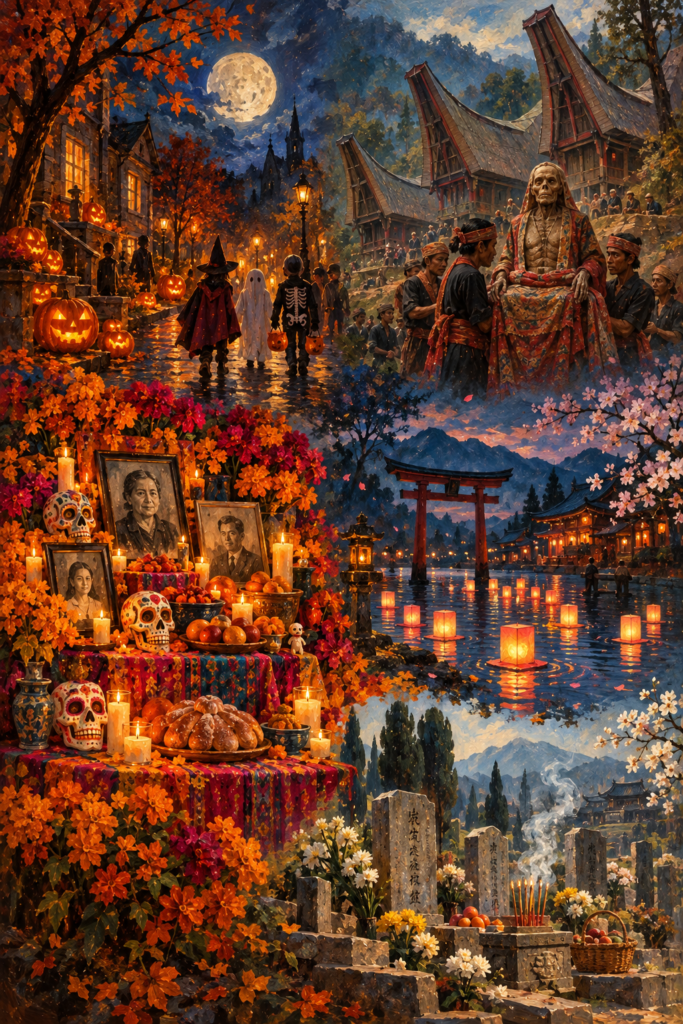
Families build ofrendas, altars layered with photographs, candles, marigolds, food, and personal objects. The photographs specify: these are the dead we are addressing. Candles and marigolds signal presence and path, light and scent to guide the returning souls. Food — favorite dishes, bread shaped like bones, sometimes alcohol or sweets — is an offering of hospitality. Personal objects can be almost anything that evokes the person’s life.
The assumed storyline is simple and radical: on these days, the dead return home. They arrive as guests and family members. The living, in turn, act as hosts. They sweep graves, decorate them, and sit nearby talking, eating, remembering. Streets may fill with skull imagery, but the skulls are smiling, painted, affectionate. This is a festival where the family explicitly extends across the boundary of death.
From an anthropological angle, Día de Muertos is one of the clearest cases of Halloween and ancestor veneration being structurally different, not historically connected. Catholic observances of All Saints’ and All Souls’ mix with indigenous Mesoamerican understandings of cyclical time and ongoing relations with the dead. The result is its own synthesis.
At the level of human psychology, Día de Muertos shows that memory insists on material form. When you set out food, arrange clothing, or place a photograph, you give memory a physical anchor and refuse to let the dead exist only as abstractions. You stage continuing bonds with the dead through acts of hospitality: you are still my grandmother; I still cook for you.
Halloween tends to picture the dead as anonymous figures wandering the neighborhood; Día de Muertos individualizes them, re-inscribing them into the household.
Toraja: When the Dead Remain at Home
Shift from Mexican graveyards to the highlands of Sulawesi, where some Toraja communities organize life around a different calendar of death.
When a family member dies, they may not be immediately defined as dead in the social sense. A deceased person may remain in the home for an extended period before the funeral and be treated as part of the household. The body is cared for, visited, spoken to. Relatives may refer to the person as sick or resting rather than gone. Everyday life and mourning intertwine under the same roof.
Later, lavish funerals mark another transformation, but even then the relationship does not end. In the practice known as Ma’nene, ancestral remains are periodically revisited, cleaned, redressed, and sometimes carried in processions. Here, care does not stop with burial. The dead can reappear in family space, not symbolically as a ghost but literally as tended remains.
These customs emerge from Toraja social structures, religious histories, and ideas about kinship and land.
Anthropologically, they sharpen the question that hovers over Halloween. What if death is not an instantaneous severing but a drawn-out reconfiguration of roles? In Toraja worlds, death is gradual: first biological, then social, and even then incomplete. The dead continue to claim and be claimed.
This stands as an alternative to the assumption that the dead should vanish quickly from daily sight. Where some cultures hide embalming and burial in specialized spaces, Toraja practices keep those processes at the center of village life.
Obon: Lights for Returning Ancestors
Turn again, this time to Japan, where Obon offers yet another way of staging the traffic between living and dead.
Obon is often described as a Buddhist-influenced period during which ancestral spirits revisit their descendants. Families clean graves, make offerings, and gather together. Food and incense connect daily life to ritual attention. Dance festivals and community events add a public dimension, but the emotional focus remains on family continuity.
Fire or lanterns play a crucial role. People may light welcoming fires at the beginning of Obon to guide spirits home, and later, farewell lanterns or floating lights help guide them back. Light is both a signal and a boundary marker: you are welcome now; later we help you return.
Obon emerges from the meeting of local Japanese customs with Buddhist understandings of rebirth, merit, and ancestry. Its emotional color is different from Halloween’s: gentle, reflective, sometimes festive, rarely aimed at fright.
Here, too, the dead are not fully gone. They are part of a cycle of visiting and leaving, woven into the domestic year. Children encounter death through acts of cleaning, offering, and shared meals, not primarily through horror tropes.
A contemporary case: Qingming and the politics of presence
Outside the now-familiar examples of Obon, Toraja rites, and Día de Muertos, China’s Qingming Festival (often called Tomb-Sweeping Day) offers a contemporary case of how states and families negotiate the ongoing presence of the dead.
Each spring, families travel to ancestral graves to clean tombstones, burn incense, and present offerings of food, paper money, or symbolic goods. The work is physical: clearing weeds, repainting characters, repairing stone. The acts are also legal and political, especially in dense urban regions where cemeteries compete with development and where digital “cloud sacrifices” have emerged when travel is restricted. Regulators debate cemetery land use and environmental impacts of ritual burning; families insist on the right to maintain face-to-face obligations to their dead.
Qingming makes the tension visible: ancestors are not only private memories but public presences that claim space, time, and resources in the present. Like Halloween and other rituals of the dead, it asks how far the living are willing to go to keep those claims active, but it does so through graveside labor and bureaucratic rules rather than masks or lantern parades.
Independent Traditions, Shared Question
Día de Muertos, Toraja mortuary customs including Ma’nene, Obon in Japan, and Qingming in China do not descend from Samhain or Halloween. Their anthropological history is local, shaped by their own religions, empires, economies, and ecologies.
Yet as a comparative study of death rituals, they align on one striking point: many cultures refuse to imagine a world where the dead simply vanish. Instead, they construct times and spaces where the boundary thins — a cemetery lit by candles, a living room where an embalmed relative still lies, a summer evening with lanterns swaying by the shore.
These are not proto-Halloweens; they are independent answers to a shared human concern. The idea that “the dead are with us” keeps reappearing, not because cultures copy each other, but because grief, memory, and kinship keep pushing against the limits of biology.
From this angle, Halloween is one local variant in a global pattern of cultural traditions of the dead that keep the social presence of ancestors alive.
The Dead Who Never Fully Leave
Across Halloween, Samhain’s shadow, Christian All Saints’ and All Souls’, Mexican ofrendas, Toraja homes and graveyards, Japanese lantern-lit nights, and Qingming grave-cleaning, humans treat death less as a wall and more as a membrane. The dead may be distant, but they remain socially present through stories, names, photographs, bones, candles, and food.
The paradox is that the strangest idea is not that the dead come back once a year. It is that in some places, they never entirely left.
Halloween, viewed this way, is part of a global conversation about whether someone’s place among the living truly ends at death. It joins other traditions in insisting that memory is active, not passive; that we do things with and for the dead. The border between worlds is seasonal, ritual, emotional — but rarely absolute.
These rituals invite you to examine your own inner arrangements. Which dead remain with you, and how? Are they frightening, comforting, awkward, beloved? The answers you carry shape how you move through late October streets, sit by a graveside in spring, or stand before an altar, even if you never name it as such.
If you want to keep following these lines between culture, memory, and the inner cosmos, you will find more to explore at thenoetik.
References
From thenoetik
- The Cadaver Synod: When a Pope Put a Dead Pope on Trial
- The Culture of Small Talk: Politeness or Emotional Armor?
- The Strength of Inuit Culture: Resilience and Lessons from the Arctic
Authoritative Sources
- Halloween History — NASA Science, 2014
- Hutton, Ronald, The Stations of the Sun: A History of the Ritual Year in Britain, Oxford University Press
- Rogers, Nicholas, Halloween: From Pagan Ritual to Party Night, Oxford University Press