
Last updated: October 27, 2026
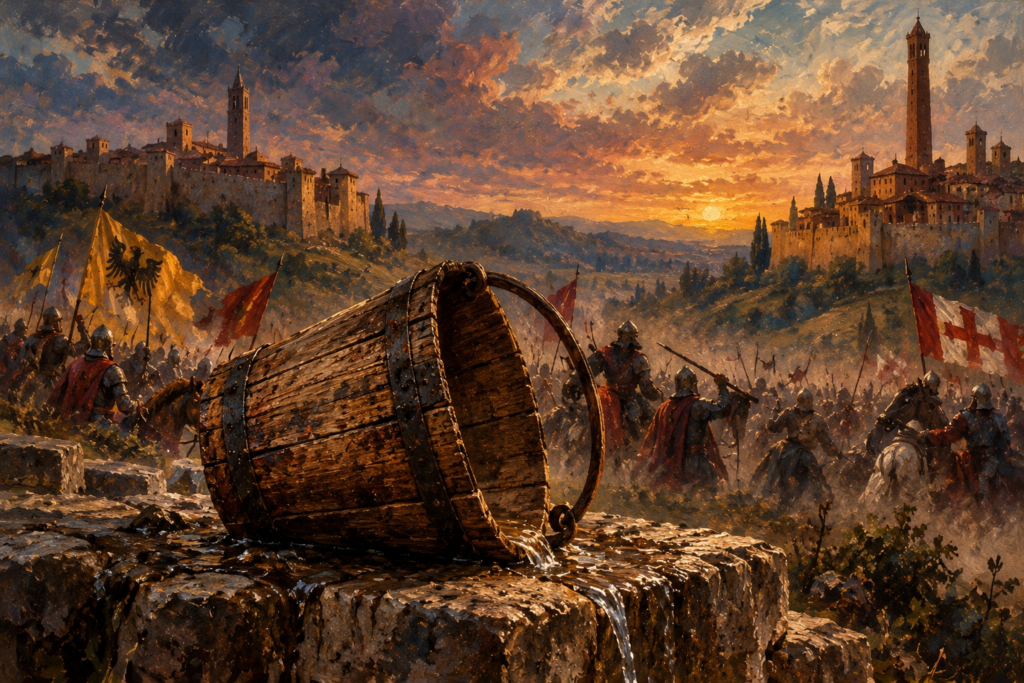
A wooden bucket did not start the 1325 war between Modena and Bologna. A captured fortress and an old political rivalry did. The bucket, probably taken after the fighting, became the war’s symbol.
Two neighbours in an Italy without a centre
Picture the map of northern Italy in the fourteenth century, and you will not find one country. You find a mosaic of city-states. Each one has its own walls, its own lords or councils, its own grudges.
Modena and Bologna sit close together in that mosaic, and closeness among rival cities rarely meant friendship. In 1325 the two went to war. Later centuries remembered it as the War of the Bucket, known in Italian as the Guerra della secchia rapita, “the war of the stolen bucket”. The popular telling is wonderfully simple. Modenese soldiers take a wooden bucket from a well in Bologna, the insult stings, and armies march.
I find that simplicity suspicious, and the record supports the suspicion. In September 1325, Modena captured Monteveglio, a Bolognese fortress. The Italian castle archive iCastelli.it records that the castle fell through betrayal into the hands of Passerino Bonacolsi, lord of Modena. Historians writing in The Conversation call this capture a serious threat to Bologna’s defences. It gave Bologna a real reason to seek redress. Two months later, in November, the armies met at Zappolino.
Popes, emperors and the quarrel inside every city
To understand why a fortress mattered so much, you need the wider fault line running through medieval Italy. People took sides with the two great factions of the age: Guelphs and Ghibellines. Broadly, the Guelphs backed the papacy and the Ghibellines backed the Holy Roman Emperor. In practice, the labels often became banners for local ambitions, family feuds and the question of who controlled which road, river or hilltop.
That is the rivalry the bucket later stood in for. Territory, political factions and the long Guelph–Ghibelline struggle all ran beneath the surface of the conflict. A city’s loyalties shaped its friends and its enemies. A border fortress in the wrong hands was never just a building. It was a statement about which side was winning.
A bucket taken from a well, and a legend that sticks
Now return to the well. In the version most people know, the Modenese raid Bologna and carry off its wooden bucket as a trophy. The theft becomes an outrage, and the outrage becomes a war. In this telling the object is everything: humble, ridiculous and somehow sacred.
That telling owes most of its shape to one poem. Alessandro Tassoni published La secchia rapita in 1622. The writer Guy Fassler, on the history site Scilicet, describes it this way: the poem “contains all the elements that made up the story about a highly revered wooden bucket whose kidnapping started a bloody war between two rival cities.”
In other words, you are not reading a chronicle of 1325 when you hear the bucket story. You are reading a seventeenth-century comedy about it.
Why the bucket explains so little
Ask yourself what would actually move two medieval governments to put armies in the field. A missing household object makes a poor answer. Contested borders, rival loyalties and a lost fortress make a much better one.
The pressures were already in place before anyone touched a bucket. Bologna and Modena competed over territory between them, and the faction quarrel gave that competition an ideological edge. The fall of Monteveglio turned long tension into immediate danger. So when you weigh causes, the bucket does not hold up. It survived for a different reason: it was entertaining and easy to remember.
Sunset at Zappolino
The decisive fighting came on 15 November 1325, around sunset, near Zappolino. Bologna arrived with the larger force. Modena’s army was greatly outnumbered, the kind of imbalance that usually decides a battle before it begins.
This time it did not. Modena defeated the bigger Bolognese army. I think this result matters more to the legend than the theft itself. Victory gave the Modenese a story worth telling, and a story wants a souvenir. The Modenese won their triumph at the Battle of Zappolino. The bucket would soon supply the image.
How a trophy became the cause
The historians writing in The Conversation argue that the bucket was most likely taken after the battle, not before. That single shift in timing changes everything. A trophy carried home by winners becomes, in retelling, the spark that lit the fire. Cause and consequence quietly swap places.
Tassoni’s poem then fixed that reversed version in place. Comedy travels better than military logistics. You can retell a stolen bucket at a dinner table in one sentence. Explaining a betrayed fortress, factional politics and border control takes far longer, and it rarely makes anyone laugh.
Why history keeps the strangest detail
Wars are rarely caused by one ridiculous object. Yet memory works by compression. It squeezes years of tension, shifting alliances and contested ground into something you can picture. The stranger the picture, the longer it lasts. A bucket is perfect for this. It is ordinary, it is concrete, and its absurdity invites you to ask how anyone could fight over it.
That question is the real gift of the legend, because it leads you back to the causes it once hid. The bucket did not start the war, but it gave the war the story history chose to remember.
Frequently asked questions
What war started over a bucket?
The War of the Bucket, fought in 1325 between Modena and Bologna, is the war popularly said to have started over a stolen wooden bucket.
Historians now see Modena’s capture of the Bolognese fortress of Monteveglio as the far more likely cause. The bucket was probably taken after the Battle of Zappolino and became the war’s symbol later.
Who has Italy gone to war with?
In 1325 Italy was not a single state, so its wars were often fought between its own city-states. The War of the Bucket is one example: Modena and Bologna, two neighbouring cities, fought each other. Their rivalry drew on territory, political factions and the Guelph–Ghibelline struggle.
If questions like this one draw you in, thenoetik publishes short, daily insights across history, philosophy, language, geography, art and science. Read the next one with the same suspicion you now bring to that bucket.
From thenoetik
- The Power of Maps: Understanding Geopolitical Conflict and Controversy
- Borders and Conflict in Africa: Understanding Historical Context and Modern Consequences