
A World That Woke Up With Ten Days Missing
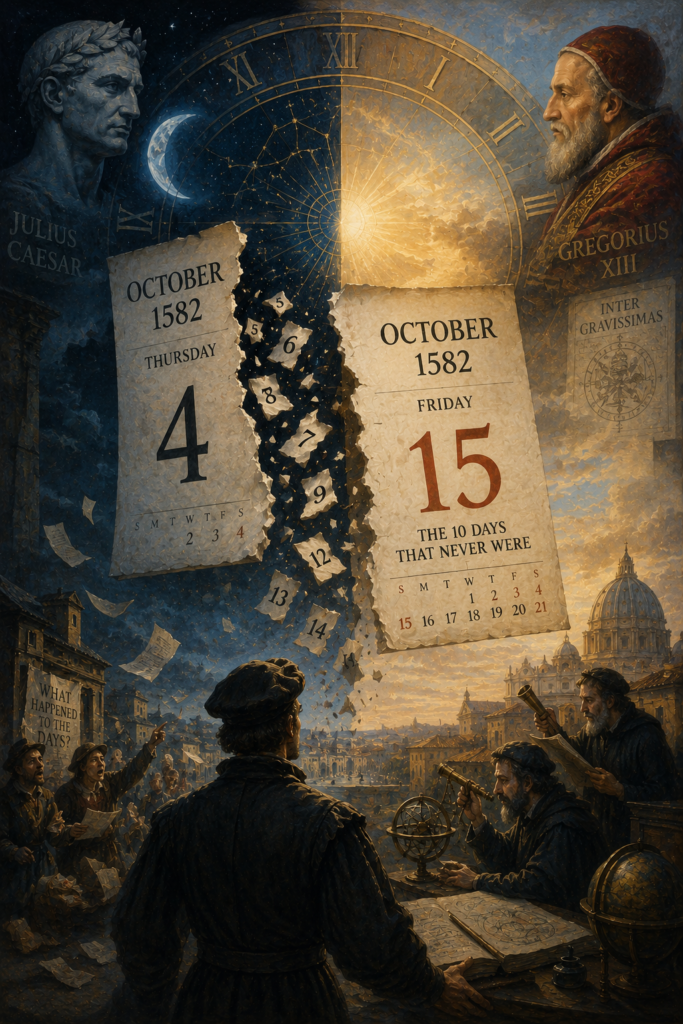
Imagine going to sleep on Thursday 4 October and waking to find that the next morning is Friday 15 October. No quiet weekend, no missing memories, only missing numbers. History
This is what happened in 1582 in parts of Catholic Europe. To most people, the sun rose as usual, bread was baked, debts were collected, and prayers were said. Yet on paper, ten days had never existed. They were not forgotten but officially erased, sacrificed to repair a long‑growing error in humanity’s shared script of time.
The Problem With The Julian Calendar
The story begins with a small numerical mistake and a very long patience.
The Julian calendar, introduced by Julius Caesar in 46 BCE, assumed that a year—the time between successive spring equinoxes—lasted exactly 365.25 days. To approximate this, the system added a leap day every fourth year, giving an average year length of 365.25 days.
Astronomically, however, the tropical year is closer to 365.2422 days. That tiny difference of about 11 minutes each year meant that the Julian calendar ran slightly too long.
Over a century, the Julian system drifted by roughly three‑quarters of a day. Across thirteen centuries, that became almost ten full days.
Drift, Equinox, And Sacred Time
For Christian Europe, this drift was not just technical. It was theological and liturgical.
From the early church, the date of Easter depended on the spring equinox. Church authorities traditionally fixed the equinox on 21 March, following calculations from the Council of Nicaea in 325 CE. By the sixteenth century, because of Julian drift, the astronomical equinox was falling around 11 March.
This meant that the most important feast in the Christian year was slipping earlier relative to the sky it was meant to echo. Sacred time was out of tune with celestial time.
Scholars, monks, and astronomers had long noticed the problem. But altering the calendar meant altering contracts, customs, and power. For centuries, Europe lived with an increasingly inaccurate timekeeping framework, a quiet mismatch between human counting and cosmic cycles.
The Gregorian Reform: Why Ten Days Vanished
By the sixteenth century, calls for reform had grown urgent. The task fell, finally, to a pope with both political authority and access to skilled astronomers.
Who Changed The Calendar?
Pope Gregory XIII (Latin: Gregorius) commissioned a group of mathematicians and astronomers, including the Jesuit priest Christopher Clavius, to propose a more accurate system. Their work resulted in a papal bull, Inter gravissimas, issued in 1582.
The new system came to be known as the Gregorian calendar, derived from Gregory’s name, much as the Julian calendar had taken its title from Julius Caesar.
What Actually Changed?
The Gregorian reform was surgical rather than revolutionary. It kept the twelve familiar months and the seven‑day week but corrected the way leap years worked.
Under the Julian rule:
- Every year divisible by 4 was a leap year.
Under the Gregorian rule:
- Every year divisible by 4 is still a leap year,
- Except years divisible by 100, which are not leap years,
- Unless they are also divisible by 400, in which case they are leap years.
So 1600 and 2000 remained leap years, but 1700, 1800, and 1900 did not. This slightly shortened the average year to 365.2425 days—much closer to the actual tropical year.
Why Exactly Ten Days?
By 1582, the accumulated Julian drift since Nicaea was about ten days. To restore the spring equinox to around 21 March, the reformers removed ten calendar dates at once.
In countries that obeyed the papal decree, Thursday 4 October 1582 was followed immediately by Friday 15 October 1582. Those ten numbers—5 through 14 October—were skipped to pull civil time back into alignment with the sun.
Living Through Lost Days
The sky did not jump. Human life did.
For ordinary people, the ten deleted days raised practical questions long before they raised philosophical ones.
Wages, Rents, And Contracts
If you were paid by the month, did you lose ten days of wages? If rent was due on the first of the month, did the skipped days change your obligation?
In many places, authorities decreed that contracts and periodic payments should ignore the lost days: a monthly wage should not be reduced simply because the calendar grid had shrunk. But such decrees had to contend with landlords, employers, and local customs.
Religious Festivals And Saints’ Days
For clergy and the devout, the reform re‑anchored holy days. Easter would once again closely follow the observed equinox. Feast days tied to specific dates simply moved along the new sequence.
A saint whose feast fell on one of the deleted days might seem, symbolically, to have had their commemoration erased for a year. The reform thus touched not only economics but devotion, memory, and ritual.
Suspicion And Resistance
Time is power. When a distant authority announces that ten days have vanished, it is not surprising that some respond with suspicion. In later adoptions of the Gregorian system, especially in Protestant regions, rumors circulated that the reform was a scheme to steal days of life or wages.
The gap between abstract astronomical justification and everyday experience opened space for mistrust. The reform exposed how deeply people inhabit the calendar as part of their social reality.
Global Adoption And Resistance
The 1582 reform began in Rome, but time, like politics, is not changed everywhere at once.
Catholic countries such as Spain, Portugal, and much of Italy adopted the Gregorian calendar immediately, making the October 1582 jump. Others delayed.
- Many Protestant states in Germany switched in 1700, by then needing to remove eleven days.
- Britain and its colonies waited until 1752, skipping 11 days in September: Wednesday 2 September was followed by Thursday 14 September.
- Some Orthodox Christian countries, including Russia, did not adopt the Gregorian calendar for civil purposes until the twentieth century. Russia’s shift in 1918 required a jump of 13 days.
The longer a region stayed with the Julian system, the more days had to be deleted later, because the drift continued.
This staggered adoption meant that, for centuries, a date in one place did not match the same date elsewhere. Historians still deal with this by distinguishing “Old Style” (Julian) and “New Style” (Gregorian) dates.
A Qualitative Timeline Of Adoption
| Region Or Tradition | Approximate Adoption For Civil Use | Days Skipped | Notes On Motivation |
|---|---|---|---|
| Catholic Western Europe | 1582 | 10 | Papal authority, liturgical alignment |
| Many Protestant German States | 1700 | 11 | Scientific accuracy accepted, religious hesitations softened |
| Britain And Its Colonies | 1752 | 11 | Commercial coordination, imperial administration |
| Russia (Civil Calendar) | 1918 | 13 | Post‑revolution modernization, global synchronization |
| Eastern Orthodox Churches | Varied, often retain Julian liturgically | 13 (current) | Sacred tradition vs. civil practicality |
This uneven timeline underlines that calendars are negotiated spaces, shaped by theology, diplomacy, trade, and identity.
Beyond Europe: Other Calendars, Other Times
The Gregorian calendar is now the dominant civil standard, but it is not the only way humanity has carved up time.
Lunar And Lunisolar Rhythms
- The Islamic calendar is purely lunar. Months follow the phases of the moon, and the year roams through the seasons. There is no attempt to keep Islamic dates fixed relative to the solar year.
- Jewish and traditional Chinese calendars are lunisolar, combining lunar months with periodic adjustments to keep festivals in their proper seasons. Instead of deleting ten days at once, they insert leap months on a recurring cycle.
Where the Gregorian reform solved drift with a one‑time deletion and subtle leap‑year tweaks, other systems accept, or cyclically correct, different kinds of mismatch.
Regional Civil Calendars
In many parts of Asia, local calendars persist alongside the Gregorian one. Lunar New Year, Diwali, Nowruz, and countless other festivals are timed according to systems that encode local cosmologies and agricultural cycles.
From this global vantage, the calendar that deleted ten days is one chapter in a broader story: the negotiation between a now‑global civil standard and diverse temporal traditions that shape identity and ritual.
Philosophical Reflections On Erased Time
What does it mean to “erase” ten days? From one angle, nothing at all. No one’s heartbeat skipped. No tree accelerated its growth. Time, as lived duration, continued smoothly.
Yet on paper—and in law, liturgy, and trade—those ten days did not exist. This reveals a crucial distinction: between time as experienced and time as measured.
Phenomenology Of Timekeeping
Phenomenologically, we live time as a flow: anticipation, presence, memory. Calendars and clocks interrupt this stream, slicing it into countable units. When authorities delete dates, they change the structure, not the flow. The move exposes how constructed our temporal grids are.
Historical Continuity And Discontinuity
Yet those constructed grids matter enormously. Historical documents, legal rights, and sacred narratives are all dated. When ten days vanish, archivists and historians must decide how to map old references onto new systems.
The calendar that deleted ten days thus created a subtle scar in historical time—a reminder that continuity is maintained not only by events, but by agreements about how to count them.
What Deleted Days Reveal About Our Control Of Time
The calendar that deleted ten days exposes a paradox at the heart of human timekeeping.
On one hand, it shows our humility before the sky. Faced with accumulating error, authorities adjusted their system to better mirror the sun’s path. It was a gesture of alignment, a recognition that our grids must bend to celestial realities.
On the other hand, it reveals our audacity. We claimed the power to declare that certain dates never existed, to re‑write the sequence of days in the name of higher accuracy. Time, as a shared social fabric, proved pliable to collective decision.
Between these poles—cosmic constraint and human creativity—our calendars continue to evolve. Leap seconds, time‑zone adjustments, and digital timestamps all extend the same negotiation.
To contemplate the ten days that “never were” is to notice how much of our reality rests on quiet agreements. We do not control the flow of time, but we do shape the stories and structures through which we meet it.
Frequently Asked Questions
How did the Julian calendar’s slight inaccuracies result in a ten-day discrepancy?
The Julian calendar calculated the solar year at exactly 365.25 days, failing to account for a surplus of 11 minutes annually. Over thirteen centuries, this minor discrepancy accumulated into a ten-day gap. This drift meant the calendar no longer aligned with astronomical events like the spring equinox, necessitating the 1582 Gregorian reform to restore seasonal accuracy.
Which European countries were the first to adopt the Gregorian calendar reform?
Catholic nations including Italy, Poland, Spain, and Portugal were the first to implement the change in October 1582. While these regions skipped ten days immediately to realign with the solar year, Protestant and Orthodox countries often waited centuries to adopt the system, viewing the reform as a contentious papal overreach rather than a scientific necessity.
How did the missing ten days affect financial contracts and legal obligations in 1582?
The abrupt removal of dates created significant logistical hurdles for rents, wages, and interest payments. Because ten days of productivity and time effectively vanished from the record, landowners and creditors had to negotiate complex recalculations. Many workers felt cheated of wages, as legal deadlines arrived ten days sooner than they had physically prepared for in the new system.
Why was the spring equinox the primary motivation for Pope Gregory XIII’s reform?
The Catholic Church required an accurate spring equinox to calculate the correct date for Easter, which is tied to the first full moon of spring. By the 16th century, the equinox had drifted to March 11. Dropping ten days restored the equinox to March 21, ensuring the holiest feast aligned with theological and astronomical traditions established centuries prior.
What is the difference between Julian and Gregorian leap year rules?
The Julian system added a leap day every four years without exception. The Gregorian reform refined this by omitting leap years in centurial years unless they are divisible by 400. This modification accounts for the extra 11 minutes of the solar year, preventing the calendar from drifting away from the seasons during future centuries of timekeeping.