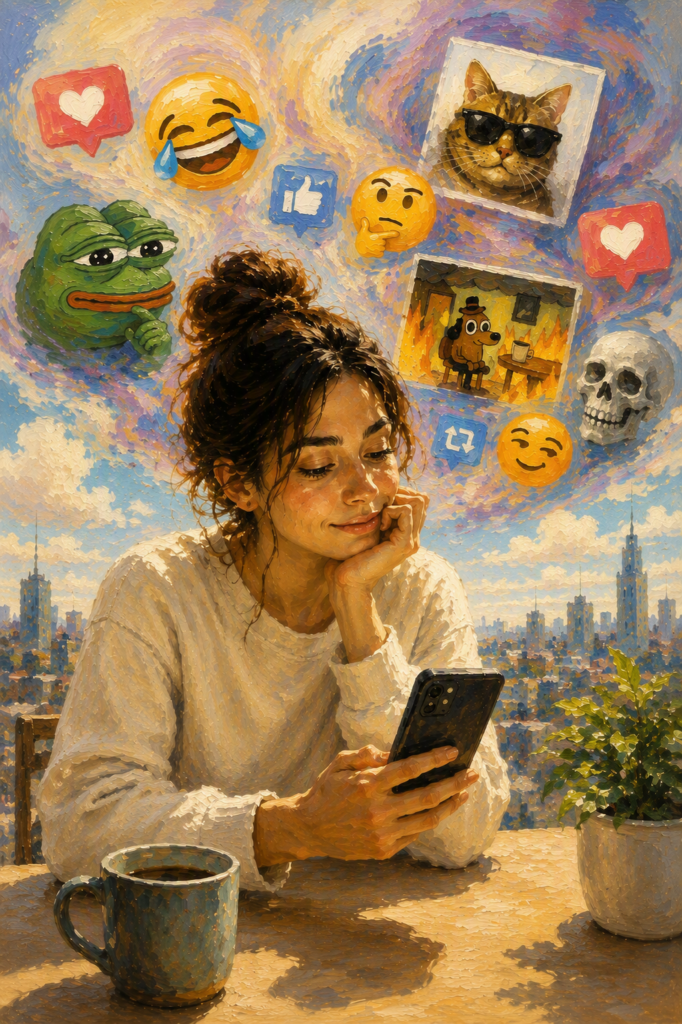

Modern humor is so ironic because it emerges from a world of information overload, disillusionment, and unstable identities. Hyper-irony—jokes about jokes, detached and self-aware—protects us emotionally, fits digital media rhythms, and mirrors a culture wary of sincerity yet still longing for authentic connection.
- Hyper-irony reflects a protective distance in an era of overload and disillusionment.
- Digital media accelerates self-referential, meme-based humor that constantly comments on itself.
- A noetic lens helps us engage humor consciously, balancing insight, play, and sincerity.
Defining Hyper-Irony And Framing The Question
To understand why modern humor is so ironic, we need a precise sense of hyper-irony.
Classical irony says one thing and means another. Hyper-irony multiplies this. It is irony about irony: jokes that signal awareness of their own absurdity, anticipate criticism, and often refuse a clear emotional position. (The Irony of Irony: Is Gen Z Scared of Showing Sincerity?)
Think of a meme that mocks a trend, then mocks itself for mocking the trend, all within one image. The humor lies not only in the content but in the layered awareness: “I know that you know that I know this is ridiculous.”
From an interdisciplinary vantage, hyper-irony is not merely a fashion. It is a structure of consciousness in late modern life. It reveals how we protect ourselves, how our media environment shapes expression, and how our longing for meaning meets our fear of being naïve.
This is where thenoetik dwells: at the intersection of culture and inner wisdom, where noesis—a clear, intuitive seeing—meets analysis. To explore hyper-irony is to ask how we might awaken a more conscious curiosity toward the humor that fills our feeds and conversations.
A Brief Genealogy Of Irony: From Socrates To Postmodern Culture
Irony is ancient, but hyper-irony is distinctly contemporary. A short genealogy illuminates the path.
Socratic Irony: Feigned Ignorance As Awakening
In classical Athens, Socrates practiced eirôneia: he pretended ignorance to expose contradictions in others’ beliefs. Irony here was a tool of wisdom, inviting dialogue and self-examination.
This is irony as noetic provocation—not detachment, but a way to awaken deeper understanding.
Romantic And Modern Irony: The Divided Self
By the late 18th and 19th centuries, Romantic writers saw irony as a sign of a self aware of its own fragmentation. The artist could create and mock the creation simultaneously.
Irony became a way to navigate incongruence between ideal and reality—already a step toward the divided, self-aware stance of today’s humor.
Postmodern Irony: Everything As Quotation
In the 20th century, postmodern culture expanded this stance. Advertising, television, and film often adopted a winking tone, referencing their own constructedness. Nothing was simply presented; everything was an echo, a remix, a quotation.
Cultural theorists linked this to consumer society’s saturation with images. Irony became a default posture to avoid being fully “taken in” by any message.
Hyper-irony emerges when this posture migrates from art and theory into everyday life and online interaction. It is postmodern irony scaled and accelerated by digital networks.
The Conditions Of Hyper-Irony: Media, Acceleration, And Content Saturation
Hyper-irony does not arise in a vacuum. It is intimately tied to our media ecology.
Attention Economies And Short Cycles
Global surveys on digital behavior consistently show high daily screen time and heavy use of social platforms, especially among younger users. Content flows in endless streams; each post competes for a brief glance.
Humor that is fast, condensed, and self-explanatory thrives here. Irony—especially hyper-irony—compresses critique, emotion, and commentary into a single, shareable unit.
Algorithmic Amplification
Platforms reward what is:
- Quickly legible: recognizable formats, familiar tones
- Highly shareable: relatable, adaptable templates
- Engagement-driven: provoking likes, comments, and remixes
Hyper-ironic memes and clips fit these criteria. Their self-referential nature invites endless iteration. Each new version comments on the last, creating chains of layered in-jokes.
Content Saturation And Defensive Distance
When people report feeling overwhelmed by news, ads, and opinions, humor becomes a buffer. Irony softens the impact of constant exposure. Hyper-irony adds another layer: it distances us not only from content, but from our own emotional stake in it. Why Is Millennial Humor So Weird?
This is central to why modern humor is so ironic: detachment feels safer in a world where every sincere position can be instantly scrutinized, archived, and weaponized online.
Psychology Of Hyper-Ironic Humor: Defense, Distance, And Disillusionment
Hyper-irony is not only cultural; it is psychological.
Irony As Armor
From a psychological perspective, humor often functions as a defense mechanism. It allows us to approach difficult topics with reduced anxiety.
Hyper-irony intensifies this by guarding against vulnerability. If everything is already framed as “I am joking about my own joke,” then the risk of genuine rejection or misunderstanding decreases. The self remains partially hidden.
Disillusionment And Skepticism
Many people, especially younger generations navigating economic precarity and climate anxiety, report a sense of disillusionment with traditional institutions and narratives.
Hyper-irony captures this mood: it is the language of those who have seen too many promises broken, too many slogans exposed. It says, “I will not be fooled again,” but also, “I do not entirely know what to believe.”
Inner Split And Numbness
Yet this constant ironic distance carries a cost. When every emotion is immediately framed, quoted, and joked about, direct feeling can be difficult to access.
This is where a noetic concern appears. Our inner wisdom senses that endless detachment risks an impoverished emotional life. Conscious curiosity asks: What is this ironic laughter protecting in me? What is it avoiding?
Hyper-Irony In Practice: Memes, Meta-Jokes, And Self-Referential Humor
To see hyper-irony clearly, consider some common patterns in online humor.
- Meme templates about memes: images that parody the overuse of a popular format while still using that very format.
- “We are self-aware” brand jokes: companies joking about their own marketing tactics to appear relatable.
- Stand-up and sketch styles that constantly comment on the act of joking itself.
These forms combine three traits:
- Self-reference (the joke knows it is a joke).
- Preemptive critique (it mocks its own possible flaws).
- Ambiguous stance (it avoids clearly endorsing or rejecting a viewpoint).
The result is a flexible, global language: even across cultures, users recognize the structure of meta-humor, then adapt it with local references, languages, and symbols.
Sincerity Vs. Hyper-Irony: What Happens To Meaning And Connection?
To ask why modern humor is so ironic is also to ask what happens to sincerity.
The Sincerity Paradox
In many online spaces, being earnest can feel risky. A heartfelt statement may invite mockery or out-of-context screenshots.
Hyper-irony seems to solve this by hiding sincerity beneath layers of play. But over time, we may forget how to signal honest feeling without a protective joke.
The Cost To Meaning
When every statement contains its own subversion, meaning becomes unstable. Audiences are left unsure: Is this serious? Half-serious? Purely performative?
This can erode trust. If we cannot discern when others mean what they say, shared reality becomes harder to negotiate.
The Hunger For Authenticity
At the same time, the popularity of more intimate formats—podcasts, long-form conversations, and communities built around thoughtful discussion—suggests a counter-movement. People are seeking spaces where vulnerability and reflection are possible.
Hyper-irony, then, is both a shield and a symptom. It protects, but it also points to a deep hunger for meaning that it cannot entirely satisfy.
Pros And Cons Of Hyper-Ironic Humor
| Aspect | Potential Benefit | Potential Cost |
|---|---|---|
| Emotional Protection | Reduces anxiety and fear of criticism | Can block genuine vulnerability and intimacy |
| Social Bonding | Creates quick in-group recognition and shared codes | Excludes those outside the reference loop |
| Critical Insight | Exposes absurdity and hypocrisy in culture | May slide into cynicism and resignation |
| Flexibility In Expression | Allows playful exploration of identity and viewpoints | Keeps positions ambiguous, weakening clear commitments |
| Adaptation To Fast Media | Fits short, remixable digital formats | Trains attention away from depth and sustained focus |
A Noetic Lens: Intellect-Intuition Union As Response To Hyper-Irony
Within the thenoetik ethos, the central question is not whether hyper-irony is good or bad, but how consciously we relate to it.
Noesis As Clear Seeing
Noesis invites us to see both the surface play and the inner movement beneath. Instead of simply consuming ironic humor, we can pause and notice:
- What emotion is this joke masking or revealing?
- What cultural tension is being negotiated here?
- How does my body feel when I laugh—light, numb, relieved, exhausted?
This is the Intellect-Intuition Union: analysis meets subtle inner sensing.
Conscious Curiosity In Everyday Humor
A noetic approach does not demand that we stop enjoying memes or meta-jokes. Rather, it asks that we:
- Witness our own participation: Am I using irony to connect or to hide?
- Discern context: When is ironic distance wise, and when is it a reflex?
- Experiment with sincerity: Can I allow small moments of unguarded expression, even within humorous exchange?
In this way, humor becomes a space for inner wisdom to awaken—not by rejecting irony, but by integrating it into a larger field of awareness.
Toward A Wiser, More Conscious Humor
To ask why modern humor is so ironic is to look into a mirror. Hyper-irony reveals a culture weary of being deceived, flooded with content, and cautious about feeling too openly.
Yet within that same laughter lies a quiet yearning—for connection without naïveté, for meaning without denial of complexity.
A noetic path does not seek to erase irony. Instead, it invites us to:
- Recognize irony as a skillful tool when used consciously.
- Notice when it hardens into automatic armor.
- Cultivate small acts of sincere presence, even in the midst of jokes.
You might experiment with a simple inner practice the next time you share or create an ironic meme:
- Pause for one breath before posting.
- Sense: What truth, fear, or tenderness lives beneath this humor?
- Choose: Do I wish to emphasize distance, or can I let a hint of honest feeling show through?
In this quiet act, humor becomes more than escape. It becomes a subtle exercise in consciousness: a way to awaken perspective, to weave intellect and intuition into a single movement, and to rediscover the gentle power of laughing while still caring deeply.
In the end, the question is not just why modern humor is so ironic, but how we can let that irony serve wisdom rather than numbness—how we can, together, learn to smile with clear eyes.
Frequently Asked Questions
How does social media scrolling influence the use of hyper-irony?
Social media platforms prioritize speed and trend-cycling, making straightforward sincerity feel vulnerable or outdated. Users employ hyper-irony as a defensive layer to signal they are “in on the joke,” allowing them to navigate saturated digital feeds without appearing naïve or overly invested in a single performance of identity or opinion.
What role does information fatigue play in the development of modern ironic humor?
Information fatigue creates deep skepticism toward grand narratives and objective truths. Hyper-ironic humor functions as a coping mechanism, allowing people to acknowledge the chaotic and contradictory nature of modern life. By refusing to take a definitive stance, individuals find temporary relief from the pressure of constant commitment and digital burnout.
What is the difference between classical Socratic irony and modern hyper-irony?
While Socratic irony uncovers philosophical truths and Romantic irony explores internal contradictions, modern hyper-irony is defined by digital acceleration and systemic disillusionment. It focuses on self-referential cycles where the humor often mocks the act of joking itself, reflecting a culture that is increasingly wary of traditional meaning and earnestness.
How do memes facilitate self-referential and meta-ironic commentary?
Memes utilize layers of remixing and visual shorthand that require deep cultural context to understand. This structure naturally favors hyper-irony because the funniest iterations often satirize the meme’s own popularity or cliché status. This constant meta-commentary rewards users who can identify the absurdity within the medium’s own repetitive and derivative nature.
How can hyper-irony lead to genuine human connection despite its detached nature?
Hyper-irony acts as a low-risk testing ground for vulnerability. By using humor that mocks its own seriousness, individuals can gauge whether others share their underlying concerns or anxieties. If the sentiment is met with recognition, it creates a safe space for solidarity and authentic conversation beneath the protective layers of irony.