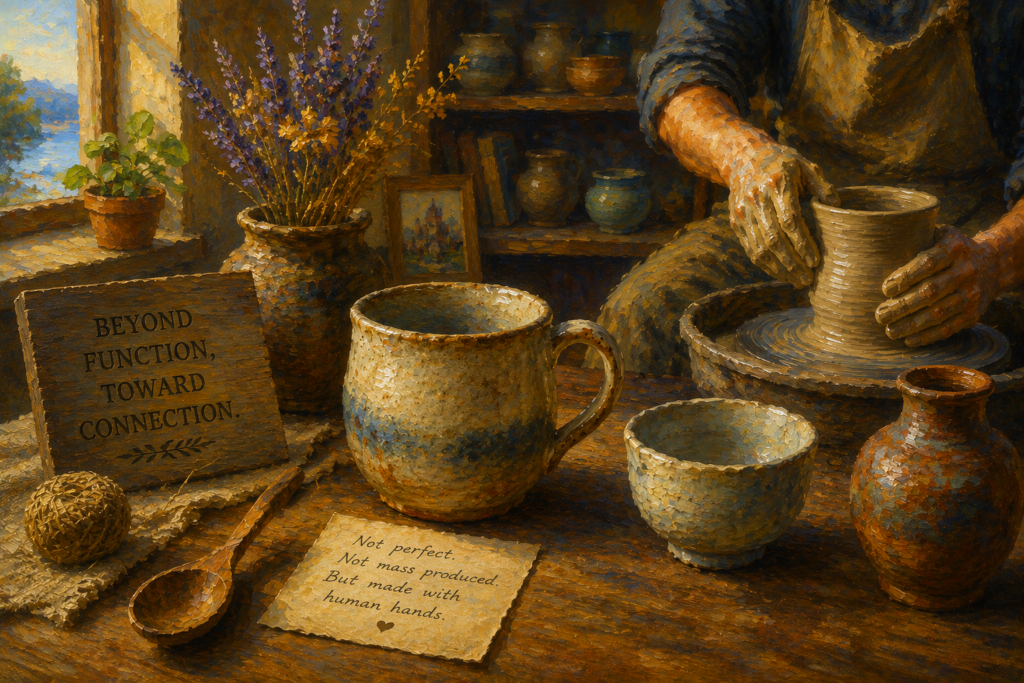

The reason we feel handmade products more authentic is rooted in our perception of presence, intention, and human trace. Crafted objects bear visible marks of care, time, and vulnerability, inviting a deeper sensory, emotional, and spiritual connection than standardized items produced at industrial scale. They condense relationship into material form. (Humanizing Handmade Brands: How Handmade Brands Are Perceived Authentic)
- Handmade objects feel authentic because we sense the maker’s embodied presence within them.
- Our perception, memory, and touch weave stories around crafted things, intensifying their reality.
- Mass production is useful, yet often thins the felt presence that handmade craft preserves.
Situating The Question In A Manufactured World
We live in an era where most things around us are made by machines, arriving in our hands without names, faces, or stories. Yet many people still feel a pull toward a hand-thrown cup, a woven basket, a carved wooden spoon. They often say these things feel more real.
From the perspective of thenoetik, this is not nostalgia but a clue. The difference between handmade and mass-produced objects opens a window into how noesis—our capacity for deep, conscious knowing—relates to the material world. It reveals how intellect and intuition together recognize degrees of presence, authenticity, and meaning in what we touch and use.
To ask why handmade products feel more authentic is to ask what we mean by reality itself: not in the abstract, but in the quiet encounter between hand, object, memory, and cosmos.
Defining Realness And Authenticity
When people say a handmade object feels more “real,” they are not doubting the physical existence of industrial products. The distinction is more subtle. We can approach it from three intertwined dimensions.
Philosophical And Epistemic Dimension
In philosophy, the real is often linked to what resists us—what cannot be fully controlled or reduced to our concepts. An authentic object appears as more than its function or label. It surprises us, has texture, invites interpretation.
A mass-produced object, engineered for uniformity, minimizes this resistance. Its reality is clear but thin: we understand what it does, yet we sense little mystery in it. By contrast, a handmade bowl, slightly asymmetrical, resists our expectation of perfect sameness. That resistance signals that we are meeting another subject’s choices, judgments, and limitations.
Aesthetic And Experiential Dimension
Aesthetically, authenticity points to coherence between appearance and origin. We feel a work is authentic when what we see and feel matches what we intuit about how and why it came into being.
Handmade things often carry visible traces of process: tool marks, subtle variations in color, the grain of wood that guided the carver’s hand. These are not flaws; they are evidence. Our intuition reads them as signs that this object emerged from lived time, attention, and risk. Its beauty is not detached from its becoming.
Existential Dimension
Existentially, something feels more real when it matters. Authenticity here means congruence between object and life: the sense that an item participates in a story, a relationship, a world of values.
A cup given by a friend, shaped by someone’s hands, joins our biography. It becomes a witness to mornings, conversations, and seasons. Realness, in this sense, is density of connection.
The Maker’s Trace: Presence, Intention, And The Human Hand
At the heart of our sense that handmade objects are more authentic lies what we might call the maker’s trace: the felt presence of another consciousness encoded in matter.
Irregularity As Signature
Handmade forms seldom obey perfect geometry. A line wavers; a stitch tightens then loosens; a glazing pool gathers at one edge. These irregularities are not simply tolerated—they are treasured. They indicate that the object is not merely the result of a formula but of situated judgment: the maker adjusting to material, mood, and moment.
Our perception is sensitive to such patterns. We can distinguish between a hand-written note and a printed font, even when they carry the same words. The difference is not just visual; it is relational. The trace of the hand hints at breath, fatigue, patience, perhaps even joy or frustration.
Intention Condensed In Form
In many craft traditions, making is not only technical but contemplative. The artisan returns to a form again and again. Each repetition refines technique but also condenses intention. Over time, the posture of making—care, respect for material, a desire to serve use and beauty—becomes palpable in the finished piece.
Even when we cannot name this directly, we sense it. The object seems to carry a certain gravity, a quietness that asks to be handled attentively. Intention has become form.
Embodied Perception And Noesis
Our understanding of why handmade products feel more authentic deepens when we consider embodiment. Noesis is not detached from the body; it arises through it.
Touch As A Way Of Knowing
Neuroscience and cognitive science suggest that our brain does not merely receive information from the senses; it actively predicts and shapes experience. Touch engages a rich network of neural pathways connected to emotion and memory.
When we hold a handmade object, our fingers explore variations in texture, weight, and temperature. These micro-differences keep our predictive brain attentive. Instead of sliding over a uniform surface, we encounter a landscape. Attention intensifies, and with it, the sense of reality.
Use And The Accumulation Of Meaning
Phenomenology reminds us that objects are rarely experienced as isolated things; they appear within fields of action. A handmade knife or textile is learned through use. The handle molds slightly to our grip; the fabric softens where it rubs against the skin. The object and our body adapt to one another.
Through repeated gestures, we come to know the object’s tendencies—how it responds to pressure, heat, or time. It becomes familiar in the deep sense of belonging to our world. Authenticity, here, is the recognition that the object is not static but part of a living dialogue between body, material, and intention.
Cultural And Historical Perspectives On Craft
Across cultures, craft has often been regarded as more than technique: it is a vessel of wisdom, lineage, and cosmology.
Diverse Traditions Of The Maker’s Presence
In many East Asian ceramic traditions, the potter’s acceptance of imperfection is aesthetic and spiritual. A bowl is valued not despite irregularities but because they reveal the interplay between human intention and natural forces—fire, clay, air, chance.
In various African textile and carving traditions, patterns encode histories, proverbs, or social structures. The crafted object is a carrier of collective memory, not simply an individual expression. Authenticity here emerges from alignment with a lineage of practice.
Indigenous weaving traditions across the Americas often treat the act of making as relational. Fibers, dyes, and motifs connect the artisan to land, ancestors, and community. To use such an object is to participate, however humbly, in that web of relations.
Craft As Cultural Memory
Historically, craft guilds, apprenticeships, and family workshops served as repositories of technique and worldview. Tools and objects were shaped not only by individual taste but by shared values: proportionality, usefulness, harmony with environment.
When we feel that a handmade object is more real, part of what we sense is this condensation of cultural time. A single bowl or cloth may hold echoes of generations who learned to see, feel, and work in certain ways.
AOE Snapshot: The Spiritual And Symbolic Life Of Objects
From a spiritual perspective, objects are not inert matter but nodes in a larger cosmos of meaning.
Intention As Subtle Presence
Many contemplative traditions insist that intention matters. When something is made with care, gratitude, or a wish to serve, that inner stance shapes the rhythm of the gestures by which the object comes into being.
We might say, cautiously, that intention leaves a subtle resonance. A handmade item offered as a gift often feels saturated with this quiet presence. We handle it differently, store it differently, perhaps even repair it instead of discarding it. Its persistence in our life reflects the spiritual weight we attribute to it.
Objects As Story-Bearers
Handmade things are also powerful symbolic actors. They become anchors for memory: a cup linked to a grandparent, a carved figure associated with a ritual, a piece of jewelry tied to a promise.
These objects gather stories, and stories give them a distinctive kind of reality. They are no longer interchangeable with others of their type. To lose them can feel like losing a chapter of one’s own narrative.
In this way, handcrafted items mediate between inner life and outer world, between personal memory and cultural myth.
Comparison Table: Handmade And Mass-Produced Objects
| Dimension | Handmade Object | Mass-Produced Object |
|---|---|---|
| Visible Trace Of Maker | Irregularities, tool marks, unique variations | Designed uniformity, minimal visible trace of individual workers |
| Perceived Authenticity | High: sensed presence, story, and intention | Variable: often functional, less tied to individual narrative |
| Sensory Complexity | Rich textures, asymmetry invite exploration | Smooth, standardized surfaces reduce sensory variation |
| Cultural And Historical Link | Frequently tied to lineage, place, or tradition | Often detached from specific cultural context for global markets |
| Emotional Attachment Over Time | Tends to increase with use and story accumulation | Depends more on function and personal associations |
Convergence Of Intellect, Intuition, And Matter
To understand why handmade products feel more authentic is to glimpse how reality appears through relationship. Handmade objects gather time, attention, vulnerability, and cultural memory into a form we can hold. They invite our senses to awaken and our stories to root.
Mass-produced things will continue to shape our world, and rightly so. Yet the quiet gravity of a crafted object reveals something essential: our deepest sense of the real arises when we perceive intention, limitation, and care converging in the tangible.
From the perspective of thenoetik, handmade objects are not merely alternatives to industrial goods; they are teachers. They remind us that noesis is incarnate—that wisdom can be carried in clay and fiber, in wood and metal, in the everyday things through which we meet the world and one another.
Frequently Asked Questions
How do slight imperfections impact the perceived authenticity of handmade items?
Minor irregularities like visible tool marks or asymmetrical finishes act as “human signatures.” These unique variations signal that a product was shaped by active decision-making rather than automated repetition. Because the brain interprets these nuances as evidence of human presence and effort, the object feels more unique, vulnerable, and emotionally resonant than a perfect factory copy.
What is the psychological difference between industrial uniformity and artisan craft?
Industrial uniformity suggests a lack of human history, whereas artisan craft embodies the concept of “materialized time.” When consumers see hand-woven textures or hand-thrown ceramics, they subconsciously recognize the hours of focus invested in the material. This perceived density of attention transforms a functional object into a vessel for human connection, making it feel more genuine.
How does the “maker’s mark” influence a buyer’s emotional connection?
The maker’s mark represents a level of intimacy and vulnerability that mass production lacks. Seeing physical evidence of a craftsman’s hands—such as finger ridges in clay or unique grain choices in wood—creates a bridge between the creator and the user. This perceived closeness fosters a sense of stewardship over the item rather than simple, disposable ownership.
Why is tactile feedback critical to the experience of authentic craftsmanship?
Tactile feedback provides sensory confirmation that an object is responsive and grounded in reality. Unlike the sterile surfaces of plastic or machine-milled metal, handmade materials often retain natural warmth, organic grain, and varying weight. This haptic richness confirms the material’s origin, making the product feel more “present” and alive in the user’s hands.
What role do ancestral techniques play in establishing product value?
Ancestral techniques link a physical object to a specific lineage, culture, or geographic location. When a product utilizes traditional methods like natural indigo dyeing or ancient joinery, it carries historical weight and continuity. This connection to the past provides a depth of meaning that mass-produced goods, which are often anonymous and placeless, cannot replicate.