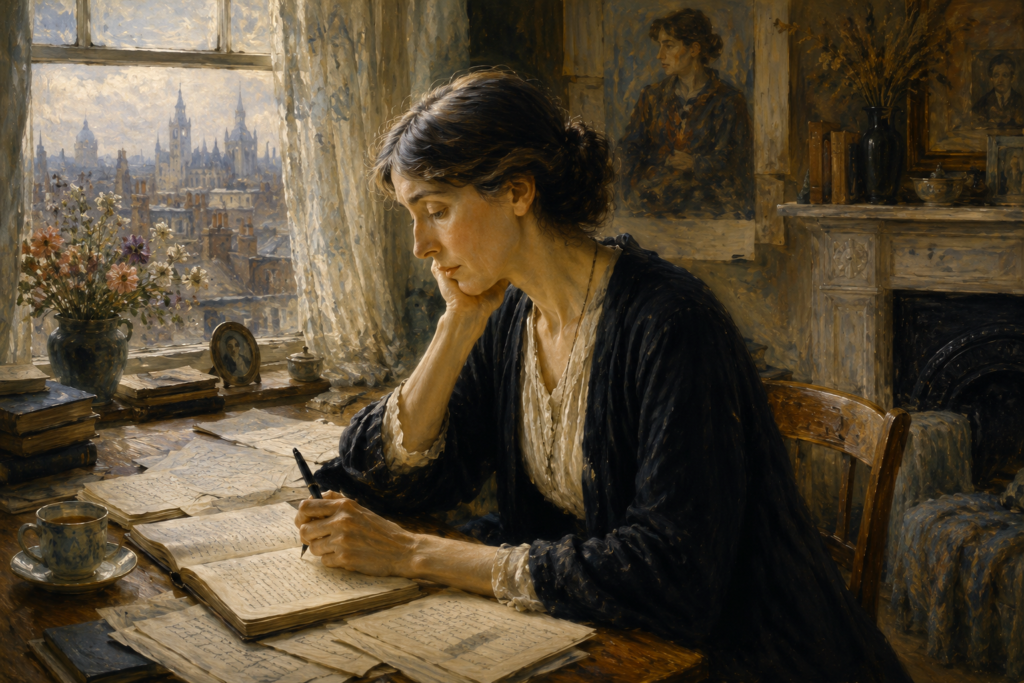

Virginia Woolf’s diaries offer an unparalleled window into her private psychological turmoil, disciplined creativity, and evolving sense of self. Read alongside her novels and essays, they reveal modernism not only as a literary style, but as a radical reorientation toward inner life, time, and consciousness. (The Diary of Virginia Woolf – History & Critical Overview)
- Virginia Woolf’s diaries function as a laboratory where modernist form and inner life coevolve.
- They expose the tension between mental fragility, creative ambition, and daily discipline.
- For contemporary readers, the diaries model reflective writing as conscious, noetic practice.
A Privileged Vantage Point On Modernism’s Inner Life
For The Noetik, the Virginia Woolf diaries are less a private notebook than a map of a shifting inner cosmos. They disclose how modernism was lived from the inside: as oscillation between despair and exhilaration, domestic interruption and visionary form, self-doubt and radical experiment.
Written from the 1890s until shortly before her death in 1941, the diaries move from teenage fragments to the full maturity of the Bloomsbury years. They track Woolf’s emergence as a central figure of literary modernism and, simultaneously, a woman negotiating illness, marriage, friendship, and the constraints of a gendered world.
This aligns with The Noetik’s mission: to treat the inner life not as a private luxury, but as a site where culture, consciousness, and form are continuously re-imagined. Woolf’s diary habit becomes an everyday ritual of conscious curiosity, where intellect and intuition meet on the page.
Life, Moment, And The Place Of The Diary
Virginia Woolf (1882–1941) wrote in a period shaken by industrialization, empire, and two world wars. The apparent solidity of Victorian certainties gave way to fractured time, contested identities, and new media. Modernism emerges here as a search for forms adequate to this altered experience.
Amid this turbulence, Woolf’s creative life branched in three main directions:
- Novels such as Mrs Dalloway (1925), To the Lighthouse (1927), and The Waves (1931), which reconfigured narrative time and interiority.
- Essays and criticism, especially collected in The Common Reader (1925, 1932), where her public voice is crafted, controlled, and often argumentatively clear.
- Diaries and letters, published posthumously as The Diary of Virginia Woolf (5 vols, ed. Anne Olivier Bell, 1977–1984), where the voice is more volatile, immediate, and formally experimental.
The diary sits between life and work. On 28 November 1928, after the success of Orlando, she notes the diary’s purpose with striking clarity: she wants “to practice my craft” and “loosen the ligaments” of style. The diary is not merely confession; it is a training ground for form, a workshop where she tests perspectives, rhythms, and tones that will later crystallize in fiction.
The Diaries As Inner Cartography
Across decades, Woolf’s diaries become a subtle cartography of moods, intuitions, and fleeting perceptions. She is ceaselessly mapping inner weather against outer events.
On 9 January 1915, as she struggles after a severe breakdown, she writes of feeling “a little distraught and tremulous,” capturing in a few words both fragility and ongoing self-observation. This is not self-pity; it is diagnostic attention turned inward, a cartographer noting the fault-lines of a landscape that constantly shifts.
Three features of this inner cartography stand out:
- Temporal layering – She records the present while folding in memory and anticipation. A walk by the river dilates into reflections on childhood summers or unwritten books. This layered time anticipates the temporal structure of Mrs Dalloway, where a single June day holds an entire life.
- Multiperspectival self – Woolf often writes of “she” and “I” almost interchangeably, observing herself from a slight distance. This matches her later narrative habit of gliding between consciousnesses without firm borders.
- Attention to micro-perceptions – Shifts in light on the wall, the “buzz” of London streets, or the silence of the country become keys to inner states. The diary trains her to see the cosmos within the everyday.
In this sense, the diaries enact, in raw form, what her fiction refines: the inner world as a field of forces—memory, sensation, intuition—rather than a fixed, stable self.
Private Battles: Mental Health, Doubt, And Discipline
Any reading of the Virginia Woolf diaries must acknowledge the recurring presence of mental suffering. Yet the diaries also insist on her discipline and lucid self-scrutiny.
- On 22 August 1922, while working toward Mrs Dalloway, she writes, “I am always on the verge of bursting into tears or laughing.” The volatility is intense, yet the sentence is precise, rhythmically balanced, almost crafted as if for publication.
- On 13 June 1925, just after Mrs Dalloway appears, she notes feeling “oddly empty” and questions whether the book matters at all. Success does not cancel doubt; it reframes it.
These entries show a threefold tension:
- Depression and determination – Periods of exhaustion are countered by resolve to continue writing. On 10 March 1920, she notes feeling “sunk” but decides she must “go at it again tomorrow.” The diary is where she recommits to the work.
- Self-worth and external judgment – She records reviews, gossip, and sales with candor, then returns to the question: is the work true to her intuition of reality? External praise coexists with deep internal skepticism.
- Illness and schedule – Woolf logs hours spent writing or reading, even on bad days. This reveals an ethics of craft: creativity is not pure inspiration, but patterned discipline negotiated with a fragile mind.
The diaries therefore do not merely dramatize suffering; they reveal how suffering and discipline interweave to create space for modernist innovation.
Modernism From The Inside
When we read the Virginia Woolf diaries alongside the novels, modernist technique ceases to be an abstract term. It becomes the visible trace of a mind searching for adequate form.
- Stream of consciousness: Long diary sentences, especially in the 1920s, move fluidly from domestic detail to metaphysical reflection. On 27 June 1923, thinking about Mrs Dalloway, she records “tunnelling” into her characters. The diary itself demonstrates such tunnelling—slipping beneath surfaces to the currents of thought.
- Fragmented time: She often interrupts an entry with a dash, a change of subject, or a sudden note about the time. This formal fragmentation mirrors her sense of lived time as discontinuous, a key modernist insight.
- Shifting perspectives: In the diaries she regularly moves between describing herself, her friends, and her own writing in quick succession. This anticipates the polyphonic structures of The Waves and Between the Acts.
A brief comparison helps clarify this dynamic:
| Aspect | In The Diaries | In The Fiction |
|---|---|---|
| Time | Jumps between days, memories, and plans in one entry | Single days carrying whole lifetimes (Mrs Dalloway) |
| Voice | Raw, self-addressed, shifting pronouns | Carefully mediated interior monologues |
| Structure | Fragments, abrupt endings, unfinished thoughts | Orchestrated patterns, recurring images and motifs |
| Aim | Self-observation, experiment, emotional relief | Shaping a shared vision of consciousness and reality |
The diary is the laboratory; the published work is the crystallized result. Yet the laboratory has its own aesthetic force, revealing modernism as a lived experiment in perception.
Gender, Society, And The Domestic Sphere
Woolf’s diaries also document the friction between her intellectual ambitions and the invisible labor expected of a woman in early twentieth-century Britain.
On 30 March 1929, around the time she was working through ideas that appear in A Room of One’s Own, she records how domestic interruptions “break the thread” of thought. The continuity of noesis is severed by social expectation.
Recurring diary themes make this tension vivid:
- Marriage and autonomy – She writes affectionately about Leonard Woolf, yet also notes the relief of solitary hours in her writing room at Monk’s House. The diary preserves moments when the need for an “inner room” is acute.
- Household administration – Decisions about servants, meals, and budgets appear alongside reflections on Proust and Greek tragedy. The page becomes a palimpsest of the domestic and the cosmic.
- Public roles – Lectures, publishing responsibilities at the Hogarth Press, and social visits are recorded not only as events, but as forces that either nourish or drain her creative energy.
Through this, the diaries chart a gendered modernism: one in which the revolution in form is inseparable from a struggle over time, space, and social expectation. The cosmos of the everyday—washing, letters, visits—becomes the field in which a woman writer negotiates her right to interior life.
The Noetic Practice Of The Diary
From The Noetik’s perspective, the Virginia Woolf diaries model a daily practice of noesis: an active, conscious engagement with inner life that joins intellect and intuition.
Several elements mark this as a noetic ritual rather than mere habit:
- Conscious curiosity – Woolf does not simply record events; she interrogates them. Why does a review wound her? Why does a walk lift the fog? The diary page is an instrument of inquiry.
- Perspective-shifting – She repeatedly re-reads earlier entries, measuring how her states of mind change over time. This meta-perspective turns the diary into an evolving mirror, not a static reflection.
- Integration of the cosmos – Weather, war, friends’ births and deaths, the rise of fascism in Europe—all appear alongside her changing sentences. Inner and outer cosmos are understood as continuous.
To write this way is to accept that the self is not a fixed substance but a dynamic field. The diary becomes both record and engine of transformation.
From Private Struggle To Cultural Transformation
Read as a whole, the Virginia Woolf diaries transform our understanding of modernism. They show that behind the radical forms of her novels lies a lifelong practice of examining consciousness from within, under psychological and social pressure.
The diaries bridge several realms:
- Private struggle and public innovation – Episodes of illness and doubt become, through disciplined attention, the soil from which new narrative forms grow.
- Gendered constraint and expansive vision – Domestic details coexist with cosmic speculation, revealing how a woman writer claimed inner space within a constricting culture.
- Individual psyche and collective history – The intimate record of moods is never sealed off from war, politics, and intellectual movements. Inner life is historically situated.
For The Noetik, the enduring invitation of these diaries is twofold. First, to read modernism not only as a catalogue of stylistic techniques, but as an experiment in living with conscious curiosity amid fragmentation. Second, to adopt a daily noetic ritual: a space where we map our interior weather, honor our uncertainties, and practice the art of seeing the cosmos in the smallest turn of thought.
In returning to the Virginia Woolf diaries, we learn that the evolution of literary modernism is also the evolution of how a single consciousness dared to record itself—patiently, vulnerably, and with a commitment to truth of perspective.
Frequently Asked Questions
How do the Virginia Woolf diaries illuminate the development of her modernist narrative style?
The Virginia Woolf diaries serve as a developmental laboratory for her stream-of-consciousness technique, recording the structural risks and stylistic trials used in “Mrs Dalloway.” These journals reveal how Woolf’s daily observations and meditations on time directly informed the revolutionary narrative shifts that defined British modernism during the early twentieth century.
In what ways do the Virginia Woolf diaries reveal her struggles with mental health and creative discipline?
These journals chronicle Woolf’s volatile cycles of depression and anxiety alongside her rigorous daily writing quotas. They demonstrate how she utilized the diary format as a cognitive stabilizer, balancing the exhaustion of mental illness with a disciplined routine of reading and reflection to maintain her creative momentum and literary output.
How do the Virginia Woolf diaries differ from her novels and essays in tone and purpose?
While her novels and essays represent polished aesthetic achievements, the Virginia Woolf diaries capture raw, immediate impressions and unfiltered self-critique. They function as a private workshop where the author tested experimental imagery and narrative voice, offering a visceral contrast to the carefully crafted arguments and formal artistry found in her public works.
What do the Virginia Woolf diaries reveal about her experience of gender, marriage, and the Bloomsbury milieu?
The Virginia Woolf diaries detail her complex marriage to Leonard Woolf and her intellectual life within the Bloomsbury Group. They record her resistance to patriarchal domestic expectations and financial dependence, while highlighting how these radical social circles provided the essential emotional support and creative freedom required for her literary experimentation.
How can contemporary writers use the Virginia Woolf diaries as a model for reflective practice?
Contemporary writers use the Virginia Woolf diaries as a blueprint for noetic practice, treating daily writing as a tool for clarifying thought. Her journals demonstrate how disciplined reflection can cultivate a deeper relationship with one’s inner life, turning the private diary into a vital space for both professional craft and personal psychological evolution.