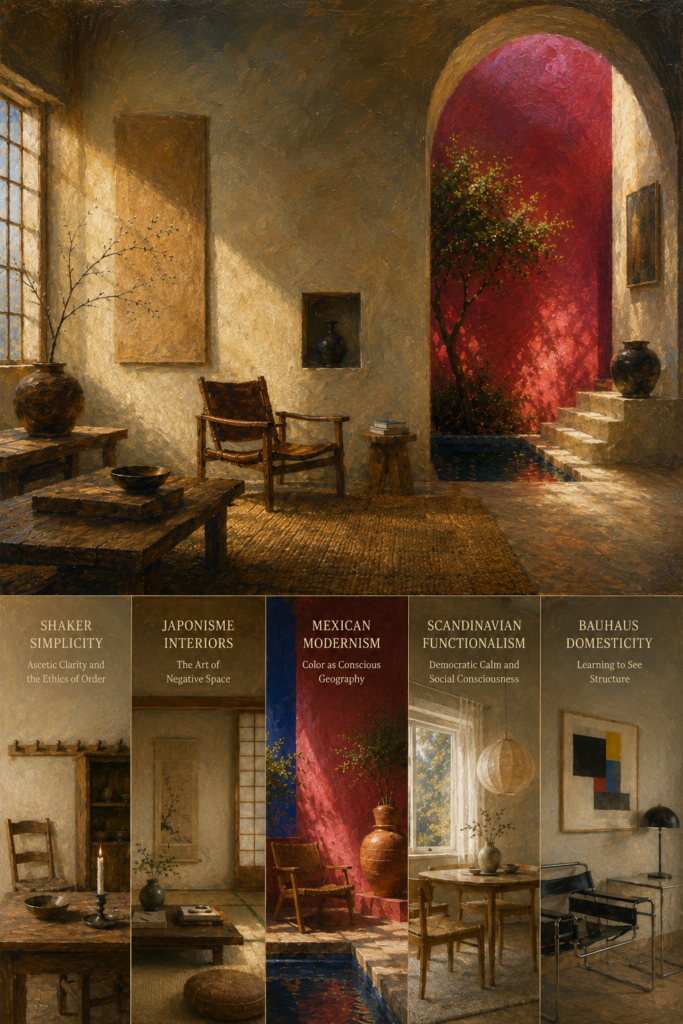

Interior design movements invite us to treat the home not as decoration, but as a field of noesis: a place where space, light, and material organize consciousness. Each movement sketches a different inner world, shaping how we feel, think, and quietly inhabit our own lives.
- Your home can function as a visible map of your inner world.
- Lesser known movements reveal alternative ways of sensing, knowing, and dwelling.
- Conscious design choices can slow perception and deepen daily awareness.
The Home As An Inner World Of Noesis
Every room is an epistemology of space: a quiet theory about what matters, how we move, and what we notice. Walls, thresholds, and textures are not passive backdrops; they participate in consciousness. In this sense, interior design is a form of noesis—the active process of perceiving, organizing, and making meaning. Dopamine Decor: How to Use Color and Pattern to Boost Your Mood According to Livingetc, this analysis holds true.
When we walk through a doorway, we cross more than a physical boundary. We step into a particular mood, a chosen rhythm of light and silence. The home becomes a small cosmos, arranging our attention just as constellations once arranged ancient skies.
thenoetik approaches interiors not as lifestyle performance, but as a daily practice of perception: how can our spaces become companions for reflection, curiosity, and inner steadiness in an age of information overload?
Why Lesser Known Interior Design Movements Matter For Consciousness
Mainstream design trends—minimalism, Scandinavian style, industrial loft aesthetics—are widely documented and imitated. They can be beautiful, but they often flatten difference into a single, globalized visual language.
Lesser known interior design movements, by contrast, act like alternative philosophies of dwelling. Each one carries:
- A historical context (a when and where)
- A geography of values (what is honored in space)
- A psychology of perception (how it feels to inhabit that world)
By studying these quieter traditions, we expand our repertoire of inner landscapes. We begin to see that a room can be contemplative without being empty, vibrant without being chaotic, and rooted without being nostalgic.
The following five movements come from different regions and periods, yet each offers a distinct way to transform a home into an introspective, psychologically rich inner world.
Shaker Simplicity: Ascetic Clarity And The Ethics Of Order
Shaker design emerged in the late 18th and 19th centuries in North America, developed by the United Society of Believers in Christ’s Second Appearing (the Shakers). Their interiors left a clear material legacy: plain wooden furniture, peg rails lining walls, built-in storage, and a radical commitment to functional beauty.
Key Aesthetic Traits
- Light-colored, often painted wood and simple joinery
- Peg rails around rooms, allowing chairs and tools to hang from walls
- Integrated cabinetry to reduce clutter
- Symmetry and proportion favoring calm visual rhythms
How Shaker Simplicity Shapes Inner Experience
Environmental psychology suggests that visual order can reduce cognitive load, freeing attention for reflection. Shaker interiors embody this principle: every object has a purpose, a place, and a quiet presence.
Living with Shaker-inspired simplicity does not require historical re-creation. It means asking: What if every visible object had to justify its presence as either deeply useful or quietly meaningful?
The inner world that emerges is one of ethical clarity. Surfaces breathe. Movement feels unhurried. Even the famous Shaker peg rail suggests a philosophy of impermanence: chairs lifted from the floor can be moved, rehung, reconfigured. Order is not rigidity; it is flexible attentiveness.
Japonisme And The Art Of Negative Space
In the late 19th century, European and North American artists and designers encountered Japanese art and domestic aesthetics with fresh eyes. This encounter, often called Japonisme, influenced movements like Art Nouveau and modernism. Within interiors, it introduced a new sensitivity to negative space, asymmetry, and the poetry of the everyday.
Key Aesthetic Traits
- Sliding partitions and screens that redefine rooms with minimal effort
- Emphasis on natural materials: wood, paper, stone
- Asymmetrical compositions and off-center focal points
- Celebration of emptiness as an active, expressive element
How Japonisme Shapes Inner Experience
In many Western traditions, space is what remains after objects are placed. Japonisme-inspired interiors reverse this logic: space becomes the protagonist, and objects the punctuation marks.
Negative space functions like silence in music—it makes perception more acute. A single branch in a vase, set against an expanse of pale wall, invites contemplative seeing. Gestalt psychology notes that our minds naturally seek patterns and closure; in such spaces, this tendency is gently slowed.
For the inner world, this design movement fosters a disciplined softness. It encourages inhabitants to value what is not filled, not said, not purchased. In an era of constant digital stimuli, such interiors provide a spatial training ground for restraint and focused attention.
Mexican Modernism: Color As Conscious Geography
Mid-20th-century Mexican modernism in architecture and interiors—visible in the work of figures like Luis Barragán in Mexico City—blended international modernist principles with local materials, vivid color, and a near-mystical treatment of light and shadow.
Key Aesthetic Traits
- Bold, saturated colors: magenta, cobalt, ochre, deep terracotta
- Thick, planar walls and enclosed courtyards
- Water elements and gardens framed as visual pauses
- Minimal furnishings offset by powerful color fields
How Mexican Modernism Shapes Inner Experience
Where many modernist interiors default to neutral palettes, Mexican modernism locates tranquility in intensity. Color becomes a geography of feeling. A cobalt wall meeting a sunlit courtyard creates a threshold not just in space, but in mood.
Color is never merely aesthetic; it encodes climate, landscape, and collective memory. In Mexican modernist interiors, bright walls often echo the surrounding environment—sky, soil, flowers—folding the outer world into the interior.
For the psyche, this creates a sense of grounded radiance. Rather than chasing serenity through absence, these spaces orchestrate calm through vivid presence. The home becomes an inner world where strong emotion is not banished but contained, shaped, and honored through architectural color.
Scandinavian Functionalism: Democratic Calm And Social Consciousness
Before Scandinavian design became a global lifestyle brand, it was rooted in early to mid-20th-century functionalism in countries like Sweden, Denmark, and Finland. This movement sought to create well-designed, affordable environments for everyday citizens, aligning aesthetics with social responsibility.
Key Aesthetic Traits
- Simple, clean-lined furniture emphasizing usability
- Light woods (such as birch) and pale color palettes to counter long winters
- Large windows maximizing natural light
- Modular, flexible layouts for small apartments
How Scandinavian Functionalism Shapes Inner Experience
Scandinavian functionalism proposes that dignity in daily life begins with intelligible, human-centered space. Doors open fully. Storage is reachable. Light is invited in as a psychological vitamin.
Natural light and views onto greenery can support mood and circadian balance. Functionalist interiors leverage these insights intuitively: windows are not luxuries but necessities; clutter is managed not for aesthetic perfection but for ease of use.
The inner world cultivated here values democratic calm. Rooms are not designed for display but for shared living, suggesting an epistemology of space in which worth is measured by how well everyone can inhabit it—children, elders, guests, and the self on a quiet morning alike.
Bauhaus Domesticity: Learning To See Structure
The Bauhaus school, active in Germany from 1919 to 1933, is famous for its impact on modern architecture and design. Its domestic interiors distilled a radical idea: form should follow function, and visual structure can teach the eye how things work.
Key Aesthetic Traits
- Geometric forms and strong lines
- Limited, intentional color palettes (often primary colors with neutrals)
- Tubular steel furniture and industrial materials adapted for home use
- Open plans emphasizing flexibility and efficient circulation
How Bauhaus Domesticity Shapes Inner Experience
In Bauhaus-inspired interiors, structure is not hidden. The logic of a chair, lamp, or table is visible. This transparency trains perception: we begin to see the inner workings of our surroundings rather than only their surface appeal.
Bauhaus domesticity becomes a kind of daily classroom for the eye and hand. We learn to appreciate joints, hinges, and proportions, to ask how something holds together.
The inner world that results is intellectually alert. Instead of being passively soothed, we are quietly engaged—invited to notice the relation between parts and wholes, between our own movements and the architecture that guides them.
Comparative Overview Of The Five Movements
| Movement | Origin Period & Region | Core Aesthetic Focus | Inner World It Encourages |
|---|---|---|---|
| Shaker Simplicity | 18th–19th c., North America | Functional wood, order, built-ins | Ethical clarity and calm attentiveness |
| Japonisme Interiors | Late 19th c., Europe meets Japan | Negative space, asymmetry, naturality | Disciplined perception and gentle restraint |
| Mexican Modernism | Mid-20th c., Mexico | Saturated color, courtyards, light | Grounded radiance and emotional presence |
| Scandinavian Functionalism | Early–mid 20th c., Northern Europe | Light, usability, democratic design | Everyday dignity and shared calm |
| Bauhaus Domesticity | Early 20th c., Germany | Geometry, structure, industrial forms | Intellectual engagement and visual inquiry |
This comparison highlights that each movement is not only a style, but a proposal for how consciousness might live within walls.
A Reflective Closing: Seeing Your Home As An Inner World
You do not need to adopt any movement wholesale. Instead, treat them as lenses. Let Shaker clarity, Japonisme emptiness, Mexican color, Scandinavian light, and Bauhaus structure become questions you can ask of your own rooms.
A simple contemplative prompt for today, in the spirit of thenoetik:
Stand in one room of your home and choose a single square meter of space. Observe it for three full minutes—its light, color, objects, and emptiness. Ask yourself: What kind of inner world does this small fragment already describe about me, and what small change would make it more truthful to the person I am becoming?
In that quiet act of looking, interior design becomes more than style. It becomes a daily practice of noesis—a way of aligning outer space with inner wisdom, one attentive moment at a time.
Frequently Asked Questions
How does the concept of noesis shape lesser known interior design movements?
In the context of interior design, noesis is the active process of perceiving and making meaning through spatial arrangement. It transforms the home from a static decorative site into a field where light, material, and thresholds organize consciousness, allowing residents to use their physical environment as a map for personal reflection and awareness.
What are the core differences between Shaker simplicity and mainstream minimalism?
Shaker simplicity is rooted in spiritual ethics and functional integrity, where every object must serve a moral and practical purpose through honest craftsmanship. While mainstream minimalism often focuses on trend-driven visual reduction, Shaker design prioritizes order, humility, and durability, creating a sense of calm through intentional utility rather than mere aesthetic absence.
How does Japonisme use negative space to influence residential psychology?
Japonisme treats negative space as an active architectural element that provides visual breathing room and rhythmic pauses. By placing intentional voids around furniture and windows, this movement reduces cognitive sensory overload. This specific use of empty space guides the eye gently, turning everyday living areas into meditative environments that encourage a slower, more focused perception.
How does color application in Mexican Modernism differ from decorative color trends?
Mexican Modernism applies color as an architectural geography rather than a decorative accent, using deep reds, yellows, and blues to reference landscape and cultural memory. Instead of using color for ornament, these bold planes are positioned to define volumes and thresholds, making the walls themselves emotional coordinates that shape how a person feels while navigating the home.
How can Shaker and Japonisme principles be applied to small apartment layouts?
Applying Shaker principles to small apartments involves reducing visual noise through high-integrity storage and multi-functional furniture. Integrating Japonisme requires creating intentional “empty zones” to prevent spatial overcrowding. By prioritizing coherent rituals of light and circulation over the accumulation of objects, residents can create a sense of expansive depth even within limited square footage.
Further Reading & Authoritative Sources
Authoritative Sources
- 4 Unusual Decor Styles That Are (Surprisingly) Timeless — Covers four unusual and relatively niche decor styles, examining how these lesser-known approaches to interior design can create distinctive, character-rich living spaces.