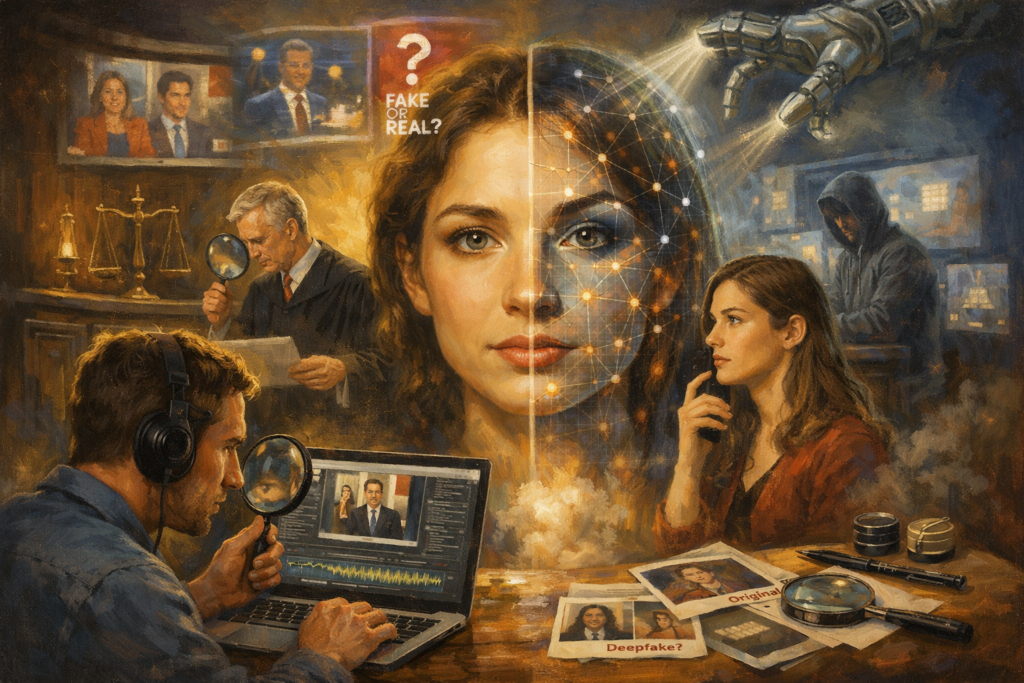

The future of deepfakes and online trust is a struggle over how we know what is real when seeing and hearing can be synthetically manufactured. It demands new standards of evidence, renewed epistemology, and an inner discipline of noesis, conscious curiosity, and cultivated wisdom. (False Failures, Real Distrust: The Impact of an Infrastructure Failure Deepfake on Government Trust)
⚡ Key Takeaways
- Deepfakes erode the long‑standing authority of eyewitness vision in public life.
- Visual evidence now requires verification, context, and interdisciplinary literacy to be trusted.
- Noesis, inner wisdom, and conscious curiosity become central tools for navigating synthetic media.
The End Of “I Was There, I Saw It” As A Reliable Claim
For centuries, the statement “I saw it with my own eyes” functioned as a powerful epistemic seal. It implied proximity, presence, and a privileged access to truth. In the digital age of deepfakes, this assurance fractures. What we see—on screen, in recordings, even live—can be algorithmically forged.
thenoetik approaches this moment not as a spectacle of technological novelty, but as an epistemic turning point. The future of deepfakes and online trust forces us to reconsider how we know, whom we believe, and what kind of inner orientation is required when appearances can be endlessly manipulated.
The Historical Authority Of The Eye‑Witness: From Oral Testimony To Photography
Long before cameras, law, religion, and everyday life leaned heavily on eyewitness testimony. To have been physically present was to possess a certain epistemic authority. Courts weighed “I saw” differently from “I heard”; memory could falter, but presence itself conferred credibility.
With the emergence of photography in the nineteenth century, a new form of witnessing appeared: mechanical vision. Photographs came to be regarded as impartial observers, supposedly untouched by human bias. The aesthetic of the photograph—its sharpness, detail, and indexical tie to light reflecting off real objects—reinforced the belief that the camera could not lie.
Film and broadcast video extended this logic. Moving images carried not only still likeness, but gesture, context, and sequence. Historically, this contributed to what we might call visual privilege in epistemology: the assumption that what is captured by optical devices is closer to reality than what is communicated by words alone.
Even as we learned to recognize staged photographs and edited films, the underlying faith remained: some trace of the real had to be there. The image was anchored in a past event. Our shared epistemic life—journalism, courts, archives, collective memory—was built on that anchor.
What Makes Deepfakes Different: Technical Overview And Epistemic Stakes
Deepfakes represent a qualitative shift because they sever the historical link between visual record and physical event. At a high level, deepfake systems use machine learning models, particularly generative architectures trained on vast datasets of images, audio, and video. These models learn statistical patterns of faces, voices, and movements, and can then synthesize new, highly realistic sequences that never occurred.
Two epistemic disruptions follow.
First, plausible fabrication: Deepfakes can imitate not only how someone looks, but how they appear to think, emote, and speak. The forged content is not a crude collage; it is dynamically generated, mimicking the subtle aesthetics of human expression.
Second, indistinguishability at scale: As the technology improves and spreads, non‑experts often cannot visually distinguish the synthetic from the authentic. Automated detection tools advance, but so do generative models, in an ongoing contest with no guaranteed victor.
The result is a landscape in which the eye, unaided, ceases to be a final arbiter. The image no longer guarantees that “something like this happened.” Instead, it becomes one hypothesis among many, requiring contextual and technical corroboration.
Epistemology In Crisis: When Perception And Recording Are No Longer Stable Evidence
Classical epistemology often treated perception as a primary source of knowledge: we trust our senses unless we have reasons to doubt them. Testimony, in turn, was weighed against the background of those perceptions. A witness’s report was strong when it aligned with what could be seen or recorded.
Deepfakes shift the ground in two ways.
First, they undermine recorded perception. Historically, recordings functioned as externalized memories. Now, a video can be a memory of an event that never occurred. The intuitive move—“I watched the footage; therefore it happened”—is no longer secure.
Second, they destabilize second‑hand seeing. When someone says, “I saw the video online,” this no longer carries the epistemic force it once did. In effect, we lose a layer of shared, easily accessible evidence that previously underwrote public discourse.
This does not mean that knowledge becomes impossible, but that the architecture of justification must change. We are compelled to move from naive visual realism to a more layered, reflective epistemology—one that treats images as claims, not as self‑authenticating truths.
Table: Traditional Visual Evidence Versus Deepfake Era Evidence
Dimension | Traditional Visual Evidence | Visual Evidence In Deepfake Era |
|---|---|---|
Link to Reality | Assumed direct optical trace of an event | May be fully synthetic with no originating event |
Required Expertise To Trust | Low; lay perception often sufficient | Higher; technical and contextual literacy needed |
Default Epistemic Status | Presumptively reliable unless proven altered | Presumptively uncertain unless verified via other means |
Role in Public Discourse | Anchor for shared narratives and legal judgments | One input among many, often contested |
Main Risk | Selective editing, staging, interpretive bias | Complete fabrication and erosion of baseline trust |
The future of deepfakes and online trust, then, is not only a technical challenge but an epistemic redesign: we must reconfigure how testimony, perception, and recording interact in our judgments.
Noesis And Inner Wisdom: Cultivating Non‑Naive Trust In A Manipulated Visual World
For thenoetik, this crisis also opens a deeper inquiry: what is the role of inner wisdom—noesis—in a world where external appearances can be engineered?
Noesis, in a classical sense, refers to a direct, intuitive apprehension of truth that is not reducible to raw sensory data. In contemporary terms, we might speak of a disciplined intuition: an inner capacity to discern coherence, to sense when narratives align with broader patterns of reality, and when they ring hollow.
In the age of deepfakes, such noetic discernment does not replace verification, but complements it. It invites questions such as:
- Does this image or video cohere with what is independently known about the world, about this person, about the situation?
- Does the emotional charge of the content exceed its evidential support, signaling possible manipulation?
- What is my own predisposition—fear, anger, hope—and how might it be exploited by synthetic media?
Inner wisdom here is not mystical escape; it is an epistemic virtue. It involves conscious curiosity rather than passive consumption, a willingness to pause before belief, and a cultivated sensitivity to the aesthetics of manipulation—the too‑perfect framing, the convenient timing, the narrative that flatters our prior convictions.
Interdisciplinary Reflections: Philosophy, Cognitive Science, History Of Images, And Aesthetics
To understand the future of deepfakes and online trust, an interdisciplinary lens is essential.
From philosophy, we inherit questions of epistemology and testimony. What counts as a justified belief when sensory proxies are untrustworthy? How do we recalibrate norms of evidence without slipping into total skepticism?
Cognitive science reminds us that human perception and memory are already fragile. We are prone to confirmation bias, motivated reasoning, and vividness effects: we believe what is striking and emotionally charged. Synthetic media amplifies these vulnerabilities by crafting images precisely tuned to our cognitive and affective patterns.
The history of images shows that every new medium—fresco, print, photography, film, digital editing—has reshaped authority and belief. Yet deepfakes mark a new metaphysical threshold. Earlier media re‑presented; deepfakes re‑instantiate visually plausible realities that never were. The image ceases even to pretend to be a window; it becomes a generative world in its own right.
Aesthetics adds another layer. The beauty—or horror—of synthetic images is not incidental. The play of light, gesture, and expression is designed to carry persuasive force. Learning to see aesthetically, not only factually, becomes part of our defense: we notice style, artifice, and the signatures of synthetic composition.
In this sense, an educated eye is both scientific and artistic: attuned to anomalies, but also to the subtle harmonies and dissonances that reveal intention.
Navigating The Age Of Deepfakes: Conscious Curiosity, Verification, And New Norms Of Evidence
How, then, do we live and inquire wisely in this environment, without collapsing into cynicism or credulity?
Conscious Curiosity As A Daily Practice
Conscious curiosity is a disciplined openness: willing to encounter new information, yet slow to convert sensation into conviction. Practically, it means:
- Treating every striking image or video as a question, not a conclusion.
- Asking who benefits from this content being believed, shared, or feared.
- Noticing our own immediate reactions and holding them lightly.
Verification Beyond The Surface
Trust, in the future of deepfakes and online trust, must be layered:
- Source scrutiny: Is the origin identifiable, consistent, and accountable? Anonymous virality is a red flag.
- Cross‑referencing: Do independent, reputable outlets report the same event with corroborating evidence—documents, multiple testimonies, physical traces?
- Technical aids: When stakes are high, expert and tool‑based analysis of metadata, compression patterns, or known synthetic signatures can supplement human judgment.
The emerging norm is clear: compelling visual evidence warrants patient verification, especially when it demands immediate outrage or allegiance.
New Social Norms Of Evidence And Trust
At scale, societies will likely need revised norms:
- Legal systems adjusting standards for admitting video and audio as evidence, requiring chains of custody and expert validation.
- Journalism codifying more explicit transparency about verification processes.
- Educational systems teaching media literacy not as an optional skill, but as a core component of civic epistemology.
For individuals aligned with thenoetik’s ethos, this is also an inner ethical commitment: to refuse the easy comfort of untested certainty, and to participate in rebuilding trust through careful, shared inquiry.
Reimagining Wisdom And Seeing Beyond Appearances
The erosion of “I saw it with my own eyes” is not merely a loss; it is an invitation. The future of deepfakes and online trust compels us to move from naive seeing to reflective seeing, from unexamined images to consciously interpreted representations.
Wisdom, in this context, is the art of holding images lightly while seeking deeper coherence. It is the practice of noesis: an inner clarity that recognizes both the power and the limits of perception. In a world where appearances can be authored by algorithms, genuine insight arises from the meeting of external evidence, interdisciplinary understanding, and inner discernment.
thenoetik envisions this not as a retreat from technology, but as a maturation of consciousness. We are called to become more deliberate witnesses—of the world, of one another, and of our own tendencies to believe. In doing so, we begin to see beyond appearances, and to cultivate a form of trust that is at once humbler and more resilient.
Frequently Asked Questions
How do courts determine the authenticity of video evidence in an era of AI manipulation?
Courts are shifting from treating video as self-evident proof to requiring a robust chain of custody. Legal verification increasingly relies on cryptographically signed metadata, such as C2PA standards, expert forensic analysis of lighting inconsistencies, and corroborating sensor data to ensure a recording has not been synthetically altered since its original capture.
What specific tools and methods can verify if a video is a deepfake?
Reliable verification involves using tools like InVID or Google Lens for reverse video searches to locate original sources. Individuals should also inspect files for metadata inconsistencies, analyze audio-to-lip synchronization, and look for “artifacts” like unnatural blinking patterns or blurring around the edges of the face that often signal synthetic generation.
What is the primary difference between deepfakes and traditional CGI or video editing?
While traditional CGI requires manual, frame-by-frame editing by experts, deepfakes utilize Generative Adversarial Networks (GANs) to automate hyper-realistic fabrication at scale. This automation allows non-experts to create convincing deceptions quickly, eroding the long-standing assumption that high-quality video recordings serve as a reliable, physical trace of real-world events.
How does the “Liar’s Dividend” complicate the landscape of online trust?
The “Liar’s Dividend” describes a phenomenon where public awareness of deepfakes allows bad actors to dismiss real, incriminating footage as “fake.” Navigating this requires noesis—a practice of conscious curiosity—to pause emotional reactions and verify the context of a claim through multiple independent channels rather than succumbing to reflexive skepticism.
What are the most common visual artifacts found in current AI-generated videos?
Current AI-generated media often contains subtle technical glitches, such as irregular reflections in the pupils, unnatural hair transitions, and flickering along the jawline. Advanced digital literacy involves recognizing these technical markers while assessing the “provenance” of the media—specifically tracking who created the file and where it was originally hosted.