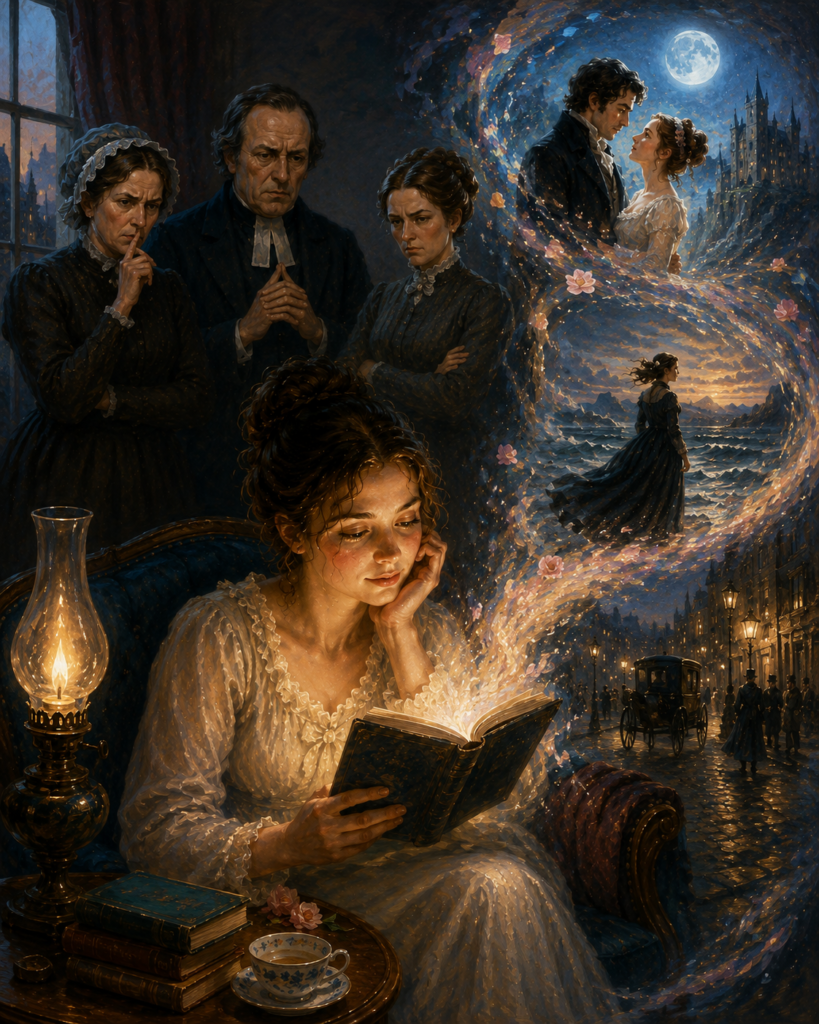

Dangerous Pages: How Reading Became A Threat
In the late eighteenth and nineteenth centuries, long-form fiction was not yet a harmless leisure activity. Novels were denounced in sermons, conduct books, and essays as sources of mental agitation, moral decay, and social rebellion.
“Reading fever” described the idea that immersion in stories could become a kind of intoxication. It suggested readers losing sleep, appetite, and judgment to fictional worlds.
This moral panic focused not only on texts but on bodies, minds, and social order. Above all, it worried about who was reading—especially young women—and what more free, imaginative reading might do to existing hierarchies.
The Birth Of The Novel As A Disruptive Medium
A New Form In A Changing Print World
From the early 1700s to the mid-1800s, several developments converged:
- Expanding literacy among the middle classes and, gradually, the working poor
- Cheaper print through technological advances and circulating libraries
- Serialized publication that spread stories over weeks and months
The novel emerged within this changing print culture as a new narrative form. Unlike religious tracts or classical histories, novels offered extended interior lives, emotional intensity, and detailed everyday settings.
They often blurred boundaries between fact and fiction. Early readers sometimes approached works like Pamela or Clarissa as if they were partly instructive case studies in virtue and vice, partly seductive fantasies.
Fiction, Identification, And New Kinds Of Attention
Novels demanded a distinctive kind of attention. They invited readers to identify with characters, inhabit their feelings, and follow long arcs of desire, misfortune, and resolution.
This immersion was new in scale and accessibility. Narrative absorption had long existed in epics or religious stories, but cheap novels placed immersive fiction in the hands of far more people, for far more hours of the day. That intensity of engagement made the novel look like a volatile medium—capable of reshaping perception and behavior.
Reading Fever And The Mind
Pathologizing Excessive Reading
Medical and philosophical language quickly attached itself to this new practice. Writers described “reading fever” and “novel reading mania” as conditions of overstimulated nerves and exhausted reason.
Symptoms attributed to this fever included:
- Insomnia and disturbed dreams from late-night reading
- Nervous agitation, tears, fainting, or fits during emotional scenes
- Inattention to daily duties and social obligations
- Confusion between fictional plots and real life
Reading was framed as a kind of nervous stimulant, akin to alcohol or gambling. For those with “delicate nerves”—a phrase often used for women and youth—the danger seemed acute.
Imagination Versus Reason
Enlightenment thought valued balanced faculties: reason should guide imagination. Novel reading appeared to reverse that order.
Critics claimed that serial exposure to passionate narratives weakened the capacity for sober judgment. Imagination, constantly aroused by tales of love, intrigue, and misfortune, would override rational self-command.
This medicalized language made cultural anxiety sound like objective diagnosis. What was at stake was not merely taste but an underlying epistemology: which mental faculties should rule, and who was considered capable of self-regulation.
Women, Novels, And Gendered Moral Panic
Why Women Readers Alarmed Moralists
The figure of the female novel reader became central to the discourse on reading fever. Several fears concentrated here:
- Susceptibility: Women were portrayed as more emotional and less rational, hence more easily “carried away” by plots.
- Sexual morality: Romantic novels were thought to inflame desire, making women discontent with arranged marriages or domestic limits.
- Idleness: Hours spent reading meant hours not spent on needlework, household tasks, or religious devotion.
- Social influence: As future mothers and moral educators, women’s reading seemed to shape the next generation.
Thus a young woman losing herself in novels became a symbol of threatened social order: if her imagination wandered, the household, and by extension the community, might follow.
Virtue, Sensibility, And Emotional Excess
Conduct literature often praised “sensibility”—refined feeling—as a feminine virtue, but it warned that novels might tip sensibility into uncontrollable sentimentality.
A careful balance was prescribed:
- Enough reading to polish taste and manners
- Not so much that feeling overwhelmed duty
Reading fever was both a diagnosis and a boundary line. It marked the point at which legitimate cultivation of the mind supposedly became dangerous indulgence.
Authority, Morality, And Control
Regulating What And How People Read
Religious leaders, parents, and educators responded to the rise of fiction with a variety of regulatory strategies:
- Banning or restricting access to certain books, especially for girls and young women
- Recommending “improving” histories and moral tales over sentimental or gothic fiction
- Supervising reading within the family, turning it into a guided activity rather than a private habit
The fear was not only that novels depicted vice, but that they did so seductively, without sufficient punishment or moral commentary. The wrong narrative arc could seem to reward transgression.
Imagination As A Challenge To Obedience
At a deeper level, anxiety about reading fever reflected anxiety about autonomous inner life. Immersive fiction gave individuals a mental space not fully governed by church, family, or state.
In that space, readers could:
- Compare their lives with alternative possibilities
- Question inherited gender roles
- Sympathize with characters of different classes or faiths
Such imaginative comparisons can loosen obedience even before explicit dissent appears. The panic around novels thus reveals the subtle ways imagination was perceived as a threat to established authority.
Case Studies And Representative Voices
To clarify these dynamics, it helps to map some recurring positions that appeared in sermons, essays, prefaces, and conduct books of the period.
| Perspective Type | Typical Concerns About Novels | Proposed Response To Reading Fever |
|---|---|---|
| Religious Moralists | Spiritual distraction, temptation, vanity, loss of piety | Ban or sharply limit fiction; promote devotional texts |
| Medical Or Nerve Theorists | Overstimulation of nerves, hysteria, melancholia, insomnia | Prescribe rest from reading, physical activity, moderation |
| Conduct-Book Authors | Female idleness, romantic fantasies, discontent with duty | Allow only select “useful” novels; supervised reading |
| Reform-Minded Educators | Misleading models of virtue and success | Create morally improving fiction as safer alternatives |
This variety shows that the panic was not monolithic. Some condemned novels outright, others aimed to domesticate them.
Prefaces to novels often addressed these criticisms defensively, insisting their stories would strengthen virtue by showing the consequences of vice. Authors sought to occupy a middle ground: fiction as entertainment that also reinforced, rather than dissolved, moral order.
Yet even these apologetic strategies acknowledged the underlying fear: that narrative form itself could direct sympathies in unpredictable ways.
From Novels To New Media
Recurring Patterns Of Media Anxiety
The cultural script that once surrounded reading fever now appears, with different content, around digital media. Today the targets are social platforms, video games, streaming series, or algorithmically curated feeds.
Common continuities include:
- Concern for youth: Young people are framed as especially vulnerable to media influence.
- Gendered unease: While the details shift, anxieties about girls’ and women’s engagement with specific platforms echo older fears of female readers.
- Medicalization: Overuse becomes an “addiction,” described in terms of brain chemistry, attention deficits, and mental health.
- Moral order: Media are blamed for weakening family bonds, civic responsibility, or religious commitment.
Like eighteenth-century worries about novels, present-day debates intertwine empirical questions about attention and cognition with deeper struggles over authority and changing norms.
New Technologies, Old Questions
The parallel should not make us dismiss all concerns as irrational. Just as expanding print culture genuinely altered how people accessed information, digital networks reshape attention, memory, and social ties.
The history of reading fever, however, cautions us to ask:
- Who is being framed as incapable of self-control?
- Which institutions present themselves as rightful gatekeepers of imagination and knowledge?
- How do claims of harm mix observed effects with fear of social change?
These questions help separate careful critique of media from broader efforts to reassert threatened hierarchies.
Epistemology, Imagination, And Social Trust
Who May Interpret Stories?
At the heart of the panic over reading fever lies a question: who is trusted to interpret narratives on their own?
In the eighteenth and nineteenth centuries, trust was unevenly distributed. Learned men were imagined as capable of reading widely without losing their judgment. Women, servants, and youth were depicted as needing guidance, lest they mistake fiction for reliable knowledge or moral law.
This hierarchy of interpretation underpinned calls for censorship or parental control. It also shaped what counted as legitimate reading: theological treatises and classical histories elevated reason; novels, especially those centered on feeling and desire, were suspect.
Imagination As A Site Of Autonomy
Despite efforts to police it, reading remained a quietly transformative practice. Even under supervision, the act of silently following a story could cultivate inner dialogue, self-reflection, and comparison.
The fear of reading fever thus reveals an intuition: imagination is not neutral. It can rearrange what seems possible or desirable. It can loosen the link between inherited roles and inner assent.
This is precisely why authorities worried, and why individuals continued to read.
What Reading Fever Still Teaches Us
Historical fears about reading fever show how a society confronts a new medium that intensifies interior life and expands access to narrative. Novels were charged with overstimulating minds, eroding virtue, and tempting especially women away from obedience.
Beneath medical metaphors and pious warnings lay a more basic struggle over imagination and autonomy. Who would decide which stories might be told, who might hear them, and how they should be interpreted?
Today, as debates about digital media echo many of these themes, the history of novel reading invites a more reflective stance. Instead of assuming that each new medium is either corrupting or liberating by nature, we can ask how it redistributes attention, authority, and the power to imagine otherwise.
For readers who wish to explore this intersection of media, imagination, and social control as an ongoing practice of inner inquiry, you can get started with thenoetik as a space for continuing that reflection.
Frequently Asked Questions
Why were eighteenth- and nineteenth-century novels seen as dangerous to readers?
Novels were viewed as dangerous because critics argued that intense immersion overstimulated the mind and eroded self-control. Moralists and clergy warned that long hours spent with fiction encouraged disobedience to religious, familial, and social authority by normalizing individual passion, secret inner lives, and personal choice over traditional duty.
How did early moralists think obsessive novel reading affected the mind and body?
Early critics argued that obsessive reading unsettled the nervous system, disturbed sleep, and produced persistent daydreaming and inattention to real-world duties. Doctors claimed that constant emotional excitement from fictional plots could physically mimic illness, fueling chronic anxiety, melancholy, and a type of addiction that destroyed practical judgment and everyday discipline.
Why were women especially targeted in moral panics about novels?
Women were primarily targeted because they were viewed as more impressionable and responsible for maintaining family virtue. Critics feared romantic plots would inspire women to question arranged marriages and religious obedience, transforming female readers into symbols of potential rebellion against established gender hierarchies and the traditional domestic order.
How did the rise of cheap print and circulating libraries intensify fears about fiction?
Cheap editions and circulating libraries made emotionally charged stories accessible to the working classes, including clerks and domestic workers. This widespread availability caused critics to fear that unsupervised reading would escape clerical and parental control, spreading new ambitions and models of behavior that threatened to destabilize the existing social class structure.
Do historical worries about “reading fever” resemble today’s concerns about digital media?
Historical anxieties regarding reading fever directly mirror modern debates over social media, video games, and streaming platforms. In both eras, authorities expressed concern over overstimulated minds, shortened attention spans, and the potential for moral corruption when youth spend unsupervised time in alternative imaginative worlds that challenge traditional structures of authority.