
Last updated: November 25, 2026
You probably met The Alchemist as a book about following your dreams. It travelled so far because it is really about fear and personal transformation: a shepherd learning to see what was always there.
How a shepherd’s simple story crossed every border
Paulo Coelho tells a deceptively simple story. A shepherd leaves behind the familiar in search of a hidden treasure, and almost nothing in the telling gets in your way. The sentences are plain. The chapters move like a fable. You never need a glossary, a theology or a map of Andalusia to follow Santiago from his sheep to the desert.
That simplicity is a design choice. Coelho builds the book on the oldest frame storytellers have: a call, a departure, mentors, trials, a return. You have met this shape in myths, scriptures and fairy tales long before you opened the novel, so it feels familiar even when its details come from Christian, Jewish, Islamic and hermetic traditions. The particular setting becomes a doorway, and the universal shape carries you through it.
Then there is the emotional core. Almost everyone has postponed something they quietly wanted. Coelho writes straight to that ache, which is why a reader in one culture and a reader in another can close the book feeling it was written about them. At The Noetik, we read the novel’s reach as a lesson in how a story can work like a mirror: the plainer the glass, the more clearly you see your own face in it. The cost of that plainness, and of the book’s optimism, comes up again near the end of this essay, because the same openness that welcomes you can also skip over hard questions.
The Personal Legend: destiny, or a calling you already hear?
Coelho’s name for the thing each person is meant to do is the Personal Legend. It is easy to read it as ambition with a mystical gloss. That reading misses what the novel actually shows you.
Santiago is not chasing status. He already has a life many would envy: freedom, a flock, the road. What unsettles him is a recurring dream, and the dream does not promise him a better job or a higher rank. It points him outward so that something inward can begin. The old king who appears early in the story tells him that, as children, people know their Personal Legend clearly, and that over the years a mysterious force convinces them it is impossible.
That detail turns destiny inside out. If the Personal Legend were imposed from outside, Santiago would only need obedience. Because it is a calling he already carries, he needs something harder: the courage to take his own desire seriously, the self-discovery to understand it, and the trust to keep going when the evidence runs thin. Conventional success can be measured by others. A calling can only be confirmed by the person living it, which is exactly why it frightens you.
What the alchemy of the title really transforms
Medieval and Renaissance alchemists sought to turn base metals into gold. Behind the laboratory work sat a philosophical idea: matter could be refined, purified and raised to its most perfect form. Many alchemical writers treated the furnace and the flask as images of the soul, and Coelho takes that symbolic tradition as his starting point.
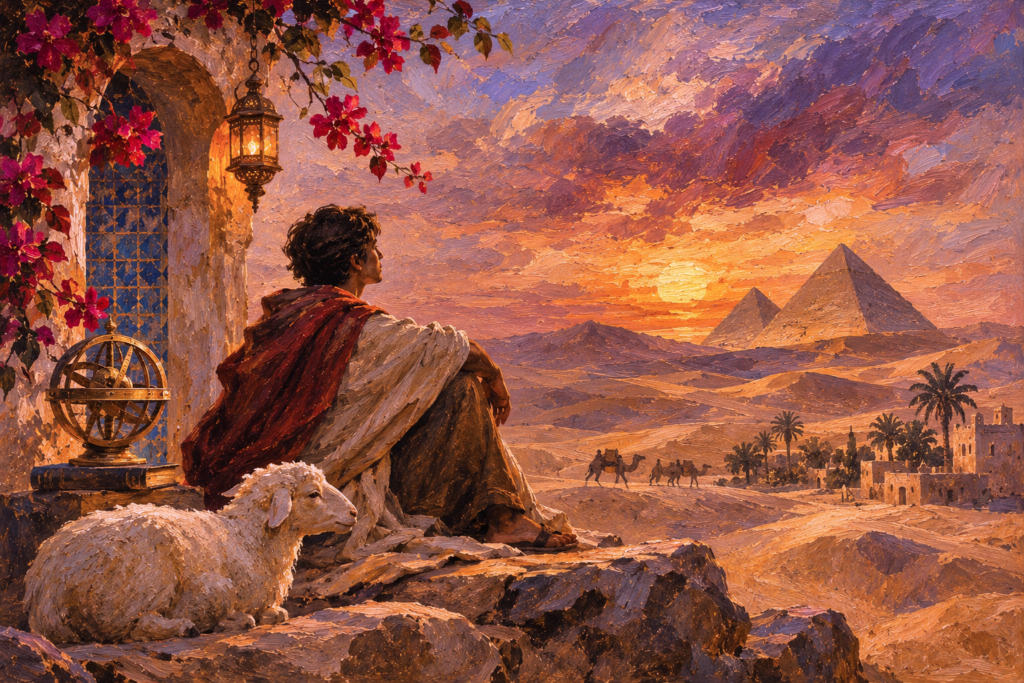
Watch how Santiago changes across the book and you see the metaphor at work. He begins as raw material, a young man who knows sheep and little else. In Tangier he loses everything and works for a crystal merchant. In the desert he travels with an Englishman who studies alchemy from books, and he learns more by watching the camels, the wind and the sand. When he finally meets the alchemist, the lessons are almost never about metal. They are about listening to his heart, about loss, about love for Fatima that does not need to hold him back.
By the time Santiago faces the moment where he must turn himself into the wind, the book has shifted the meaning of the word. The base metal was his narrow way of seeing. The gold is a consciousness that can perceive the unity behind things. You can read the whole novel as a slow refining process, and the heat of that furnace is lived experience.
The Soul of the World and the language beneath events
The novel imagines a universe that speaks. Coelho calls its deeper current the Soul of the World and its idiom the Language of the Universe, a language made of omens rather than words. A pair of stones, a hawk’s flight, a pattern in the desert: each becomes a message for someone ready to read it.
The idea underneath is interconnectedness. Santiago is not a separate observer looking at a dead world. He belongs to the same whole as the wind, the sun and the hand that wrote everything, and that belonging is what lets intuition become a kind of knowledge. The Noetik is rooted in noesis, the ancient Greek idea of the union of intellect and intuition, and we find that the novel dramatises exactly this union. Santiago does not abandon reason. He adds a second way of knowing to it.
You might ask whether reading omens is just seeing what you want to see. The novel half-answers you. The omens only guide Santiago once he has committed to his path. Before that, they are ordinary events. Meaning, in Coelho’s universe, appears where attention and intention meet.
Fear, the obstacle that keeps people at the threshold
Several characters in The Alchemist stop short, and the book treats each one with sympathy rather than scorn. The crystal merchant dreams of making the pilgrimage to Mecca and never goes, because he fears that once the dream is fulfilled he will have nothing left to live for. The old king mentions a man who once wanted to travel and chose to sell popcorn instead, because that seemed more respectable. These figures are not villains. They are you on a cautious day.
Their fear takes different shapes: fear of losing what they have, fear of failure, fear of discovering that the dream was smaller than the longing. The alchemist names the deepest of these when he tells Santiago that the fear of suffering is worse than suffering itself. That single idea sits at the centre of how the book links fear and personal transformation in The Alchemist. Fear does not stop you from suffering. It stops you from living.
Santiago never gets the certainty he would like. He is robbed, he waits out a war in an oasis, he risks his life in front of soldiers. What changes is his relationship to doubt. He learns to take the next step while uncertain, and he lets each step teach him what the following one should be. Courage, in this story, means acting before the proof arrives.
The paradox of a treasure buried at home
The ending is famous because it seems to undo the plot. At the foot of the Pyramids, Santiago is beaten by men who mock his dream, and one of them describes his own dream of a treasure buried under a sycamore in a ruined church in Spain. It is the very church where Santiago used to sleep with his flock. The treasure was where he started all along.
So was the journey wasted? The novel says no, and its reason is precise. The boy who left that church could not have found the treasure, because he did not yet know how to read the signs that pointed to it. The man who returns has been changed by the desert, by love, by loss and by fear faced in the open. The destination stays the same while the person arriving there has transformed.
That circle is the book’s quiet philosophy. You often travel far to discover what was close, and the distance is the price of being able to recognise it.
Why the novel still speaks to you, and where it falls short
You live in a world that measures you by external achievement and rewards visible results. The Alchemist offers a different scale, one where the question is whether you are becoming who you are meant to be, and that is why it keeps finding new readers who feel uncertain about where they are going.
The book’s spiritual optimism also has limits worth naming. Its universe conspires to help those who pursue their calling, and that promise can sound hollow to someone living with illness, poverty, war or loss they never chose. Not every obstacle is fear in disguise, and not every person who stops has failed to listen. The novel reads best as an invitation to examine your own hesitations, rather than as a verdict on people whose circumstances closed the road for them.
Held that way, the story keeps its power. It asks you a question that outlives any single reading: what if the purpose of searching is not simply to find what you desire, but to become capable of recognising what was already there?
Frequently asked questions
What lessons does The Alchemist teach Santiago?
Santiago learns to trust his own calling, to read the omens around him and to keep moving without certainty. He also learns that love need not hold him back from his Personal Legend, and that the fear of suffering is worse than suffering itself.
What does The Alchemist say about fear?
The novel presents fear as the main reason people abandon or postpone their deepest desires, as the crystal merchant does with his dream of Mecca. Santiago never removes his fear entirely; he learns to act while uncertain and lets each step show him the next.
What did the sheep symbolize in The Alchemist?
The sheep stand for a comfortable, predictable life that asks for nothing beyond food and water. Santiago can read and care for them, but selling them is his first act of courage, the moment he trades security for his calling.
What are the main themes in The Alchemist?
The main themes are the Personal Legend as an authentic calling, alchemy as inner transformation, the Soul of the World and the language of omens, fear as the obstacle to awakening, and the circular journey that returns Santiago to where he began.
The last transformation in the story
If this reading opened something for you, return to the novel and follow one thread through it: the moments when Santiago is afraid and moves anyway. Noetik Blog publishes short, daily insights across philosophy, art, history, language, science and geography, so you can keep pulling at questions like this one from another angle.
The greatest act of alchemy in Coelho’s novel is not the transformation of metal into gold, but the transformation of a seeker into someone who finally understands what he was searching for.
From thenoetik
- Is Orwell Still Relevant Today? A Critical Analysis of Dystopian Predictions
- The Transformative Power of Plagues: How Epidemics Shaped History
- Deleuze on Becoming: Why You’re Never the Same Person Twice