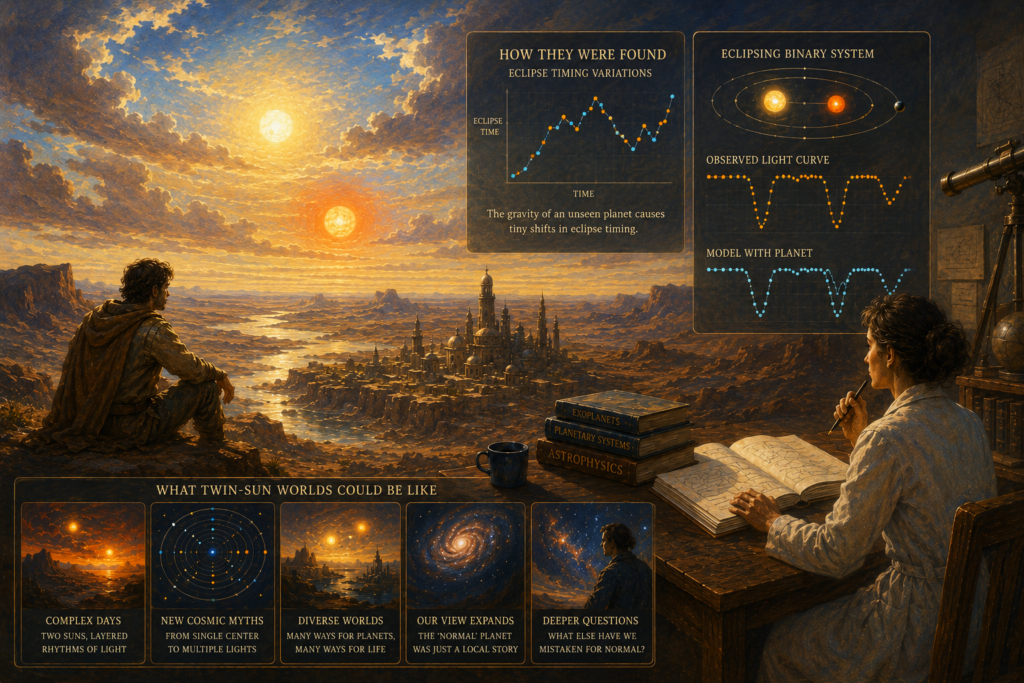

Circumbinary planets are worlds that orbit two stars instead of one, tracing wide paths around a binary pair. A 2026 study from the University of New South Wales reports 27 new candidate circumbinary, ‘Tatooine-like’ planets, suggesting such twin-sun systems may be far less rare—and less exotic—than we once believed.
⚡ Key Takeaways
- New evidence for 27 circumbinary planet candidates challenges our single-sun idea of normality.
- Shifting planetary models expose the limits of human intuition and inherited cosmic stories.
- Twin-sun worlds invite a deeper, noetic practice of questioning what counts as reality.
A Familiar Sun In An Increasingly Unfamiliar Cosmos
For most of us, “a normal world” means one sun, roughly regular seasons, and a sky whose rhythms feel stable enough to build a life upon.
Yet the cosmos keeps letting us know that our sense of normal is provincial.
In early May 2026, a team led by Margo Thornton at the University of New South Wales announced 27 new candidate circumbinary planets—potential ‘Tatooine’ worlds orbiting two stars at once. They did not find them through the usual dip in starlight when a planet passes in front of a star. Instead, they watched the timing of eclipses in 1,590 binary star systems and traced subtle shifts to the slow rotation—apsidal precession—of the stars’ orbits, influenced by possible planets. (Earth-sized ‘Tatooine’ planets could be habitable)
Roughly 2% of these binaries showed signatures consistent with planets. That small percentage quietly whispers a large question:
If twin-sun worlds are not exceptional accidents, what else about our picture of a “typical” world is simply a story born under one particular star?
What Circumbinary Tatooine Worlds Actually Are
Circumbinary planets are not mystical. They are celestial pragmatists.
Instead of orbiting a single star, they orbit around a pair locked in their own intimate gravitational dance. Imagine two suns revolving around a common center, while a planet moves on a wider path that encloses the duo. The planet’s days, seasons, and light would be shaped by this layered choreography.
The UNSW team did not measure masses, temperatures, or atmospheres. These 27 worlds are candidates inferred from light-curve timing, not fully characterized planets. Yet they are statistically persuasive enough to reshape expectation: about 2% of the surveyed eclipsing binaries seem to host such companions.
Astronomers once relied mostly on transit dips—small, periodic dimmings of a star when a planet passes in front—to find exoplanets. Circumbinary systems complicate this method; their light is already flickering as two stars eclipse each other. By tracking how the timing of those stellar eclipses drifts due to apsidal precession, the UNSW group inferred the gravitational tug of unseen, orbiting worlds. (Astronomers Discover 27 Circumbinary Planets)
Our picture of circumbinary planets is still spare: orbits, probabilities, gravitational fingerprints. Yet that is enough to pose a philosophical challenge. The cosmos is telling us: the one-sun template that shaped our myths is not a universal blueprint.
Why We Once Thought Twin-Sun Worlds Were Improbable
Before data, intuition ruled. And intuition, shaped by a single star, is a conservative advisor. Scientists find 27 more ‘Tatooine’ worlds with two suns Discovery Alert: A ‘Tatooine’ World With a Surprising Orbit
Two stars orbiting each other create a gravitational field that seems chaotic. For a long time, many models suggested that their push-and-pull might make stable planetary orbits difficult. We imagined planets either flung outward or drawn inward to destruction.
Even as simulation and theory matured, our psychological picture lagged. A single, central sun felt orderly; a binary felt unstable, like a cosmic argument.
The emerging catalog of circumbinary planets—and especially the 27 new candidates from 1,590 systems—invites a more nuanced view. While not every binary can host stable planets, some evidently can. What once seemed an exception begins to look like one pattern among many.
The shift is not merely technical. It is epistemological.
Our models are refined by surprise. When observations reveal worlds where our instincts predicted chaos, we are forced to update both equations and expectations. The cosmos becomes less a mirror of human common sense and more a teacher of its limits.
Myth Versus Reality In Our Idea Of “Normal” Worlds
We often carry unspoken myths about what a world must be like. These myths guide even sophisticated reasoning.
Below is a concise comparison:
| Dimension | Human Intuition About Planets | Emerging Reality From Circumbinary Planets |
|---|---|---|
| Host Star | One stable central sun feels “normal” | Two or more stars can also host stable planets |
| Orbital Order | Neat, circular orbits preferred | Complex, precessing orbits can still be long-lived |
| Rarity | Binary-hosted planets imagined as exotic | At least a few percent of binaries show planet-like signatures |
| Cosmic Template | Our solar system as baseline | Our solar system as one variant in a broader ecology of systems |
The UNSW study does not give us an exact census of all twin-sun worlds. It does, however, weaken the old story that such systems are wildly improbable. Reality turns out to be less aligned with our narrative of order than with its own, quiet mathematics.
Alien Skies And The Sculpting Of Consciousness
On a circumbinary planet, dawn might begin with one star clearing the horizon while the other still hangs higher in a fading night. Shadows would lengthen and twist in unfamiliar rhythms. Some days could end in a double sunset; others might feature one sun setting while the other lingers.
Even without exact climate models, we can contemplate the psychological and cultural effects of such light:
- Time Perception: If the two suns rise and set out of sync, the day’s emotional arc may not map neatly onto one period of growing and fading light. People might develop more layered notions of “morning” and “evening,” guided by overlapping cycles.
- Symbols Of Stability: On Earth, a single sun has become a metaphor for constancy, clarity, and central truth. A double sun could suggest plurality: truth as dynamic, reality as made of intersecting centers.
- Myths And Origin Stories: Under twin suns, origin stories might start not with “the first light” but with “the first relationship of lights.” Cosmogony could be framed from the beginning as relational rather than singular.
Human consciousness is not shaped by biology alone. It is sculpted by the sky it grows under: its patterns of light, its predictability, its anomalies. Circumbinary planets remind us that our own forms of attention, our deep metaphors of order and chaos, are partly local adaptations.
The next revolution in cosmology is also a revolution in self-understanding. When we imagine life under different skies, we discover that even our sense of what it means to feel “at home” in the cosmos is not universal, but conditional.
Twin Suns In Myth, Art, And Science Fiction
Long before telescopes hinted at real circumbinary planets, twin suns were present in our cultural imagination.
In art and fiction, double suns often symbolize excess—too much light, too much drama, too much power. They stand for worlds slightly out of balance, places where the ordinary is stretched.
Science fiction acts here as a psychological rehearsal space. By staging scenes under twin suns, creators explore questions we are only now facing with data:
- How does daily life change when the sky will not hold still?
- What does it mean to be centered in a system without a single center?
- How does love, law, or ritual adapt to layered cycles of light and shadow?
These stories are not prophecies. They are experiments in noesis—exercises in the mind’s capacity to perceive beyond habit. They soften the grip of what feels normal so that, when twin-sun worlds step out of fiction into observation, we are less shocked.
The UNSW catalog of 27 candidate circumbinary planets turns the metaphor on its head. What began as an artistic symbol of estrangement becomes an empirical reminder: the cosmos is richer in such configurations than our early science—or early storytelling—assumed.
Noetic Reflection On Normality, Order, And The Twin-Sun Cosmos
What the UNSW study offers is not a catalog to memorize, but a meditation prompt.
Twenty-seven candidate circumbinary planets among 1,590 eclipsing binaries may sound modest, yet it is epistemologically loud. It tells us that the universe is under no obligation to respect our private intuitions about stability, centrality, or normality.
To live wisely in such a cosmos is to cultivate a flexible sense of normal.
We can let these twin-sun discoveries work on us at several levels:
- Scientifically, they expand our sample of planetary architectures and refine theories of how worlds form and survive in complex gravitational fields.
- Psychologically, they invite us to imagine consciousness shaped under different skies, revealing how local our own mental defaults may be.
- Philosophically, they continue the long arc of decentering—pushing us from geocentrism, to heliocentrism, toward a more relational view in which no single solar arrangement is privileged.
From the perspective of thenoetik, this is an invitation to daily contemplation:
- Which of my assumptions about reality are simply the inner equivalent of a one-sun sky?
- Where do I mistake the familiar for the necessary?
- How might I expand my own noesis so that I can welcome twin-sun possibilities without fear?
The new circumbinary candidates show that the cosmos hosts worlds where light itself comes in conversations, not monologues. Perhaps wisdom, too, thrives where we allow more than one center—where multiple sources of insight, culture, and experience orbit and shape us.
To look up at our single sun now is not to feel diminished, but expanded. We see it not as the standard, but as one luminous particular among many ways a sky can be.
Science, at its best, is a gentle dismantling of the illusion that our local arrangement is the measure of all things. Each new catalog of strange worlds asks us, with quiet persistence:
What else in your life have you mistaken for the only possible way light can fall?
In that question lies the heart of a noetic practice: to meet the cosmos with conscious curiosity, to let data transform not only what we know, but how we imagine, and to hold our sense of the normal lightly—ready to be revised by the next twin sunset we discover.
Frequently Asked Questions
How common are circumbinary planets compared with planets around single stars?
Current evidence suggests circumbinary planets are less common than planets around single stars, but they are not rare curiosities. A 2026 University of New South Wales study identified candidate circumbinary planets in about 2% of 1,590 eclipsing binary systems, implying that twin-sun worlds are a regular, if minority, feature of our galaxy.
How do astronomers detect circumbinary planets if standard transit methods are difficult?
Astronomers typically detect circumbinary planets by monitoring the timing of stellar eclipses in binary systems. Tiny, systematic shifts in when one star passes in front of the other reveal gravitational tugs from an orbiting planet, even when traditional, regularly spaced transit dips are too complex to interpret through standard means.
Could circumbinary planets like Tatooine support stable climates and potentially life?
Many circumbinary planets maintain stable orbits if they reside far enough from their two host stars. Climate stability depends on orbital distance and stellar types, but scientific models suggest Earth-like circumbinary planets in the habitable zone could experience complex yet life-friendly patterns of light, seasons, and atmospheric temperatures.
When did scientists first confirm the existence of circumbinary planets?
The first widely accepted detection of a circumbinary planet was Kepler-16b, announced in 2011 using data from NASA’s Kepler Space Telescope. Orbiting two stars in the constellation Cygnus, it provided the first definitive observational proof that Tatooine-like twin-sun systems are a physical reality rather than mere science fiction.
Why did astronomers once think circumbinary planets were unlikely to form?
Earlier models suggested that the intense, varying gravitational forces near binary stars would disrupt protoplanetary disks, preventing planet formation or destabilizing young orbits. Improved simulations and the discovery of Kepler-16b proved that these disks can settle, allowing planets to form and survive on wider, stable circumbinary paths.
Further Reading & Authoritative Sources
From thenoetik