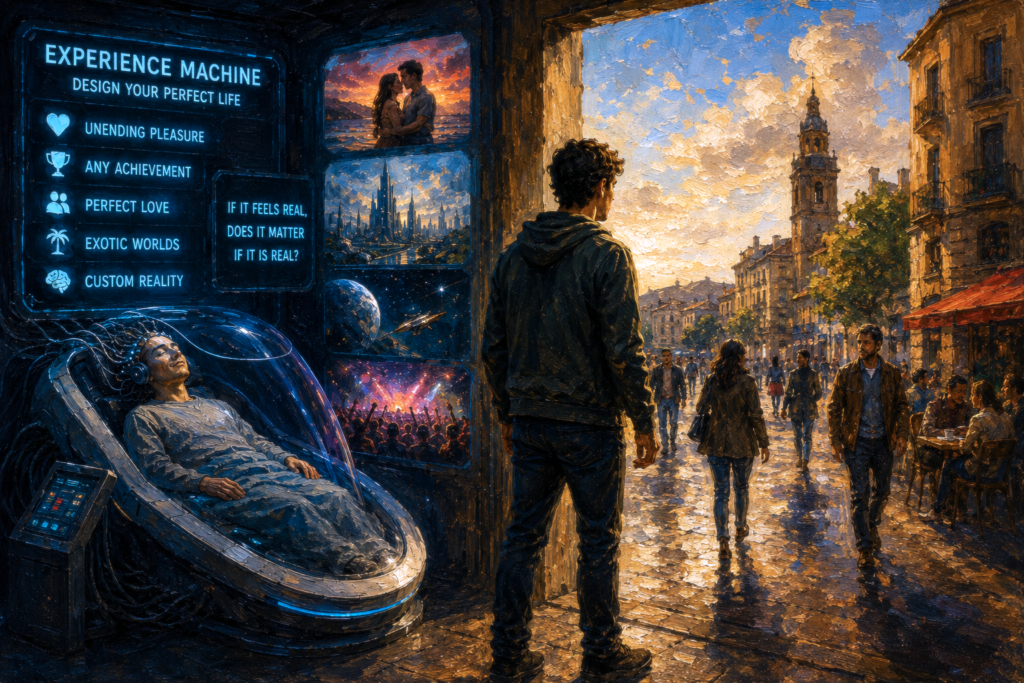

A Disturbing Choice Between Happiness and Reality
Imagine being offered a device that could orchestrate a lifetime of bliss.
Once connected, your brain is stimulated so that you experience whatever life you most desire: profound love, artistic triumph, scientific discovery, spiritual depth. Inside, it would all feel utterly real. Outside, your body would lie in a tank, your experiences produced by a perfect simulator.
Robert Nozick’s experience machine confronts us with a simple but unsettling question: if happiness could be guaranteed by such a machine, should you plug in for life?
Many find themselves hesitating or outright refusing. That hesitation is precisely where the philosophy begins.
What The Experience Machine Is And How It Works Conceptually
Nozick introduced the experience machine in Anarchy, State, and Utopia, published in 1974. The setup is deliberately stark:
- Technicians can program a sequence of experiences for you.
- The machine can simulate any reality you choose by stimulating your brain.
- Inside, you would have no awareness that it is a simulation.
- You can design your “life script” in advance but, once plugged in, you forget you chose it.
You stand at a threshold: remain in the messy, unpredictable world, or enter a perfectly curated life of unbroken satisfaction.
This is not a technological prediction but a philosophical tool. By isolating pleasure from everything else, the thought experiment presses us to ask: Is the good life nothing more than a stream of pleasant experiences?
Why Nozick Thinks Many Would Refuse
Nozick’s central claim is that most of us would not plug in—and that our refusal shows we care about more than pleasure.
He highlights at least three dimensions we seem to value beyond mere feeling.
We Want To Do Things, Not Just Feel As If We Did
Inside the machine, you might feel you have written a great novel, climbed Everest, or alleviated suffering across the world. Yet, in fact, you have done nothing; there is only neural stimulation.
Nozick suggests we want to be certain kinds of people who actually do certain kinds of things in the world, not just endure experiences that mimic those achievements. We care about the reality of our actions.
We Want To Be A Certain Kind Of Person
Plugging in also seems to dissolve your identity into a passive consumer of experiences.
Outside the tank, you confront difficulty, develop character, respond to others, and shape yourself over time. Inside, your character is largely irrelevant; the machine guarantees satisfaction regardless of your virtues or vices.
Nozick concludes that we value being a particular sort of agent—courageous, compassionate, insightful—over simply feeling as if we are such people.
We Want To Stay In Contact With Reality
Finally, there is the sheer value of reality itself.
We seem to care not only that things feel meaningful, but that there is something real behind the feeling: real landscapes, real people, real risks, real histories.
For Nozick, this reveals that the good life is not exhausted by pleasurable experience. We also prize truth, contact with reality, and genuine engagement with the world.
Happiness Versus Reality: Challenging Hedonism
Hedonism, in its simple form, claims that pleasure (or happiness) is the only intrinsic good, and pain the only intrinsic bad. Everything else is a means to those experiences.
The experience machine challenges this. If hedonism is right, we should have no reason not to plug in, because the machine maximizes the one thing that matters: pleasurable experience.
But many feel that a life in the machine is, in some profound way, less valuable than a more difficult life in reality.
The Everest Comparison: Two Climbers, One Summit
Consider two versions of a mountaineer:
- Real Climber: Trains for years, endures altitude sickness, navigates dangerous crevasses, and finally stands on the summit of Everest, feeling the thin air and the vast horizon.
- Simulated Climber: Lies in a capsule, brain connected to a perfect simulation that produces identical feelings of training, hardship, and eventual triumph.
From the inside, their experiences seem indistinguishable. Each remembers struggle and victory. Yet most of us would say the real climber’s life embodies something more:
- Authentic risk and achievement
- Genuine interaction with the mountain, the weather, the world
- A story that actually unfolded in reality
The experience machine makes this contrast vivid. Feeling fulfilled is not the same as having truly lived a fulfilling, reality-connected life.
A Qualitative Contrast, Not Just A Quantity Of Pleasure
Nozick is not arguing that the machine would fail to produce as much happiness. On the contrary, it could, in principle, produce more.
The point is qualitative: we recognize goods that are not reducible to pleasure—truth, achievement, agency, and the reality of our relationships.
A Brief Table Of Values: Inside Versus Outside The Machine
To crystallize the contrast, we can map some key values in and out of the machine.
| Dimension | Life In The Experience Machine | Life In Reality-Connected World |
|---|---|---|
| Pleasure / Happiness | Maximized and guaranteed | Variable, often mixed with pain and frustration |
| Achievement | Simulated; no external impact | Genuine; changes the world and oneself |
| Agency | Front-loaded choice, then largely illusory | Ongoing, uncertain, responsive to real constraints |
| Relationships | With simulated agents only | With actual persons, with independent minds and histories |
| Contact With Reality | Severed; experiences do not track the external world | Direct engagement with a shared, resistant environment |
| Narrative Ownership | Pre-scripted and hidden from future awareness | Emergent, revisable, co-authored with others and circumstance |
This comparison suggests why many would resist plugging in even at the price of some happiness. Our intuitions about value are richer than pure hedonism allows.
From Nozick To The Matrix: Modern Technologies And Soft Machines
When Nozick wrote in 1974, the experience machine was purely hypothetical. Today, it resonates with a world increasingly shaped by virtual reality, artificial intelligence, and immersive media.
Films such as The Matrix dramatize a version of the same dilemma: if your entire perceived world were a simulation, would it matter?
Meanwhile, modern technologies form softer, incremental machines:
- Virtual reality creates convincing artificial environments that can be more appealing than the physical world.
- Social media curates identity and experience, offering highlight-reels that may feel more meaningful than everyday life.
- AI-generated content can simulate conversation, companionship, and creativity.
We may not be sealed in tanks, but parts of our lives increasingly unfold in carefully mediated spaces where experience can be curated, filtered, and optimized.
The experience machine becomes a lens for asking: At what point does the pursuit of optimized experience disconnect us from the world and from each other?
What Counts As An Authentic Life In A Mediated Age?
The thought experiment can seem too stark: real life versus total illusion. In practice, our condition is subtler. Our experiences are already deeply mediated—by language, memory, narrative, and now by technologies.
We remember selectively, interpret continuously, and tell stories about ourselves that reshape how events feel. In that sense, we each carry a partial “experience machine” in our minds.
This raises a more intricate question: If all experience is filtered and interpreted, what makes a life genuinely ours and authentically lived?
Authenticity Beyond Pure Rawness
Authenticity cannot simply mean “unfiltered rawness,” because human perception is never raw. Instead, authenticity seems to involve several intertwined elements:
- Responsiveness to reality: Our beliefs and actions can be corrected by how the world actually is.
- Ownership of narrative: We participate in shaping our life story, rather than having it fixed from the outside.
- Mutual recognition: Our relationships are with other genuine centers of experience, not pre-programmed responses.
- Integration over time: We thread our memories, projects, and commitments into a life that makes sense to us.
On this view, the problem with the machine is not merely that it is artificial, but that it blocks these forms of authenticity. Reality can contradict us; the machine cannot.
Between Illusion And Contact
We live on a spectrum between full contact with reality and crafted experience. Reading a novel immerses us in a fictional world; listening to music modulates our mood; engaging with digital media overlays filters on our perception.
The challenge is not to avoid mediation altogether, but to ask: Do our chosen mediations deepen or dilute our connection to truth, agency, and others?
- A virtual reality training that prepares a doctor for real surgeries may enhance authentic capacity.
- A curated social persona that erodes our sense of who we actually are may diminish authenticity.
The experience machine is a limiting case that clarifies the direction of the drift: a life where mediation ceases to be a tool for engaging the world and becomes a substitute for the world.
Is Happiness Enough If Nothing Behind It Is Real?
In the end, Nozick’s experience machine is less about technology than about self-knowledge.
When you imagine standing before the machine, what surfaces?
- Do you feel a pull toward guaranteed joy, away from the contingencies of life?
- Do you sense resistance—an insistence that your joys and sorrows be rooted in a world that pushes back?
- Which matters more to you: the texture of consciousness from the inside, or the pattern of reality your life weaves from the outside?
There is no single mandated conclusion. Instead, the thought experiment invites conscious curiosity about what you truly value when happiness comes apart from truth, agency, and contact with others.
Perhaps the most unsettling realization is not whether we would reject a dramatic machine, but how many small machines we already accept: curated feeds, comforting narratives, plausible illusions about ourselves.
So the question lingers: If your happiness could be secured forever, but nothing behind it was real, would that be enough—for you?
If you wish to continue exploring how questions like this can shape a daily intellectual ritual, you can get started with thenoetik and deepen your own ongoing inquiry into reality, consciousness, and the human condition.
Frequently Asked Questions
Why does Robert Nozick’s experience machine feel disturbing to many people?
Many people find the idea disturbing because it highlights a trade-off between guaranteed pleasure and contact with an independent reality. The scenario suggests that surrendering genuine relationships and real achievements for a manufactured bliss results in a loss of human dignity and an abandonment of authentic personal agency.
When was the experience machine thought experiment first introduced?
Robert Nozick first introduced the experience machine in his 1974 book, “Anarchy, State, and Utopia.” He developed this thought experiment within the context of moral philosophy to argue against ethical hedonism, suggesting that humans value things beyond the internal feeling of pleasure, such as actual truth and character.
What are the primary reasons Nozick believes people would refuse the simulation?
Nozick argues that people would refuse because they want to perform certain actions, not just have the experience of performing them. Additionally, humans desire to be a certain type of person and stay connected to a reality that is not limited by what a perfect machine can simulate.
How does the experience machine challenge the philosophical view of hedonism?
This scenario challenges hedonism by demonstrating that pleasure is not the only thing that matters. If happiness were the sole intrinsic good, everyone would plug in. The widespread hesitation suggests that values like authenticity, truth, and real-world impact are equally essential components of a life well-lived.
What is the difference between simulated pleasure and a meaningful life in this experiment?
Simulated pleasure is an internal state created by the machine, while a meaningful life involves external facts and genuine interactions. The machine offers stable satisfaction, but the real world provides the necessary conditions for actual growth, authentic connection, and the pursuit of an objective reality beyond ourselves.
Further Reading & Authoritative Sources
Authoritative Sources
- Stanford — Authoritative Stanford Encyclopedia of Philosophy entry on well-being that includes a substantial section explaining and analyzing Nozick’s experience machine as a central objection to hedonism.