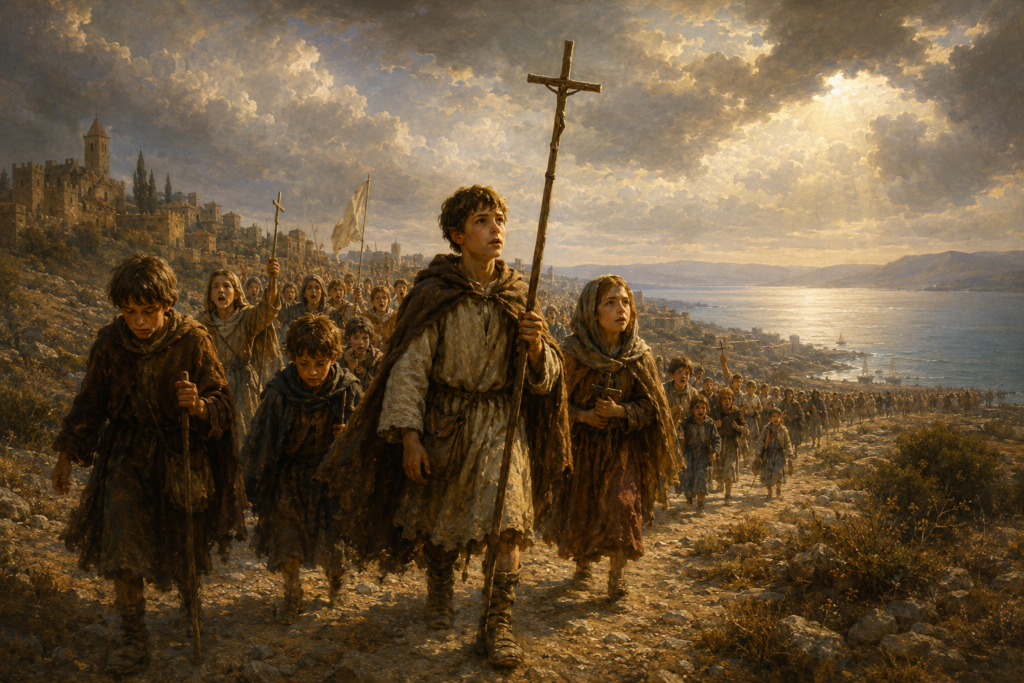

The question of the children’s crusade myth or reality leads us into a complex space between legend and evidence. Most historians today see no single, vast crusade of children in 1212, but fragmented youth and poor people’s movements later mythologized into a haunting story of innocence, faith, and tragedy.
- The Children’s Crusade mixes fragmentary records with powerful later storytelling.
- Translation, bias, and memory turned scattered youth movements into a single legend.
- The story invites conscious curiosity about both medieval suffering and modern narratives.
Contextual Prelude: Crusades And Medieval Consciousness
The Children’s Crusade belongs to the restless world of early‑thirteenth‑century Europe. Several major crusades had already marched toward the eastern Mediterranean. Preaching about holy war, salvation, and penitence saturated the air. (The Children’s Crusade Set Out for the Holy Land in 1212. It Never Arrived.)
This was a culture steeped in visions, relics, and shared rituals. Ordinary people, including the very poor and the young, lived in a universe where divine signs felt near and urgent. In that atmosphere, the idea that children might undertake their own holy journey did not seem impossible; it felt like an extreme, but imaginable, expression of collective faith.
When we ask whether the story is myth or reality, we are also asking how medieval people saw the cosmos: a charged field where human suffering, spiritual longing, and political power constantly intersected.
What Was The “Children’s Crusade”? The Traditional Story
The traditional narrative, shaped over centuries, tells a starkly simple tale.
In 1212, so the story goes, thousands of children in parts of France and the German lands felt called to liberate Jerusalem. Led by charismatic boys—often named as Stephen of Cloyes in France and Nicholas from the Rhine region—they marched toward the Mediterranean, expecting the sea to part as it had for Moses.
In this popular version, the sea did not open. Instead, the children were betrayed, sold into slavery, or died from hunger and exhaustion. Their innocence became a symbol of both holy zeal and catastrophic manipulation. Art, sermons, and later literature turned this into a powerful image: pure-hearted youth sacrificed to the ambitions or negligence of adults.
Yet when we step back and examine actual medieval records, this unified story begins to dissolve. What looks, from a distance, like one great march appears, up close, as multiple events, partial memories, and later embroidery.
Sources And Misreporting: What The Records Actually Show
Our main window into 1212 is a patchwork of chronicles written by monks and clerics, often decades after the events. They relied on oral reports, hearsay, and earlier notes, weaving them into the grand narratives of their own communities.
Two key movements emerge from these sources:
- A French movement, associated with a shepherd boy, often called Stephen of Cloyes.
- A German movement, associated with a leader named Nicholas, drawing followers along the Rhine toward Italy.
Many chroniclers describe crowds of pueri. Here a linguistic nuance becomes crucial. In medieval Latin, pueri can mean children, but it can also mean servants, low‑status youth, or more generally the poor. Some texts likely describe not only children, but impoverished adolescents, landless laborers, and marginal people.
Later writers, translating pueri simply as “children,” helped solidify the image of an army of small boys and girls. A term that originally blended youth and poverty hardened, in time, into the literal picture of child crusaders.
Romantic retellings from the nineteenth century intensified this. In an age fascinated by childhood innocence and national epics, writers and artists amplified the emotional charge of the story. The Children’s Crusade became a moral drama: pure faith betrayed by corrupt society.
Modern historians, working patiently with the surviving documents, have proposed several cautious conclusions:
- There were genuine popular religious movements around 1212 involving many young and poor people.
- These groups undertook long journeys, often without clear clerical authorization.
- Numbers in the thousands are possible but uncertain; chroniclers often exaggerated for effect.
- Evidence for a single, coordinated “crusade” of children aiming directly at Jerusalem is weak.
- Later retellings merged separate episodes and added tragic details that may not reflect specific documented events.
In short: there is historical reality here, but it is more fragmented and ambiguous than the legend suggests.
Myth And Reality: A Simple Comparison
To clarify this tension between story and evidence, it helps to map key elements side by side:
| Aspect | Legendary Narrative | Historically Plausible Picture |
|---|---|---|
| Main Participants | Mostly small children | Mix of poor youth, adolescents, and marginal adults |
| Scale | Vast, unified movement across Europe | Several regional movements, uncertain numbers |
| Leadership | Two inspired child prophets (Stephen, Nicholas) | Charismatic young leaders, partly documented, partly embellished |
| Goal | Direct liberation of Jerusalem | Vague penitential journeys, desire to reach holy places or gain favor |
| Outcome | Mass enslavement or death after betrayal | Hard to trace; many likely dispersed, suffered hardship, or returned |
| Name “Children’s Crusade” | Assumed from the start | Constructed gradually through later interpretation of pueri |
This table does not solve the question of children’s crusade myth or reality; instead, it shows how both dimensions intertwine.
Myth, Memory, And Noesis: How Legends Grow
Here the story becomes a meditation on noesis—our capacity for inner understanding.
Human communities rarely remember the past as a neutral list of facts. We shape events into narratives that express hopes, fears, and collective self‑images. The Children’s Crusade, whether fully accurate or not, condensed several medieval anxieties:
- The fear that zeal without guidance leads to ruin.
- The sense that the poor and young could be both holy and dangerously uncontrolled.
- The haunting possibility that God might speak more clearly through the powerless than through the powerful.
As later generations retold the story, they did not merely transmit information; they performed meaning‑making. Details that strengthened the emotional and moral message were preserved or heightened; others faded. Over time, scattered reports of pueri on the road crystallized into one stark image: a procession of children walking to their doom.
Noesis invites us to listen to this mythic resonance without surrendering our critical mind. The legend tells us something about medieval consciousness—the way people imagined innocence, sacrifice, and divine will—even if some specifics are uncertain.
The key is balance: to honor the symbolic dimension without mistaking it for literal, precise history.
Medieval Tragedy: Human Costs And Vulnerability
Behind both myth and cautious reconstruction lies a simple, sobering reality: vulnerable people walked long roads under harsh conditions.
Imagine being a poor adolescent in 1212. Famine, disease, and social instability shaped daily life. Hearing sermons about holy places and salvation, the idea of journeying with others toward a sacred goal might feel like both escape and calling.
Whether or not the sea was expected to part, such journeys exposed participants to hunger, exploitation, and violence. Local authorities sometimes tried to stop the groups; others may have let them pass, ambivalently. Along the way, merchants, ship captains, and opportunists could profit from their desperation.
Even if mass enslavement tales are exaggerated, it is likely that some were abused, some vanished, and many returned with shattered illusions. The tragedy lies not only in spectacular catastrophes, but in the ordinary suffering of those whose names we do not know.
This dimension matters ethically. If we treat the Children’s Crusade only as a dramatic legend, we risk turning real pain—however fragmentarily recorded—into a mere symbol. A wisdom‑seeking approach keeps the human faces in view, even when evidence is thin.
Epistemological Reflection: How We Know The Past
The Children’s Crusade becomes a quiet lesson in epistemology: the study of how we know.
Several themes appear:
- Mediated Knowledge
We do not see 1212 directly. We see traces: chronicles, letters, later summaries. Each trace passes through minds shaped by their own fears, loyalties, and hopes. - Language And Interpretation
A single word like pueri can tilt centuries of understanding. Translating it simply as “children” generates one image; reading it as “poor young people” generates another. Our inner wisdom grows when we notice how language filters reality. - Bias And Agenda
Medieval chroniclers sometimes used these movements as cautionary tales: to criticize unapproved enthusiasm or to warn against neglecting clerical authority. Their narratives are not neutral recordings but crafted arguments. - Gaps And Silence
Many participants left no written record. We know almost nothing about how they understood their own journeys. Historical knowledge often rests on the voices of the literate few.
To practice conscious curiosity is to hold all this in mind: to ask not only what happened, but how we have come to think that it did. Instead of seeking a final, rigid answer to children’s crusade myth or reality, we cultivate a layered understanding—one that accepts ambiguity without collapsing into confusion.
Insight For The Present: From Medieval Rumor To Modern Overload
Medieval Europe did not have social media, but it had its own rumor networks: preachers, travelers, marketplaces, local storytellers. News moved slowly yet could still transform lives.
The story of the Children’s Crusade shows how:
- emotionally charged events spread quickly,
- details are added or lost in transmission,
- and, over time, narratives become more emotionally satisfying than factually precise.
Our age of constant notifications repeats these dynamics at higher speed and scale. Viral stories, simplified dramas of heroes and villains, and emotionally tuned headlines can function like modern crusade tales—pulling us into movements without full understanding.
A noesis‑centered response is not withdrawal, but disciplined attention. We might ask, each time a powerful narrative reaches us:
- Who is telling this story, and when?
- What words shape my perception—are there “pueri” moments of ambiguity?
- Which details are vivid because they serve an emotional script, not because they are well attested?
Practically, this can mean pausing before sharing, seeking at least one independent source, and noticing our own emotional reactions as data, not commands. The same skills we use to read 1212 wisely help us navigate 2025 with greater inner steadiness.
Closing Contemplation: Walking The Thin Road Between Legend And Truth
The Children’s Crusade, whether myth, misreporting, or dispersed tragedy, stands as a quiet mirror for our own search for wisdom.
We will never reconstruct every step of those young and poor travelers. Yet by studying how their story was told, retold, and transformed, we attune ourselves to the subtle currents shaping all narratives, including those we tell about our own lives.
thenoetik invites you to stand at this threshold where intellect and intuition meet. Let your reason question sources, translations, and motives. Let your inner wisdom listen for the symbolic echoes—innocence longing for meaning, vulnerability seeking direction, communities wrestling with faith and power.
Between children’s crusade myth or reality lies a third path: conscious engagement. Not naive belief, not cold dismissal, but a clear‑eyed, compassionate gaze. When we walk that path with history, we also learn how to walk it with ourselves—honoring our stories, testing them gently, and letting them evolve toward deeper truth.
Frequently Asked Questions
Which historical figures are associated with leading the 1212 youth movements?
Nicholas of Cologne led a group from Germany toward Italy, while Stephen of Cloyes gathered followers in France. These leaders believed their innocence would secure divine victory, a central theme in the children’s crusade myth or reality debate, though neither group successfully reached or reclaimed the Holy Land through military force.
Which primary medieval sources document the 1212 expeditions?
Information primarily comes from monastic chronicles like the Chronica Regiae Coloniensis, written years after the events. These records are often biased, using the “pueri” to illustrate moral lessons. This fragmentation of evidence is why the children’s crusade myth or reality remains a subject of intense historical scrutiny and interpretation.
Did thousands of medieval children truly expect the Mediterranean Sea to part?
Accounts suggest Nicholas of Cologne’s followers reached Genoa expecting the sea to open for their passage. When no miracle occurred, the movement collapsed. This specific event reflects the visionary culture of the era and remains a cornerstone of the children’s crusade myth or reality discussion regarding medieval religious expectations.
How did the Latin term ‘pueri’ contribute to the Children’s Crusade legend?
The Latin word “pueri” can mean “children” but often referred to “servants” or “landless peasants.” Later translators likely misinterpreted this social class, transforming a movement of marginalized adults into the children’s crusade myth or reality we recognize today, featuring thousands of innocent children instead of impoverished laborers.
What were the actual outcomes for those who joined the 1212 movements?
Many participants perished from hunger and exposure, while others were reportedly sold into slavery or settled permanently in Mediterranean port cities. Few ever returned to their homes. These documented hardships provide the grim historical foundation underlying the children’s crusade myth or reality, distinguishing tangible suffering from later romanticized legends.