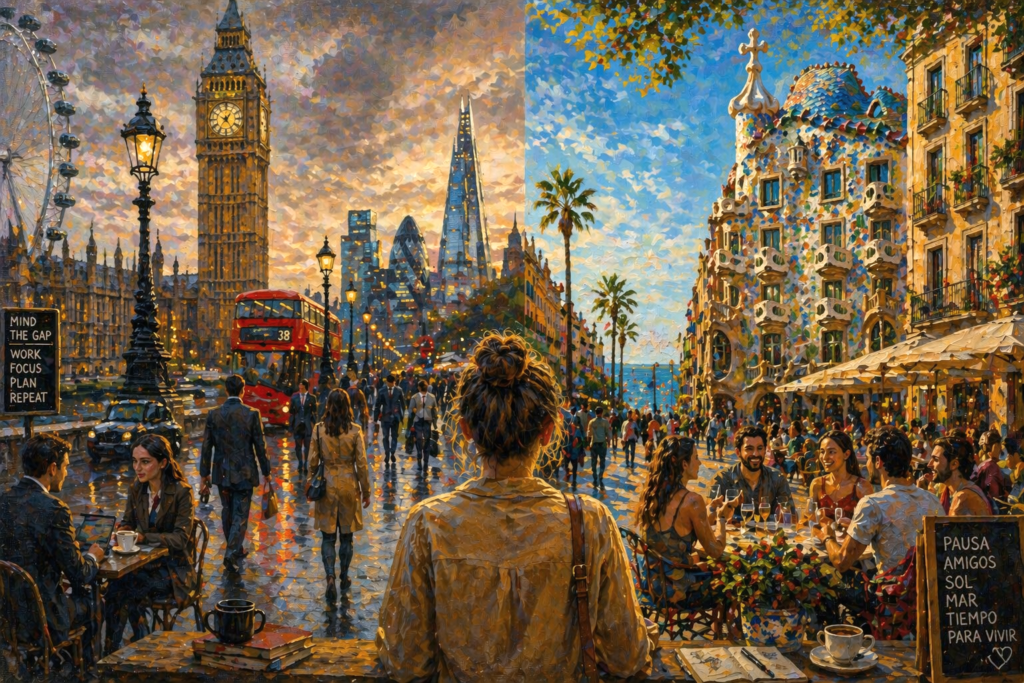

London vs Barcelona… Social life and culture reveals how radically different urban rhythms, social fabrics, and aesthetic environments co‑produce distinct versions of the self. Living in each city reshapes time perception, relationships, inner narratives, and identity through their contrasting pace, public spaces, and cultural expectations. (Barcelona vs. London – London Expats Guide)
- London and Barcelona generate different senses of time, productivity, and everyday meaning.
- Social life, intimacy, and belonging follow distinct cultural architectures in each city.
- Architecture, climate, and light subtly sculpt emotional tone and identity narratives.
Framing The Noesis Of Place And Self
To ask how London’s social life and culture differ from Barcelona is, at depth, is like to ask a noetic question: how does a city participate in what and who we become?
Noesis here means more than perception. It is the way knowledge, feeling, and meaning arise from our embeddedness in a specific environment. A city is not just a backdrop; it is a co‑author of our epistemology of everyday life.
London and Barcelona are ideal case studies. Both are global, creative, historically layered. Yet their temporal rhythms, social expectations, public spaces, and sensory atmospheres diverge so strongly that, over time, they can produce recognizably different inner selves.
The comparative lens is not about deciding which city is “better.” It is about uncovering how each one configures time, social life, space, and inner state and how, in turn, these configurations shape identity.
Time And Pace: Acceleration And Mediterranean Rhythm
Every city teaches a philosophy of time. London’s teaching is acceleration; Barcelona’s is rhythm.
London’s Compressed Hours
London is one of Europe’s largest metropolitan areas, with a population exceeding 9 million in the wider urban region. High wages, high costs, and global competition combine into what sociologists call a culture of “time scarcity.”
Average commute times frequently hover around 40–45 minutes one way, with many residents spending over an hour crossing the city by Underground or rail. The working week, while nominally similar to the European norm, often extends through long office hours, after‑work networking, and side projects in creative or entrepreneurial fields.
This compression of time produces a particular inner stance:
- Time as a resource to optimize. The day becomes a puzzle of slots: commute, gym, meetings, “quality time.”
- Acceleration as identity. Busyness becomes an implicit status marker, a sign of being in demand, connected, relevant.
- Fragmented attention. Moving across zones, platforms, and roles encourages a multi‑tabbed consciousness, constantly switching but rarely dwelling.
London invites you to know the world through speed: rapid scanning, constant updating, perpetual becoming.
Barcelona’s Layered Tempo
Barcelona, with a city population of roughly 1.6 million and a metropolitan region of about 5 million, offers a different temporal script. The workday may also be long, and tourism and service industries can be intense, but the Mediterranean structure of time persists.
Lunch remains a central, often elongated ritual. Many shops historically closed for a mid‑day break; while this is fading, the cultural memory remains embedded in expectations around meals, rest, and socializing. Evenings stretch into the late hours, with public spaces animated long after midnight, especially in warmer months.
This produces another kind of inner state:
- Time as cyclical and relational. Meals anchor the day as social, not merely functional, events.
- Pace as texture. Moments of slowness—coffee on a terrace, walking by the sea—are not deviations but integral parts of the day.
- Presence over optimization. There is more cultural permission to linger, to repeat encounters, to be.
Here, knowledge of the city emerges from rhythm: revisiting the same streets at different hours, watching light and conversation shift across the day.
Temporal Identity
Over years, these temporal epistemologies become self‑concepts. The London self may learn to narrate identity as projects, goals, and milestones. The Barcelona self may narrate identity more as seasons, relationships, and recurring rituals.
Neither is essential; each is co‑created by the city’s infrastructure, climate, and economic structure—and by our willingness to internalize or resist them.
Social Life, Networks, And Belonging
If time is one axis of identity, social architecture is another. London and Barcelona build different social selves.
London: Networked Individualism
London’s social life is dense but distributed. With millions of inhabitants, diverse neighborhoods, and a high degree of professional mobility, friendships tend to organize around networks rather than tightly bounded communities.
Characteristics often observed:
- Multiplicity of circles. Work friends, creative collaborators, flatmates, diaspora communities, hobby groups—each with partial overlap.
- Planned encounters. Diaries fill weeks in advance; spontaneity exists, but often within scheduled windows.
- Polite distance. In public transport and streets, there is a tacit norm of non‑intrusion; intimacy is reserved for chosen spaces.
This can produce a strong sense of freedom and reinvention: you can continually curate your social world. It can also generate subtle loneliness, where connections are many but spread thin across space and time.
Barcelona: Proximity And Repetition
Barcelona’s scale and urban design foster another social architecture. With a more compact core and a high density of bars, plazas, and local markets, daily life repeatedly crosses the same paths.
Common features include:
- Neighborhood recognition. The barista, the neighbor, the kiosk owner—faces recur, small talk accumulates into familiarity.
- Collective public life. Squares, rambla‑like streets, and the seafront act as social condensers, where different social circles overlap physically, not just digitally.
- Embeddedness in language and custom. Catalan and Spanish dynamics, local festivals, and traditions invite participation in a shared symbolic world.
Here, belonging often feels thicker but more locally bounded. Identity is less about curating far‑flung networks and more about deepening proximity.
Social Architectures Of The Self
In London, you may increasingly think of yourself as a node in multiple networks—a flexible, adaptive, portable self. In Barcelona, you may experience yourself more as a situated presence—rooted in neighborhood, language, and recurring encounters.
Space, Light, And The Aesthetics Of Everyday Experience
Architecture and public space are not just visual. They recalibrate cognition and emotion.
London’s built environment is polyphonic: glass towers in the City, Victorian terraces, concrete estates, expansive parks. Barcelona is more overtly designed as a continuous urban fabric, from Cerdà’s Eixample grid to Gaudí’s organic interventions and the linearity of the seafront.
Comparative Spatial Qualities
| Dimension | London | Barcelona |
|---|---|---|
| Population Density (city) | Lower than Barcelona’s core in many boroughs | Among the highest in Europe in central districts |
| Urban Form | Polycentric, irregular, often sprawling | Compact grid plus medieval core and seafront axis |
| Green Space Access | Large royal parks and commons distributed across city | Fewer huge parks; many smaller plazas and urban beaches |
| Light And Climate | More overcast, shorter sunny seasons | More daylight hours, frequent sun, Mediterranean climate |
These qualitative differences shape noesis in daily life.
London: Pockets Of Escape
London’s great parks—Hyde Park, Hampstead Heath, Greenwich Park—offer immersive green refuges. Yet they are often separated from where many work and live by significant commutes. The aesthetic contrast between dense, grey commuting routes and expansive greenery can create a rhythm of tension and release.
Architecturally, the coexistence of historical and hyper‑modern buildings stimulates a sense of temporal layering. You are constantly moving between epochs. Cognitively, this can foster a heightened sense of historical consciousness and possibility, but also fragmentation.
Barcelona: Continuous Public Stage
In Barcelona, public space flows more continuously. The Eixample’s chamfered corners, abundant balconies, and ground‑floor cafes create a semi‑porous boundary between private and public life. The sea is not a distant horizon but an accessible daily presence.
Light plays a critical role. Mediterranean brightness sharpens edges, saturates color, and extends outdoor hours. Increased exposure to natural light is associated with improved mood and circadian regulation, subtly influencing well‑being and attention.
The result is an everyday aesthetic where the city feels like an ongoing performance in which residents are both audience and actors.
Cultivating Conscious Curiosity Between Cities
If cities help create us, how can we participate more consciously in that creation—especially when moving between places like London and Barcelona?
1. Observe Your Temporal Script
Notice how your day is structured.
- In London, where do you feel time compress? Commutes, inboxes, social obligations—what would it mean to protect small pockets of slowness within that acceleration?
- In Barcelona, where do you genuinely slow down, and where do you still import hurried habits from elsewhere?
2. Map Your Social Architecture
Draw a simple map of your current social world: circles, overlaps, distances.
- Are you living as a networked individual, constantly shifting between groups, as in much of London life?
- Or as a neighbor among neighbors, rooted in a few dense ties, as Barcelona often encourages?
Choose which architecture supports the kind of self you wish to become, rather than defaulting to the city’s strongest pulls.
3. Attend To Aesthetics And Atmosphere
Make a practice of aesthetic noticing.
- In London, observe how you feel in historical streets versus glass districts, in crowded tubes versus open parks.
- In Barcelona, track your state in narrow Gothic lanes, sunlit avenues, or by the sea.
Ask: which spaces sharpen my attention, which soften it, which restore it? Let this inform where you spend your most reflective hours.
4. Rewrite Your Inner Narrative
Finally, bring these observations into your self‑story.
Instead of saying “I am an anxious person” or “I am a relaxed person,” experiment with: “In London, I tend to become more accelerated; in Barcelona, I tend to become more spacious.”
This honors the interconnectedness between self and environment. It opens the possibility of deliberate experimentation: importing Barcelona’s rhythms into a London week, or London’s focus into a Barcelona afternoon.
Use London and Barcelona not simply as destinations or lifestyle choices, but as mirrors for noesis itself. By seeing how cities sculpt us, we awaken a more fluid, reflective relationship to who we are—and who, in dialogue with place, we might yet become.
Frequently Asked Questions
How does daily social life in London vs Barcelona differ for young professionals?
Social life in London centers on structured after-work drinking cultures, professional networking, and pre-planned weekend events necessitated by sprawling geography and long commutes. Conversely, Barcelona’s social life thrives on spontaneity and street-level interaction, where long dinners and plaza gatherings occur naturally within a rhythm that prioritizes present-moment connection over rigid scheduling and professional utility.
In what ways do London and Barcelona shape different senses of time and productivity?
London fosters a time-scarcity mindset where productivity is synonymous with speed, linear progress, and tightly packed calendars. Barcelona encourages a cyclical perception of time, integrating work with mandatory pauses like the midday break and extended social meals. This rhythm softens the boundary between labor and leisure, fostering a less hurried, more integrated daily existence focused on quality of life.
How do public spaces influence social connection in London vs Barcelona?
London’s social architecture is largely interior, revolving around pubs, cafes, and weather-protected cultural venues that favor curated, intimate groups. Barcelona’s urban design utilizes the street as a communal living room, with plazas, promenades, and beaches acting as democratic social stages. This promotes casual, high-frequency encounters that make social interaction a constant, effortless feature of the urban environment.
What are the key differences in how belonging and community are experienced in London and Barcelona?
Belonging in London is often found through elective affinities—specialized subcultures, niche hobbyist groups, and professional networks—resulting in a fragmented but diverse social experience. In Barcelona, belonging is deeply geographic and intergenerational, anchored in specific neighborhoods (barris) where shared public space and local festivities create a visible, stable sense of place-based community and collective identity.
How do architecture, light, and climate affect mood and identity in London vs Barcelona?
London’s variable light and dense environment often cultivate an “interior” identity, where overcast weather encourages introspection and a focus on private life. Barcelona’s intense sunlight and sea-facing orientation promote sensory openness, shaping an identity that is more outward-facing and performative, where mood is significantly influenced by consistent access to nature, vitamin D, and outdoor aesthetic stimulation.
Further Reading & Authoritative Sources
Authoritative Sources
- London vs Barcelona: Which European Gem Offers the Ultimate City Break? — Travel feature comparing London and Barcelona’s cultural attractions, food, nightlife, and general vibe, providing a narrative look at how each city feels socially and culturally.