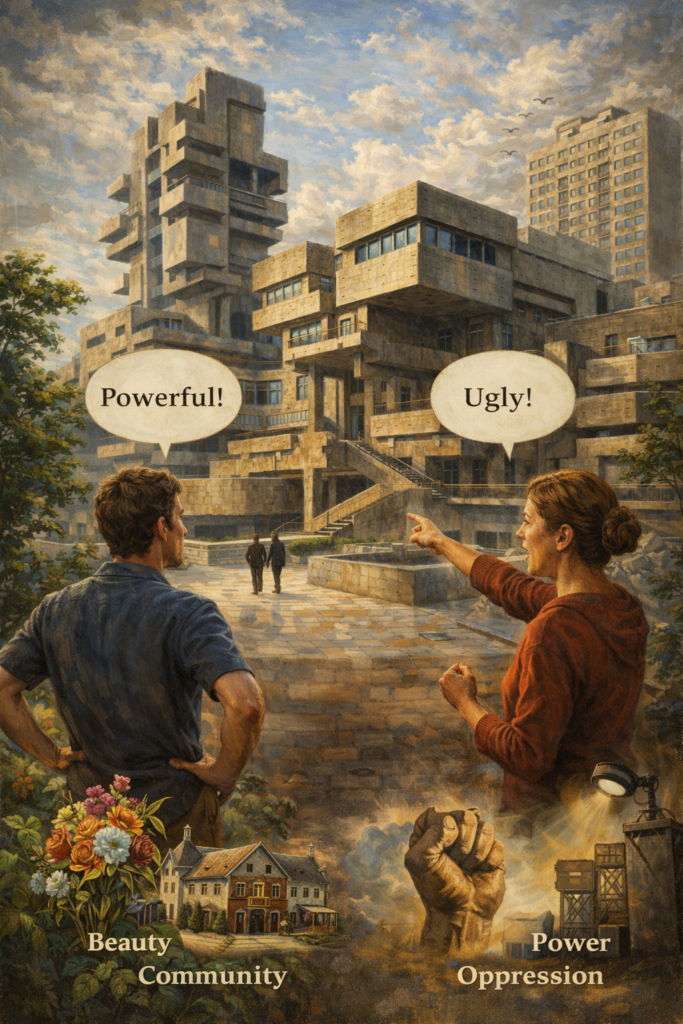

Brutalist architecture is a mid‑20th‑century movement defined by raw, exposed concrete, massive forms, and an ethic of structural honesty. It provokes intense division because its aesthetics, social history, and psychological impact collide, forcing us to question what we call beauty, power, community, and truth in the built world. (Why We Love/Hate Brutalist Architecture)
⚡ Key Takeaways
- Brutalist architecture exposes structure and material, challenging conventional expectations of beauty.
- Its association with post‑war reconstruction, welfare states, and authority deeply colors public memory.
- Our reactions to Brutalism reveal as much about modern consciousness as about concrete itself.
Brutalism As A Mirror Of The Shared Psyche
To stand before a Brutalist building is to confront a concrete Rorschach test. Some see serenity and ethical clarity; others sense oppression and fatigue.
Brutalist architecture crystallizes tensions at the heart of modern life: between idealism and disillusion, community and control, exposure and protection. It is an architecture that refuses to disappear into the background. Its very presence asks us what we expect from buildings: comfort, spectacle, shelter, truth, or perhaps absolution.
When we respond strongly to these structures, we reveal our own aesthetic upbringing, our class histories, our memories of institutions, and our anxieties about modernity. Brutalism becomes a stage on which our inner wisdom and our inherited judgments quietly wrestle.
Defining Brutalist Architecture And Its Raw Origins
The term Brutalist architecture emerged in the 1950s, rooted in the French phrase béton brut—“raw concrete”—used by Le Corbusier to describe unfinished concrete surfaces. British critics later adapted this into “New Brutalism,” naming a movement that valued:
- Exposed, unfinished materials (especially concrete)
- Clear legibility of structure and function
- Monumental, often block-like forms
- Minimal ornament, if any
- A sense of ethical “honesty” in revealing how buildings are made
Key early examples include Le Corbusier’s Unité d’Habitation in Marseille (completed 1952) and the work of Alison and Peter Smithson in Britain. Through the 1960s and 1970s, the style spread globally: university campuses, cultural centers, government buildings, and large-scale housing projects from Europe to Latin America and Asia took on its muscular geometries.
From its beginnings, Brutalism was more than a style. It claimed a moral stance: to reveal structure, to serve collective needs, and to resist what its proponents saw as superficial decoration. This ethical ambition partly explains why reactions to it are so charged; disagreement is not just about form, but about values.
Historical And Social Context: The Democratic Promise Of Concrete
Brutalism rose from the rubble of the Second World War. Many cities faced acute housing shortages and devastated infrastructure. Concrete—cheap, moldable, and structurally strong—offered a way to build quickly and at scale.
The movement aligned with late modernist optimism and, in many countries, with expanding welfare states. Vast social housing estates, new universities, and civic centers promised accessibility and equality. In this context, concrete symbolized a democratic material: the same substance could shape a small community hall or a national theater.
However, as decades passed, maintenance budgets shrank, social policies changed, and some estates suffered from neglect and underinvestment. The ideal of egalitarian space became, in many places, associated with visible decay and social marginalization.
In surveys in various European cities, residents often describe mid‑century concrete estates with words like “grey,” “unsafe,” or “forgotten” when maintenance is poor, while well‑maintained Brutalist cultural buildings are more likely to attract terms like “iconic” or “impressive.” History and social policy have etched divergent emotional scripts into similar forms.
Table: Myth And Reality In Public Perception Of Brutalism
| Aspect | Common Myth | Nuanced Reality |
|---|---|---|
| Social Housing Estates | “All Brutalist housing failed.” | Outcomes vary widely; management, policy, and maintenance are crucial factors. |
| Emotional Atmosphere | “Concrete is inherently depressing.” | Light, scale, greenery, and use strongly shape mood, even with concrete. |
| Symbolism Of Power | “Only authoritarian regimes used Brutalism.” | Democratic states, universities, and cultural projects also embraced Brutalism. |
| Aesthetic Intention | “It ignores beauty.” | It seeks a different beauty: structural clarity, weight, and material truth. |
| Public Opinion Over Time | “Everyone always hated it.” | Opinions have shifted; recent decades show rising appreciation and nostalgia. |
The historical layer thus becomes a palimpsest: under early ideals of social justice lie later experiences of neglect. Our feelings about Brutalism often track this arc from hope to ambivalence.
The Aesthetics Of Rawness And Exposure
A central reason Brutalist architecture divides opinion is its deliberate aesthetics of rawness. Instead of polished stone or decorative façades, we encounter:
- Rough concrete surfaces bearing the grain of wooden formwork
- Sharp, uncompromising geometries
- Heavy cantilevers and deep shadows
- Minimal color, often a monochrome grey
For some, this is a form of architectural truth-telling. Nothing is disguised; structure and service cores become part of the composition. The building appears almost geological—carved rather than composed—offering a kind of urban sublime.
For others, the same features read as hostile. The absence of ornament can feel like an absence of welcome. The sheer mass can evoke emotional weight rather than stability. Where one viewer senses honesty, another senses indifference.
Philosophically, Brutalism challenges a long Western tradition that linked beauty with harmony, proportion, and refined surface. It invites a different aesthetic category: the sublime of weight and the beauty of the unfinished. It asks us to reconsider how we know something as beautiful. Do we trust inherited canons, or can our intuition find grace in roughness?
Psychology Of Perception, Memory, And Scale
Our emotional response to a Brutalist space is filtered through memory and bodily experience.
- Scale: Huge concrete volumes, especially when close to the human body, can trigger awe or anxiety. Tall, windowless façades may feel like cliffs; generous light-filled atria can transform the same material into a calming presence.
- Light and shadow: Deep recesses and overhangs create strong contrasts. In bright sunlight, these can feel dramatic and sculptural; under low, overcast skies they may seem oppressive.
- Acoustic texture: Exposed concrete can amplify echoes, adding to a sense of institutional distance, or, in carefully designed spaces, a hushed, contemplative mood.
Studies of environmental perception suggest that people tend to prefer environments that balance complexity with coherence and provide clear cues of safety and orientation. Poorly lit passages, confusing layouts, and neglected surfaces—often linked to funding rather than form—can intensify negative responses.
Memory deepens this. Someone whose childhood home was a concrete estate may associate Brutalist architecture with warmth, play, and community. Another person who only encountered similar spaces as intimidating bureaucratic interiors might feel unease at first glance. Our intuition is not purely visual; it is biographical.
Power, Politics, And Class Inscribed In Concrete
Brutalist architecture is inseparable from questions of power. Many of its most prominent expressions housed institutions: universities, city halls, courthouses, state broadcasting centers. Others formed large social housing complexes.
This dual life—home of the citizen and face of the state—means that class and authority are embedded in the style’s reception.
- For residents of social housing, concrete blocks can symbolize both shelter granted and care withheld. When lifts fail, façades crack, or communal areas become neglected, architectural blame often layers over policy failure.
- For those who encountered Brutalism as the architecture of bureaucracy, its mass may echo the impersonality of distant systems.
Critiques that label Brutalism “authoritarian” often arise from such experiences, even when the original design intentions were socially progressive. Conversely, some architects and historians defend these buildings as monuments to a time when the public realm still commanded visionary budgets.
The result is a style that carries class-coded and political associations. When we call a Brutalist building “ugly,” we may also be, however unconsciously, judging the social projects it once embodied.
Metaphysical And Symbolic Readings Of Concrete
Beyond social history, Brutalism invites metaphysical reflection. Concrete appears solid and permanent, yet it cracks, stains, and weathers visibly.
Symbolically, this creates tensions:
- Permanence and fragility: Vast walls suggest endurance, but fractures and water marks reveal vulnerability. We are reminded that even our heaviest constructs are temporary.
- Exposure and protection: Exposed structure is both a shield and a confession. Nothing is hidden, yet nothing is softened.
- Matter and meaning: The insistence on raw material foregrounds the question: how does matter become meaningful? When does a bare slab of concrete become a bearer of memory?
In this sense, Brutalist architecture can be read as a built meditation on modernity itself—bold, rational, technologically confident, yet streaked with signs of decay.
Noesis In The City: Re‑Encountering “Unloved” Buildings
The most fertile question is not “Is Brutalism beautiful?” but “What happens in our consciousness when we stand before it?” This is where conscious curiosity enters.
To practice reflective seeing in the city is to pause before a building we think we dislike and ask:
- What in this façade unsettles me—scale, color, association, neglect?
- Which memories, stories, or media images shape my reaction?
- What details emerge if I look beyond first impression: joints, rhythms, plays of light?
Such questions do not demand that we convert dislike into admiration. Instead, they transform impulsive judgment into considered perception. The building becomes a site for inner dialogue, not merely an object of taste.
In this way, Brutalist architecture can train a kind of urban wisdom: an ability to distinguish between the discomfort of genuine oppression and the discomfort that arises when our aesthetic habits are stretched.
What Our Reactions Reveal About Beauty And Modern Life
Our judgments of Brutalist architecture are, in the end, reflections of ourselves.
If we dismiss such buildings as irredeemably ugly, we might ask: What forms of beauty feel endangered in our lives—warmth, ornament, softness—and how do we wish cities to embody them? If we champion Brutalism uncritically, we might ask whether our fascination with rawness risks overlooking lived hardship within these walls.
The deeper invitation is to let these massive structures awaken subtle insight. They remind us that beauty is not a fixed canon but an evolving dialogue between matter and mind, history and hope. They show that inner wisdom grows when we hold tension rather than resolve it too quickly—between admiration and discomfort, solidity and decay, idealism and critique.
Brutalist architecture will likely continue to divide opinion. Yet if we approach it with conscious curiosity, it can also unite us in a shared practice: learning to see more fully, to feel more honestly, and to think about our built world with both rigor and compassion.
Frequently Asked Questions
Why does brutalist architecture often evoke such strong emotional reactions?
Brutalist architecture confronts viewers with massive forms, exposed concrete, and little visual softness, triggering instinctive responses linked to safety, authority, and past experiences with institutions. Its stark honesty and scale can feel either reassuringly solid or oppressively impersonal, depending on an individual’s personal memory, class background, and specific cultural context.
How did post-war politics influence the rise of brutalist architecture?
After World War II, governments embraced brutalist architecture for public housing and civic buildings because concrete was affordable, durable, and symbolically democratic. These structures represented the strength of the welfare state and collective provision. However, these same links to bureaucracy and centralized authority continue to shape public perception of the style today.
Why is raw concrete considered the defining element of brutalist design?
Raw concrete, or béton brut, allows architects to create sculptural forms while revealing the building’s true texture and construction process. This material choice embodies an ethic of “honesty,” where the structure is never hidden by decorative facades. Its inherent heaviness and permanence also reinforce themes of social ambition, power, and architectural endurance.
How do scale and proportion in brutalist architecture affect the human experience?
Brutalist buildings utilize oversized volumes, deep shadows, and heavy cantilevers to create a sense of monumental shelter or institutional dominance. Large, repetitive elements emphasize collectivity over the individual, while the contrast between compressed interior entrances and vast exterior plazas can intensify psychological tensions between a sense of security and exposure.
What is the difference between Brutalist architecture and International Style modernism?
While International Style modernism prioritizes glass, steel, and weightless surfaces, Brutalist architecture emphasizes raw concrete and massive, sculptural forms. Brutalism rejects the smooth, machine-like finish of early modernism in favor of rugged textures and exposed structural elements, aiming for a grounded sense of permanence that highlights the building’s physical weight and construction.
Further Reading & Authoritative Sources
From thenoetik