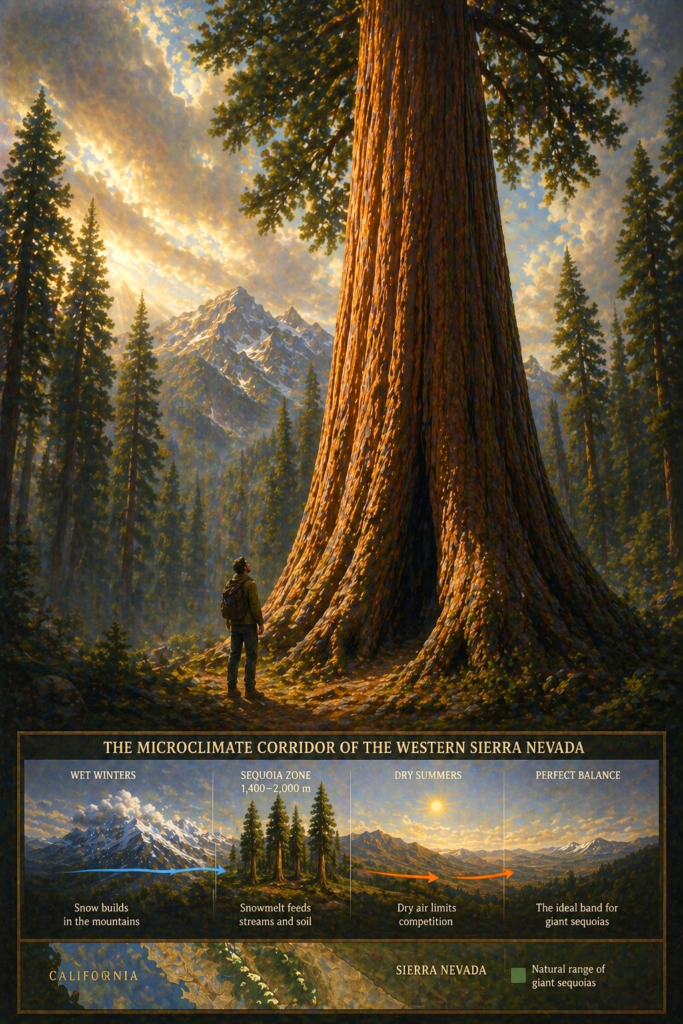

The reason giant sequoias only grow in California’s mountains is a story of an exceptionally narrow microclimate corridor on the western Sierra Nevada: a specific elevation band, winter snowpack, dry summers, fog, and well-drained soils that together create both their rare habitat and our disorienting experience of scale.(Giant Sequoias and Climate – Sequoia & Kings Canyon National Parks (U.S. National Park Service))
⚡ Key Takeaways
- Giant sequoias survive inside a very narrow microclimate corridor on Earth.
- Their extreme height and mass exceed our intuitive sense of vertical scale.
- Grove architecture and light create an experiential amplifier of otherworldly size.
Paradox of a Tree That Feels Almost Unreal
Encountering a giant sequoia in person can feel like a small tear in reality. You step into a grove, look up, and your usual sense of scale refuses to cooperate. The mind knows it is a tree; the body, somehow, does not quite believe it. According to Nps, this analysis holds true.
At the same time, this species is astonishingly provincial. For all their planetary presence in photographs and imagination, wild giant sequoias occur naturally only on a thin belt of the western Sierra Nevada in California. Almost nowhere else on Earth offers what they require.
This double paradox—almost nowhere, yet seemingly beyond the world we know—makes sequoias a powerful lens: an invitation to awaken conscious curiosity about how geography, climate, and perception weave together to shape our inner experience of place.
The Microclimate Corridor on the Western Sierra Nevada
To understand why giant sequoias are restricted to this region, it helps to picture a sloping mountain wall facing the Pacific. The western flank of the Sierra Nevada rises from low foothills to high alpine ridges. Somewhere in the middle, roughly between 1,400 and 2,000 meters above sea level, a narrow band of conditions aligns with unusual precision.
This is the microclimate corridor of the sequoias.
Altitude and the Tempered Middle
Too low on the slope, winters are mild and wet but not cold enough for reliable snowpack. Too high, winters are harsh and prolonged, and young trees risk damage from deep, persistent snow and intense storms.
Giant sequoias thrive in the temperate middle. In this band, winters are cold enough for substantial snow, yet not so extreme as to routinely break or smother them. Summers are warm and dry, but not desert-like. The altitude acts like a tuning dial, setting temperature ranges and seasonal rhythms within a narrow sweet spot.
Snowpack, Summer Drought, and Slow Release
The western Sierra Nevada experiences a Mediterranean pattern: wet winters, dry summers. For sequoias, the key is not just the total water, but the timing and storage.
Winter storms pile snow high in the mid-elevation belt. That snowpack is a natural reservoir. As it slowly melts through spring and early summer, it feeds streams and seeps into the soils around the sequoia groves. While surrounding forests face the beginning of drought, sequoia roots still sip from this delayed pulse.
By late summer, conditions become dry enough to allow the low-intensity fires that historically cleared competing vegetation and opened cones, yet not so arid as to kill these massive trees. The corridor provides a seasonal choreography: abundance, release, then careful stress.
Fog, Moist Air, and Gentle Extremes
Although the big fog banks roll inland more dramatically in coastal redwood country, moist Pacific air still plays a role higher inland. The west-facing slope intercepts storm systems and moist air masses. In the sequoia belt, this can moderate temperature swings and reduce desiccation.
The result is a world of gentler extremes: high enough for snow, exposed enough for summer dryness, yet cushioned by periodic moisture from the atmosphere. Other mountain belts on Earth may share some of these traits, but this particular combination—Mediterranean seasonality, dependable snowpack, and this exact thermal profile—is rare.
Soils, Drainage, and Room for Colossi
Sequoias favor deep, well-drained, often granitic-derived substrates that can host extensive root systems. Their roots are shallow for such large beings, but they spread wide, needing stable, aerated ground rather than waterlogged or thin soils.
The western Sierra offers broad benches and slopes where erosion has carved platforms of suitable depth, and where drainage channels move water through rather than letting it stagnate. Here, roots can fan out in all directions, anchoring hundreds of tons of living wood.
Taken together, this corridor is less a single factor and more an orchestra: altitude, snowpack, summer drought, moist air, soil depth, and drainage playing in synchrony. This is why giant sequoias, as a wild presence, only grow in this Californian belt.
Geography of Scale and the Limits of Intuition
Once we stand among these trees, geography shifts into psychology. Our visual system evolved to navigate human-scale environments—forests, hills, buildings—not living columns rising 70 to 90 meters into the air.
Why Vertical Mass Confuses Us
We intuitively grasp horizontal distance: we walk it, measure it with our bodies. Vertical extent, especially extreme verticality, is different. Looking up compresses perspective. The top of a sequoia converges toward a single point in the sky; its true height collapses into a steep angle rather than a length we can visually “unroll.”
Our internal reference library—houses, other trees, city blocks—rarely includes living structures that immense. Without familiar comparison, our intuition misfires. We know, abstractly, that the tree is as tall as a high-rise building, but the visual field offers no reassuring everyday anchor.
Time, Growth, and Invisible Mass
The disorientation is also temporal. A sequoia can live for millennia. Its trunk is not just tall; it is densely layered time. We see bark and crown; we do not see the centuries of growth rings within.
Human perception is poor at estimating mass when it is stacked vertically and hidden. A mountain broadcasts its bulk in all directions; a sequoia compresses its mass into a tight vertical column. The result is a quiet cognitive dissonance.
This is the geography of scale: the way spatial forms exceed the intuitive frameworks our minds carry. In sequoia groves, that excess becomes palpable.
The Architecture of the Groves as Scale Amplifier
The disorientation does not arise from the trees alone. It is also reinforced by the architecture of the groves themselves.
Spacing and the Empty Middle
Giant sequoias rarely grow as a dense wall. In many groves, they appear as widely spaced pillars within a more usual forest of firs and pines. This spacing matters. (Sequoiadendron giganteum, giant sequoia – US Forest Service Fire Effects Information System) Giant Sequoias: Why They Only Grow in California’s Sierra Nevada The Giant Sequoia: Forest Giants That Defy Human Perception
Each tree is given room to stand as an individual presence. The gaps between them create a “negative space” that frames their outlines clearly. Our gaze can trace an unbroken line from buttressed base to distant crown without constant visual interruption.
That clarity intensifies their apparent isolation from the ordinary world. We do not register them as just part of a dense canopy; we register them as singular phenomena.
Light, Understory, and the Cathedral Effect
Historically, periodic low fires and the sequoias’ own shade created open understories. Even where modern conditions alter this, many groves still retain an airy, legible ground layer.
Light from the high canopy filters down in shafts and patches, illuminating massive trunks while leaving upper crowns in a soft, unreachable glow. The effect recalls a cathedral: tall verticals, dim heights, focused light.
This visual composition acts as a psychological amplifier. The openness lets us see the full vertical gesture of each tree, while the elevated light hints at a realm just beyond precise perception.
Topography as Quiet Stagecraft
The western Sierra groves often occupy gentle slopes, benches, or the shoulders of shallow basins. Approaching along a path, we may first glimpse a trunk from below, then rise to meet it at mid-height, then look across to other crowns.
Such movement shifts our vantage point continuously. The tree’s apparent size stretches and contracts as we walk, reminding us that our perception is not fixed.
In this sense, the grove is not only a habitat; it is an experiential architecture of scale—an ensemble of light, spacing, and terrain that invites our senses into deliberate confusion.
Noesis, Microclimate, and the Inner Geography of Place
The sequoia belt is more than a climatic curiosity. It is a living illustration of noesis: the deep, intuitive knowing that arises when intellect and perception align in a holistic perspective.
Scientific understanding tells us why giant sequoias only grow in California’s specific mountain band—the snowpack, the soils, the elevation. Aesthetic attention reveals how their groves manipulate light and space to unsettle us. Noesis emerges when we hold both at once.
In that moment, geography is no longer background. It becomes active, shaping consciousness. We realize that our inner landscapes—our sense of awe, smallness, disorientation—are co-authored by ridgelines, storm tracks, and grains of soil.
The trees feel no less extraordinary because we understand their corridor. Instead, understanding becomes a kind of reverence: an appreciation for how precisely Earth must arrange itself to host such beings.
Global Niches, Sacred Groves, and Shared Human Wonder
Although giant sequoias are tied to one Californian mountain belt, the pattern they represent—a rare ecological niche creating an outsized human response—is global.
Elsewhere, other narrow corridors host their own singular lifeforms and experiences. Think of ancient cedar groves on wet, wind-exposed coasts. High-altitude tree lines where the last twisted pines cling to rock. Pockets of cloud forest where moss, orchids, and mist turn a slope into an intimate cosmos.
Across many cultures, certain trees and groves become sacred: not as abstractions, but as specific, situated presences. Their power often arises from this same convergence of uniqueness and scale—whether spatial, temporal, or symbolic.
In that sense, standing among sequoias is not a purely local experience. It is one expression of a wider human pattern: encountering a landscape so finely tuned that it feels like a threshold between the familiar and the immeasurable.
Closing Insight: Learning to Notice Our Own Scale
To ask why giant sequoias only grow in California’s narrow mountain band is also to ask how a place can reconfigure our sense of reality.
The answer is not only in climate charts or growth rings, but in the recalibration that happens inside us when we walk among them. Geography bends light, air, water, and stone into conditions that support immense trees. Those same conditions bend our perception, stretching our intuition of size and time.
The invitation is simple: carry this awareness home. We may not live beside ancient giants, but every environment—an alley of city trees, a local hill, a courtyard garden—quietly shapes how we feel scale, distance, and possibility.
When we learn to see the microclimate corridors and perceptual architectures of our own daily surroundings, we practice noesis in its most accessible form: a conscious, curious alignment between the world’s subtle designs and the landscapes of our inner experience.
Frequently Asked Questions
Why Don’t Giant Sequoias Naturally Establish in Regions Like Oregon or Europe?
Giant sequoias fail to naturally establish in Oregon or Europe because those regions lack the Sierra Nevada’s unique combination of deep winter snowpack and bone-dry summers. While they can be planted ornamentally elsewhere, the wild ecosystem requires a specific seasonal rhythm and granitic soil drainage that is rarely replicated outside of California’s western slopes.
What Specific Elevation Range Defines the Narrow Belt Where Giant Sequoias Grow?
Giant sequoias are naturally restricted to a narrow elevation band between 4,500 and 7,000 feet (1,400 to 2,000 meters). Below this range, the climate is typically too warm and dry for saplings to survive; above it, the freezing temperatures and heavy snow loads become too physically damaging for the trees to reach maturity.
How Does Winter Snowpack Function as a Water Reservoir for These Trees?
The deep snowpack of the Sierra Nevada acts as a slow-release hydration system, melting gradually to feed the trees’ roots throughout California’s long, rainless summers. This reliable moisture source allows the trees to sustain their massive bulk in a Mediterranean climate that would otherwise be too dry to support such immense, thirsty vegetation.
What Unique Soil Conditions Are Required for Giant Sequoia Groves to Survive?
These trees require highly specific granitic, well-drained soils that are rich in minerals but porous enough to prevent root rot. This soil type, prevalent in the western Sierra Nevada, allows for the complex root networks needed to support trees weighing millions of pounds while ensuring water reaches the deep underground aquifers they rely on.
How Does the Sierra Nevada’s Summer Fog Affect Giant Sequoia Growth?
Frequent summer fog provides a critical cooling effect and supplemental moisture that reduces water loss through the needles. This helps giant sequoias maintain the massive internal water pressure required to pull moisture hundreds of feet into the air, a biological necessity that limits their natural range to this specific atmospheric mountain corridor.
Further Reading & Authoritative Sources
Authoritative Sources
- Biogeography of Giant Sequoia – U.S. Geological Survey (Deborah L. Elliott-Fisk) — USGS biogeography chapter that analyzes the natural range, environmental constraints, and historical factors that limit giant sequoias to California, directly addressing why their distribution is so restricted.