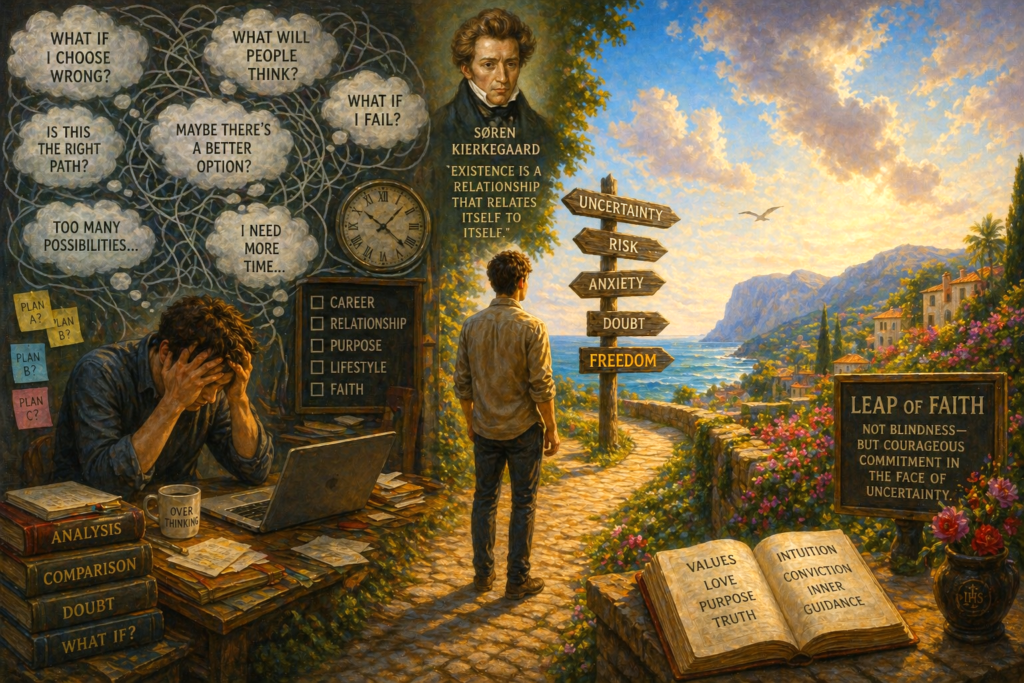

Overthinking your life is the habit of endlessly analyzing possibilities and risks until decisions feel impossible, action is delayed, and lived experience becomes thin. Kierkegaard’s leap of faith suggests that, beyond analysis, authentic life requires a courageous commitment in the face of uncertainty. (How to Stop Overthinking and Live Your Life)
- Overthinking your life intensifies existential anxiety when analysis replaces committed action.
- Kierkegaard’s leap of faith is not blind irrationality, but courageous decision under uncertainty.
- Noesis and intuition help balance rational thought with grounded, lived commitment.
When Thinking More Makes Life Feel Smaller
You refresh the same pages, reread the same messages, reopen the same life questions: which city, which partner, which work, which version of yourself. You are not lazy or indifferent. You are simply exhausted by possibilities. According to Plato, this analysis holds true.
In a world where you can compare every path, every belief, every identity, more information can quietly shrink your capacity to move. Overthinking your life begins to feel like responsible adulthood. Yet the more you analyze, the more distant real experience becomes.
This is the tension Søren Kierkegaard, a nineteenth‑century Danish thinker, placed at the center of philosophy: at some point, thought reaches its limit. The crucial question is not What is the perfectly justified choice? but Will you dare to choose at all?
Who Kierkegaard Is And Why He Matters Today
Kierkegaard (1813–1855) wrote in a small European city, long before digital feeds and global networks. Yet his concerns anticipate ours with uncanny clarity: anxiety, indecision, identity, and the difficulty of living as a singular person in a complex world.
He is often called a founder of existentialism. For him, philosophy was not an abstract puzzle but a question of how to exist. Concepts like subjectivity, inwardness, and choice were not side issues; they were the core.
Two of his insights feel strikingly contemporary:
- Truth as subjectivity: Some of the most important truths—about meaning, love, commitment—cannot be settled by detached, objective proof alone. They require how you exist, not just what you think.
- Anxiety as a sign of freedom: Anxiety is not only a disorder to be removed. It also reveals that you are free, standing before real possibilities that have not yet been fixed.
In an age of constant comparison, algorithms, and metrics, Kierkegaard’s insistence that existence cannot be outsourced to systems or crowds is deeply relevant. He is asking: What does it mean for you to live, not merely to observe?
What The Leap Of Faith Really Means
The phrase “leap of faith” is widely used, often as a casual cliché meaning “take a random risk.” Kierkegaard meant something more precise and demanding.
The Limit Of Pure Reason
For Kierkegaard, human existence includes questions that reason alone can never fully settle: Is my life meaningful? Is this love worth committing to? Is there a God? How should I orient my finite life toward what feels infinite?
Reason can clarify options, expose contradictions, and test coherence. Yet at some decisive point, you still face an unresolved gap. No argument can live for you. The last step is not a deduction but a decision.
The Leap As Existential Commitment
The leap of faith is not an invitation to ignore thought. It is the recognition that thought cannot remove uncertainty—and that refusing to choose is itself a hidden choice.
To leap is to:
- Acknowledge that you cannot have total proof or perfect guarantees.
- Accept anxiety as part of being free and finite.
- Commit yourself—ethically, relationally, or spiritually—despite that uncertainty.
Faith here is not only about religious doctrine. It is about existential trust: entrusting yourself to a path you cannot completely justify in advance, while remaining awake to its seriousness.
In this sense, the opposite of the leap of faith is not doubt; it is paralysis.
When Rationality Becomes Paralyzing
Overthinking your life begins with a noble impulse: to avoid error, harm, and regret. Modern life amplifies this impulse with unprecedented tools.
You can compare thousands of careers, lifestyles, spiritual paths, and political perspectives. You can watch people seemingly optimize every detail of their existence. Yet the more criteria you add, the more any decision feels premature.
Analysis Without End
Rational reflection becomes paralyzing when:
- Every choice must be “maximal.” You feel that anything less than the optimal life is failure.
- You demand certainty before commitment. You wait for a feeling of absolute clarity that never arrives.
- You treat yourself as an object to be perfectly engineered, not as a subject who grows through imperfect action.
Kierkegaard describes a figure who perpetually observes, analyzes, and postpones. This person knows many perspectives but belongs fully to none. Life becomes a series of experiments in where to stand, without ever standing anywhere.
Over time, this posture produces a subtle cruelty: you become a spectator of your own existence, criticizing from a distance while never risking yourself.
Noesis As A Bridge Between Intellect And Intuition
thenoetik takes its name from noesis, an ancient Greek term pointing to a deeper mode of understanding than mere calculation or opinion. Noesis is not irrational; it is a form of insight that unites intellect and intuition.
In the context of overthinking your life, noesis offers a bridge between Kierkegaard’s leap and your everyday decisions.
Beyond Calculation, Not Against It
Noetic insight respects analysis but does not become its prisoner. It asks:
- What does reason clarify here?
- What remains essentially uncertain, no matter how much data I add?
- What do my intuitions, values, and embodied experience reveal that pure abstraction cannot?
Where overthinking tries to eliminate risk, noesis acknowledges that meaningful choices are constitutively risky. It invites you to listen to:
- The quiet sense of orientation that emerges when you pause, rather than endlessly consume information.
- The resonance between a possible choice and your deeper values, not just external metrics.
- The subtle relief you feel when you imagine fully committing, even if fear is also present.
Subjective Truth And Inner Alignment
Kierkegaard’s notion of subjectivity aligns with noesis: truth is not only about external correctness; it is about how you are in relation to what you hold true. A belief you will not live for remains shallow, however elegantly reasoned.
To move from overthinking into noetic awareness is to ask: Can I live this? Not just Can I argue this?
Global And Cross‑Cultural Resonances
Kierkegaard wrote from within a Christian and European context, yet his concern with decision under uncertainty echoes across cultures.
Greek Wisdom: Between Logos And Noesis
Ancient Greek thought already wrestled with the limits of discursive reasoning (logos) and the need for a more immediate insight (noesis). Plato distinguishes between shifting opinions and a higher grasp of form; later traditions emphasize the cultivation of character, not only argument.
The Greek call to “know yourself” is not a demand for endless self‑analysis. It is a summons to align your life with what you recognize as worthy, through practice and commitment.
Eastern Traditions: Letting Go Of Control
Many Eastern philosophies also insist that the attempt to control every outcome intensifies suffering.
- In some Buddhist perspectives, clinging to certainty and fixed identities deepens anxiety. Insight involves seeing impermanence clearly, then acting compassionately within it.
- Certain strands of Daoist thought emphasize moving with the unfolding of life rather than forcing it into rigid plans. Wisdom is expressed in responsive action, not complete foresight.
These resonances do not erase differences. They simply show that across cultures, humans have recognized a shared tension: we long for security, yet life remains fluid, unpredictable, and partially opaque.
Kierkegaard’s leap of faith is one distinctive response to this tension—insisting that, rather than escaping uncertainty, we must choose within it.
Overthinking, Anxiety, And Commitment: A Conceptual Map
To clarify the terrain, it helps to distinguish some key ideas that often blur together when you are overthinking your life.
| Concept | Description | Risk When Isolated From Action |
|---|---|---|
| Rational Analysis | Weighing evidence, clarifying options, anticipating outcomes | Infinite postponement, fear of imperfect information |
| Existential Anxiety | Feeling of openness, possibility, and risk | Avoidance, numbing, or frantic search for guarantees |
| Noesis | Integrated insight uniting intellect and intuition | Ignored as “irrational” or drowned out by noise |
| Leap Of Faith | Committed choice amid unresolved uncertainty | Misread as reckless or blindly irrational |
| Lived Experience | What actually happens when you commit and act | Thinned out when life is replaced by constant planning |
This map suggests a shift: instead of trying to eliminate anxiety and uncertainty, the task is to integrate them into a more conscious, courageous way of choosing.
An Invitation To A More Courageous, Intuitive Way Of Choosing
Kierkegaard’s challenge, read through the lens of noesis, is both unsettling and liberating: the demand for total certainty is a refusal of your own freedom. Overthinking your life is not simply a mental habit; it is a way of withdrawing from existence.
To live is to risk being wrong, misunderstood, or disappointed. But it is also to awaken to forms of meaning that no theory, no dataset, no external authority can bestow on your behalf.
thenoetik invites you to explore this territory where intellect and intuition meet. Not by glorifying impulsiveness, and not by surrendering to paralyzing analysis, but by cultivating a more holistic perspective:
- Honor rational clarity.
- Welcome anxiety as a sign that your choices matter.
- Listen for noetic insight that arises when you pause the noise.
- Dare, when the time comes, to step where you cannot entirely see.
The leap of faith is not a single dramatic jump; it is a rhythm of living. Again and again, you stand before uncertainty and choose to exist, not merely to observe. In that movement, your life ceases to be a thought experiment and becomes, quietly and courageously, your own.
Frequently Asked Questions
How can you distinguish between productive reflection and overthinking your life?
You are likely overthinking your life when reflection no longer provides clarity but instead reopens settled decisions. Key indicators include looping through identical options, feeling increased anxiety during analysis, and delaying action for more information. This process suggests that life is being experienced in theory rather than through direct practice.
Why does overthinking your life lead to feelings of entrapment rather than freedom?
Overthinking your life narrows your world because your attention shifts from lived experience to imagined scenarios. Constant comparison of paths turns possibility into pressure. Instead of expanding freedom, endless analysis erodes confidence, making every choice feel inherently risky and every step reversible, which causes your sphere of action to shrink.
What does Kierkegaard mean by a leap of faith regarding life-changing decisions?
Kierkegaard’s leap of faith suggests that decisive commitments cannot be fully justified by logic in advance. When overthinking your life leads to paralysis, a leap means choosing with courage despite incomplete evidence. Responsibility then shifts from predicting outcomes to owning the decision, recognizing that meaning grows through action rather than certainty. Søren Kierkegaard
How does excessive rationality contribute to the cycle of overthinking your life?
Rationality becomes a trap when it treats every personal choice as a puzzle solvable only through more data. Overthinking your life in this mode seeks a risk-free, fully proven option that never arrives. Instead of guiding behavior, reason postpones it, turning potential freedom into a perpetual fear of making a mistake.
How do noesis and intuition help resolve the paralysis of overthinking your life?
Noesis, or direct insight, allows the intellect and intuition to work together. When overthinking your life, this balance involves using reason to clarify your options and then listening to embodied signals—such as values and gut sense—to commit. The mind does not shut down; it yields to a deeper, integrated knowing.
Further Reading & Authoritative Sources
Authoritative Sources
- Toxic Habits: Overthinking — Scientific American piece describing overthinking (rumination), why our minds get stuck in repetitive negative thought loops, and how this pattern undermines well‑being and effective decision‑making.