
The Dogger Bank incident was an October 1904 clash in the North Sea, when Russia’s Baltic Fleet, sailing to war in the Far East, mistakenly fired on British fishing trawlers it believed were enemy torpedo boats, killing and wounding civilians and triggering a serious Anglo-Russian diplomatic crisis.
⚡ Key Takeaways
- The Dogger Bank incident reveals how fear can distort perception and ignite conflict.
- Technological transition and limited information weakened noesis and sound naval judgment.
- Today’s sensor- and algorithm-driven systems repeat the same risks in new forms.
Night Over Dogger Bank
The North Sea, on the night of 21–22 October 1904, was a basin of darkened steel. Wind pressed low over the Dogger Bank fishing grounds as small British trawlers worked their nets in practiced rhythm, lanterns swaying like fragile constellations above the waves.
Out of that darkness, another constellation emerged: the Russian Baltic Fleet, exhausted, anxious, and heavily armed, feeling its way toward the Far East. Somewhere in the night, Russian officers believed, enemy torpedo boats lurked. Shapes on the horizon thickened with meaning. A flash, a light, a sudden movement—signals in the fog of war, waiting to be interpreted.
Within minutes, interpretation became catastrophe. Guns roared against unarmed trawlers. Water exploded with shellfire. Men hauling nets found themselves framed as enemies in a conflict they had never chosen. The Dogger Bank incident unfolded as a tragic lesson in how human perception, when clouded by fear and imperfect knowledge, can turn the quiet work of fishing into a battlefield.
Historical Context of the Dogger Bank Incident
To understand the Dogger Bank incident as more than an isolated error, we must situate it within the wider noesis of a troubled empire and a changing technological age.
In 1904, Russia was at war with Japan over influence in East Asia, especially Korea and Manchuria. Early in the conflict, Russia suffered serious naval setbacks. Its Pacific Squadron at Port Arthur was pinned down and damaged, and the empire’s strategic anxiety deepened.
In response, Russia dispatched the Baltic Fleet on a vast journey from Europe to the Far East, intending to reinforce its weakened forces. This fleet sailed with the weight of imperial hope—and of recent humiliation. Rumors and intelligence, some vague and some exaggerated, suggested that agile Japanese torpedo boats might attempt daring attacks even in European waters.
At the same time, naval warfare itself was in transition. Torpedoes, wireless telegraphy, and rapid-firing guns were reshaping the psychology of the sea. Torpedo craft, small and hard to detect, represented a new kind of threat: elusive, sudden, and unsettling to officers trained in an era of visible battle lines. The technology existed at the edges of reliable detection, creating a space where imagination, fear, and misperception could easily flourish.
Within this context, the Russian Baltic Fleet did not sail as a calm, contemplative force. It moved as an armada under psychological siege, its noesis narrowed by fear, its intuition primed to see danger in every ambiguous light.
The Dogger Bank Incident: What Happened
As the Baltic Fleet steamed through the North Sea toward the English Channel, it entered the Dogger Bank area, a well-known fishing ground for British trawlers from Hull and other ports.
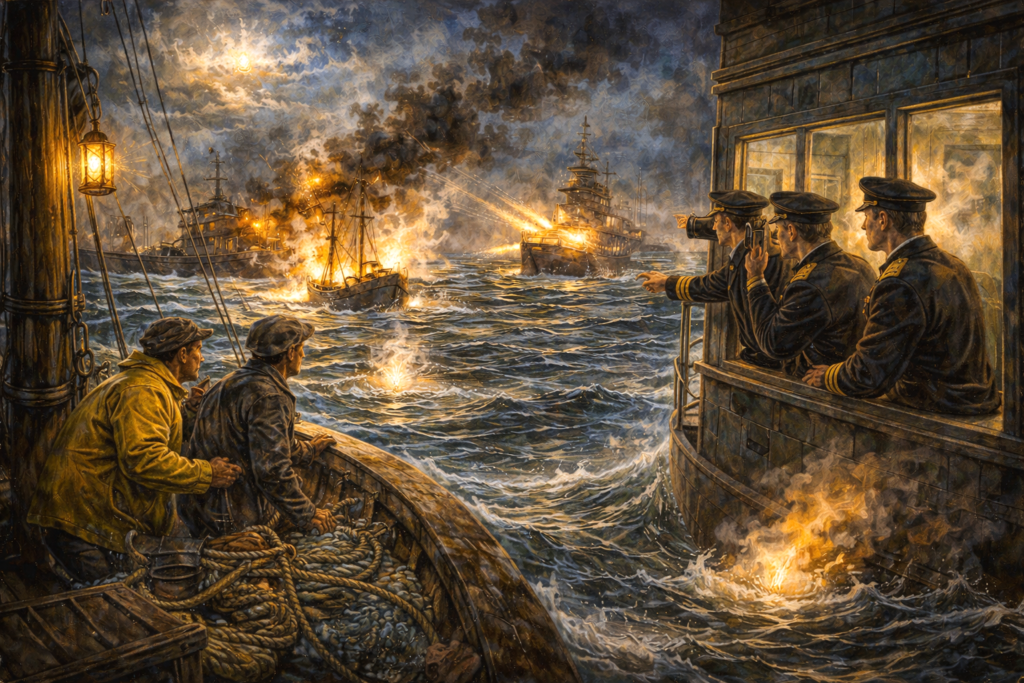
On the night of 21–22 October 1904, visibility was limited. British trawlers worked normally, their lights marking positions as they hauled and set their nets. To the fishermen, this was routine. To the Russian fleet, already filled with reports of possible enemy torpedo craft, every light on the water carried potential threat.
Russian lookouts reported suspicious vessels—interpreted as fast-moving torpedo boats. Alarm spread through the fleet. Commanders, fearing surprise attack, ordered fire. Heavy guns and small arms opened up on what were, in reality, unarmed fishing vessels.
The result was devastating for the trawlermen. One trawler was sunk; others were damaged. Several British fishermen were killed and many wounded. Amid the chaos, Russian ships reportedly even fired on one another in the confusion, underscoring how deeply perception had fractured.
The diplomatic fallout was immediate and grave. Britain, whose citizens had been attacked in home waters during peacetime, reacted with outrage. The prospect of war between Britain and Russia suddenly loomed. Yet both powers ultimately stepped back from the brink. An international commission of inquiry convened in Paris examined the incident, acknowledging Russian responsibility while recognizing the role of misidentification under stress.
The Dogger Bank incident thus stands as a moment when a misreading of signals on a dark sea briefly threatened to reshape global alliances and the trajectory of an already dangerous war.
Anatomy of a Misperception
What, precisely, failed at Dogger Bank? Beyond the mechanics of night signaling and gunnery, there was a collapse of noesis—of clear seeing and deep knowing in the midst of uncertainty.
Several strands wove together:
- Fear As A Lens
The Russian fleet sailed with heightened anxiety. They had been told to expect Japanese torpedo craft in unlikely places. Fear does not merely color perception; it organizes it. Ambiguous lights became enemies; routine fishing patterns became threatening maneuvers. - Ambiguous Signals
On a dark sea, lights and shadows provide sparse information. Fishing trawlers and small warships can look similar at distance, especially to already worried observers. The human mind completes patterns: where data is missing, imagination fills in the gaps. - Technological Transition
Torpedoes and modern naval guns extended both reach and vulnerability. New weapons created new risks but not yet reliable methods of identification. This mismatch between destructive capacity and perceptual clarity amplified the consequences of error. - Chain-Reaction Judgment
Once a few officers became convinced they were under attack, their conviction spread rapidly through the fleet. In high-stress situations, dissenting perceptions are easily suppressed, internally or externally.
In cognitive terms, we might describe this as confirmation bias, threat amplification, and pattern completion under stress. When consciousness is constricted by fear, noesis weakens. We see less, know less, and yet act more decisively.
The Dogger Bank incident is, in this sense, an anatomy lesson in misperception: a case where intellect gathered data, intuition raced ahead of reality, and both were governed not by conscious curiosity, but by a defensive imagination.
Intellect, Intuition, and Error
For thenoetik, the Dogger Bank incident becomes more than a historical episode; it is a meditation on the fragile union of intellect and intuition.
Intellect, in this context, includes the instruments of naval command: reports, orders, calculations, charts. Intuition is the felt sense of danger, the rapid judgment of officers on a darkened bridge, the immediate reading of lights and movements on the water.
At Dogger Bank, these two dimensions did not harmonize. Intuition was not the quiet, attentive listening of conscious curiosity; it was urgency shaped by fear. Intellect, rather than widening perception, reinforced a narrow expectation: the enemy is out there, therefore what we see must confirm it.
In a mature intellect–intuition union, intuition offers impressions and possibilities, while intellect tests them and searches for alternative explanations. Here, the process reversed. Intellect was captured by a single interpretive frame, and intuition became its echo, amplifying threat.
The moral question emerges: how do we assign responsibility when error is born from such a convergence of fear, limited information, and destructive capability? The inquiry commission acknowledged mistake, yet refrained from framing the actions as deliberate aggression. Still, lives were lost.
The incident thus speaks to a deeper ethical reality: our responsibility extends not only to what we intend, but to how we cultivate the inner conditions—mental, emotional, and technological—that shape our perception. When we carry weapons of great reach, our noesis must be equally far-reaching.
Closing Meditation: Listening to Signals in a Vast Sea
Return, in imagination, to the North Sea. The waves move as they did long before empires and wars. Light flickers on water. A ship’s bridge, a trawler’s deck, a human mind—each becomes a small observatory looking out into a cosmos of shifting signals.
The Dogger Bank incident reminds us that we are always interpreting. We read the gestures of others, the movements of markets, the tone of a message, the silence in a room. Each reading can be guided by fear or by conscious curiosity.
To live as thenoetik suggests is to let intellect and intuition meet not in panic, but in patience; not in projection, but in presence. It is to ask, again and again, in the face of ambiguous signals: What am I really seeing? What else might be true?
On that October night in 1904, over Dogger Bank, the sea carried both fishermen and warships. Today, the sea of information carries both wisdom and illusion. Our task is to deepen our noesis—to listen more carefully, to see more fully, and to act from a union of intellect and intuition that honors the lives, visible and invisible, moved by every choice we make.
In that sense, the Dogger Bank incident is not only a chapter in naval history. It is a standing invitation: to navigate the vast, shifting waters of our world with a more attentive mind, a more receptive heart, and a more integrated way of knowing.
Frequently Asked Questions
When Did the Dogger Bank Incident Occur and Where is the Dogger Bank Located?
The Dogger Bank incident occurred during the night of 21–22 October 1904 in the North Sea. Dogger Bank is a vast, shallow sandbank located approximately 60 to 100 miles off the east coast of England, historically serving as a vital commercial fishing ground for British and European trawler fleets.
What Caused the Russian Baltic Fleet to Fire on British Fishermen During the Dogger Bank Incident?
Exhausted Russian officers, fearing Japanese torpedo boat attacks thousands of miles from the Pacific, misidentified the flickering lights of British trawlers as enemy warships. Combined with dense fog and poor visibility, this paranoid atmosphere turned peaceful fishing vessels into perceived military targets, leading the panicked Russian fleet to open fire.
How Did the 1904 Dogger Bank Incident Almost Lead to War Between Britain and Russia?
The attack killed two fishermen and wounded others, sparking immense public fury in Britain. Since the Royal Navy was the world’s most powerful fleet, Britain mobilized for war, shadowing the Russian ships. Disaster was only averted through international arbitration at The Hague, resulting in Russia paying £65,000 in reparations to the victims.
What Role Did Technological Failure Play in the Dogger Bank Incident?
During the incident, primitive signaling and the lack of reliable wireless communication prevented the Russians from verifying their targets. The inability to distinguish civilian trawlers from military vessels through early 20th-century sensors created a lethal information gap, where frantic human intuition replaced disciplined identification protocols, resulting in a tragic and avoidable naval engagement.
How Does the Dogger Bank Incident Serve as a Warning for Modern Ai-Driven Warfare?
The incident highlights the danger of automation bias and misclassification in modern conflict. Just as Russian sailors misread shadows, today’s autonomous sensors and algorithms can misinterpret data, leading to rapid escalation. The 1904 event proves that even advanced technology remains vulnerable to human fear and the misinterpretation of ambiguous environmental signals.
Further Reading & Authoritative Sources
Authoritative Sources
- What Was The ‘North Sea Outrage’? — Article by BBC HistoryExtra (a reputable history publication) explaining the Dogger Bank incident—also known as the North Sea Outrage—its causes, course of events, and international repercussions.