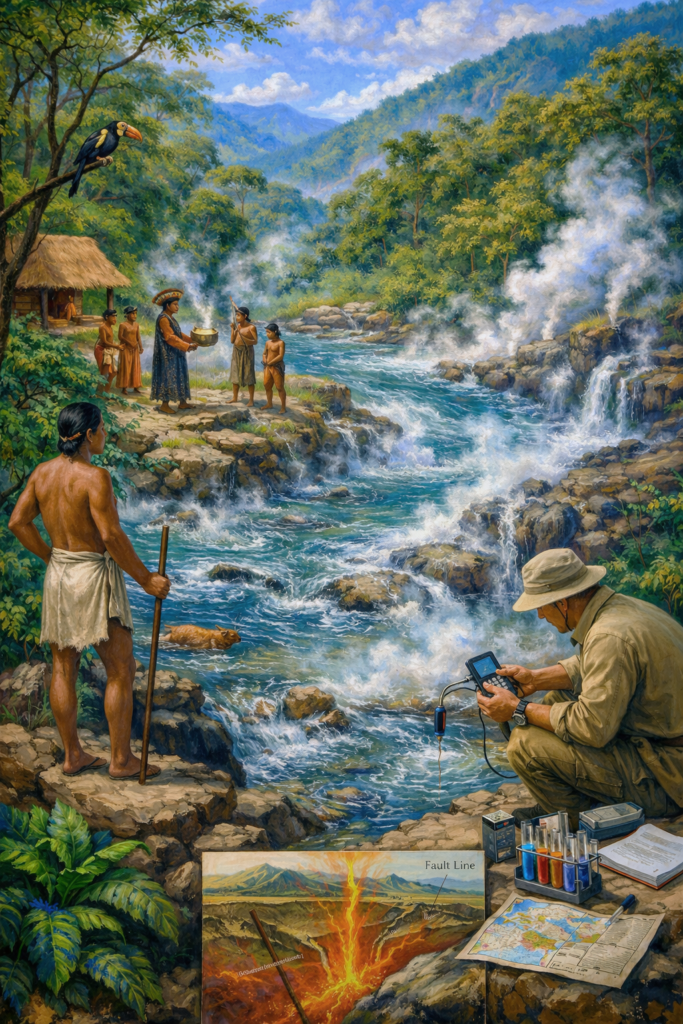

The boiling river of Peru is a rare Amazonian river system whose waters can approach 90–95°C despite lying far from active volcanoes. Its heat arises from deep geothermal circulation along faults, where groundwater is superheated underground and resurfaces through abundant hot springs that feed and transform the river. (Secrets of the Boiling River)
⚡ Key Takeaways
- A non‑volcanic hydrothermal system can heat an entire river close to boiling.
- Faults and deep groundwater circulation concentrate hidden geothermal energy in the Amazon.
- The river is both a fragile ecosystem and a living metaphor for inner intensity.
A River That Breaks Our Assumptions
In our default imagination, rivers cool the land: snowmelt, mountain streams, evaporative loss.
The boiling river of Peru overturns this expectation. In the Peruvian Amazon, far from smoking craters, a stretch of river runs so hot that small animals that fall in can be cooked. It invites a question: how can flowing water approach boiling without any nearby volcanic activity?
This question is scientific. It is also epistemological. It asks not only what the river is, but how we know what is possible for a river at all.
Geographical And Geological Context
The boiling river, often known as Shanay‑Timpishka, lies in the central Peruvian Amazon, within the Huánuco region. It flows through dense rainforest, a lowland landscape of humid air, broadleaf canopy, and thick sediments. (A Legendary Boiling River Flows Through the Amazon. Can It Be Saved?)
Crucially, it is located hundreds of kilometers from the nearest active volcanic centers of the Andes. On a classical map of global geothermal anomalies, one would expect intense hydrothermal rivers near volcanic arcs, subduction zones, or rift systems. Yet here, in apparently ordinary jungle, the water steams.
The broader geological setting offers clues. The Amazonian foreland basin is not simply flat sediment. It is crossed by faults and fractures, echoes of the immense tectonic compression from the Andean orogeny to the west. These deep structures can act as conduits, allowing groundwater to travel far below the surface, encounter hotter rocks at depth, and rise again.
The boiling river is therefore less an isolated curiosity and more a visible edge of an invisible network: fractures, aquifers, and geothermal gradients quietly at work beneath the forest.
The Science Of A Boiling River
To understand how the boiling river of Peru can almost reach 90°C without volcanic activity, we need three elements: geothermal gradient, deep groundwater circulation, and fault‑controlled hydrothermal flow.
Geothermal Gradient: Heat With Depth
Earth’s temperature increases with depth. A common global average is around 25–30°C per kilometer, though local values vary. At a few kilometers down, rock can be hot enough to significantly warm water.
On its own, this gradient is modest. The unusual behavior emerges when water circulates deeply and efficiently.
Deep Circulation: Water As A Heat Courier
Groundwater is not static. Through permeable rocks and fractures, it moves. In some systems, meteoric water—rainfall—percolates down many hundreds or even thousands of meters. As it descends, it acquires heat from surrounding rock.
If a structure then channels this hot water back upwards faster than it can cool, you obtain a hydrothermal system. The result is hot springs, fumaroles, or geysers in classic volcanic settings.
The boiling river appears to represent a non‑volcanic hydrothermal system. Here, deeply heated groundwater emerges in numerous springs along the valley, feeding the main channel with nearly boiling inflows.
Faults And Fractures: Hidden Architecture
Field investigations describe extensive fault and fracture networks in the area. These act as vertical highways for water and heat.
The emerging pattern is this:
- Rainwater infiltrates the ground in higher terrain.
- It moves downwards along permeable zones and faults, reaching depths where rock temperatures are sufficient to heat water close to boiling under pressure.
- The same or linked fault systems bring this pressurized, superheated water back toward the surface.
- As it rises and pressure decreases, the water can remain near boiling temperature and discharge as hot springs.
What makes the boiling river distinct is the scale of discharge. Instead of a few isolated springs, many high‑temperature inputs line the river, continuously feeding it and maintaining extreme temperatures over kilometers.
In essence, geothermal energy is not localized in a volcanic chamber but diffused in deep crustal rocks. Faults concentrate this energy, and the river reveals it.
Data And Observations From The River
Measurements along the boiling river show water temperatures often between 80°C and 90–95°C, especially close to major hot spring inputs. These values hover just below standard sea‑level boiling point (100°C), yet are already lethal to most organisms adapted to normal river conditions.
The river itself is not a narrow trickle. In some segments, it reaches widths of several meters and remains deep enough to form substantial pools. The flow is sufficient to carry heat downstream, meaning the water does not cool instantly but sustains high temperatures for extended stretches.
From a global perspective, such a system is extremely rare. Most hot rivers with comparable temperatures are directly tied to volcanic fields or active geothermal power areas. A non‑volcanic boiling river in a rainforest basin remains exceptional.
Qualitative Overview Of Key Features
| Aspect | Observation (Qualitative) |
|---|---|
| Location | Central Peruvian Amazon, Huánuco region |
| Proximity to Volcanoes | Hundreds of kilometers from active volcanic centers |
| Typical Water Temperature | Often 80–90°C, with peaks near 90–95°C near hot spring inlets |
| Heat Source | Non‑volcanic geothermal system along deep faults |
| Thermal Inputs | Multiple high‑temperature springs feeding the main channel |
| Global Rarity | Very few known analogues worldwide |
Cultural And Indigenous Perspectives
Before it was a subject of scientific measurement, the river was a place of meaning.
Locally, it is known as Shanay‑Timpishka, often translated as “boiled with the heat of the Sun” or in related senses, depending on the specific linguistic tradition. This name itself offers an epistemology: it links solar power, Earth’s interior, and flowing water in a single symbolic field.
For nearby Indigenous and local communities, the river is not only a geophysical anomaly. It is relational. It is embedded in stories, healing practices, and taboos. Some traditions regard its waters and vapors as spiritually potent, a threshold between ordinary and extraordinary states of being.
A respectful engagement with these perspectives does not try to reduce them to “precursors” of geology. Instead, it recognizes that multiple knowledge systems can coexist around the same river—hydrological, medicinal, spiritual, ecological.
In this sense, the boiling river of Peru is also a confluence of cosmologies. Scientific investigation arrives late in the story. It must learn to listen.
Interdisciplinary Insight And Noesis
The boiling river is an ideal case study for interdisciplinary learning.
From earth science, we learn about geothermal gradients, groundwater circulation, and the subtle power of faults. We see how a landscape we might call “flat rainforest” actually hides intense vertical exchange between surface and deep crust.
From epistemology, we see our initial assumptions exposed. Many observers once believed rivers this hot could only exist next to volcanoes. The discovery of Shanay‑Timpishka forced a revision. Knowledge is not a fixed map; it is a living process of correction.
From noesis, the direct apprehension of insight, we recognize a deeper movement. There is the data: temperatures, locations, flows. But there is also the realization that reality is more layered than our categories suggest. We move from curiosity as entertainment to conscious curiosity—a disciplined openness to what the world actually is.
The boiling river teaches three epistemic lessons:
- Anomalies Are Invitations. When a river contradicts our models, we are called to refine the model, not dismiss the river.
- Hidden Systems Matter. Much of Earth’s behavior is governed by structures we cannot see directly: faults, gradients, deep aquifers.
- Knowledge Is Situated. Local names, practices, and stories often mark places of real geophysical significance long before instruments arrive.
In the language of thenoetik, the river becomes a site where inner wisdom meets empirical inquiry.
Environmental And Ethical Reflections
The beauty of Shanay‑Timpishka is inseparable from its vulnerability.
The ecosystem around a boiling river is specialized. Extreme temperatures limit many forms of life, yet they also create niches for thermophilic microorganisms and particular plant communities adapted to heat and steam. Disturbance can erase lineages we have barely begun to understand.
At the same time, the river flows through a landscape touched by logging, development, and the pressures of global tourism. Scientific attention and media coverage, while valuable, can increase footfall and extraction.
This raises an ethical tension:
- Scientific Wonder seeks to measure, document, and share.
- Local Stewardship must protect, heal, and sometimes restrict.
An ethics aligned with conscious curiosity suggests several principles:
- Respect For Local Authority. Research agendas should be co‑designed with communities for whom the river is not a “site” but a neighbor.
- Minimal Impact. Field studies should be designed to reduce physical disturbance, pollution, and cultural disruption.
- Shared Benefit. Knowledge, conservation benefits, and any economic gains should circulate back to local guardians.
In this view, the responsibility of knowledge is not only accuracy. It is care.
Toward A Quiet Conclusion
The boiling river of Peru is not a riddle to be sensationalized. It is a precise, demanding teacher.
Geologically, it reveals the reach of Earth’s internal energy beyond volcanic frontiers. Hydrologically, it shows how deep circulation and structural pathways can rewrite our expectations of rivers. Culturally, it stands within a long lineage of Indigenous meaning‑making and local guardianship.
Philosophically, it asks us to examine how we know what we think we know. It reminds us that assumptions are often shallow, while reality flows from deeper strata.
For thenoetik, Shanay‑Timpishka becomes a figure of conscious curiosity. Knowledge is a river fed by many springs: measurement, myth, observation, reflection.
To honor such a place is to practice a quieter form of wonder. We acknowledge data and depth, science and story, outer heat and inner wisdom. We allow the world to remain more complex than our first explanations, and we let that complexity refine our own noesis.
In that sense, the boiling river of Peru is less an anomaly than a reminder. Beneath apparent stillness—in landscapes and in lives—there are currents we have yet to trace.
Frequently Asked Questions
Why does the boiling river of Peru reach near-boiling temperatures without nearby volcanoes?
The boiling river of Peru is heated by deep geothermal circulation along faults beneath the Amazonian foreland basin. Groundwater travels deep underground, encounters hotter rocks, becomes superheated, and then resurfaces through numerous hot springs that feed and transform the river, raising its temperature to a peak range of 90–95°C.
Where exactly is the boiling river of Peru located, and how far is it from volcanic activity?
Known locally as Shanay-Timpishka, the boiling river of Peru is located in the Mayantuyacu area of the Huánuco region. It flows through the central Amazonian lowland rainforest and is situated over 700 kilometers from the nearest active Andean volcanoes, making its intense hydrothermal activity geologically unique for non-volcanic settings.
What temperature range has been recorded in the boiling river of Peru by scientific measurements?
Scientific measurements of the boiling river of Peru have documented water temperatures consistently between 80°C and 90°C, with specific hotspots reaching up to 95°C. These extreme temperatures are high enough to lethally scald or cook small animals that fall into the river, creating a dangerous and fragile thermal ecosystem.
How do local Indigenous communities interpret and relate to the boiling river of Peru?
Local Indigenous communities, such as those at Mayantuyacu, regard the boiling river of Peru as a sacred, living entity protected by a powerful mother spirit. Traditional knowledge frames the river as a source of healing and medicine, guiding specific rituals and taboos that protect the site’s delicate ecological and spiritual balance.
What kind of data do researchers collect from the boiling river of Peru to study its geothermal system?
Geologists and researchers study the boiling river of Peru by collecting temperature profiles, measuring flow rates, and analyzing water isotopes. These datasets help map the subsurface plumbing of the Amazonian basin, revealing how superheated geothermal fluids mix with cooler surface waters to sustain the river’s extraordinary heat and energy flux.