
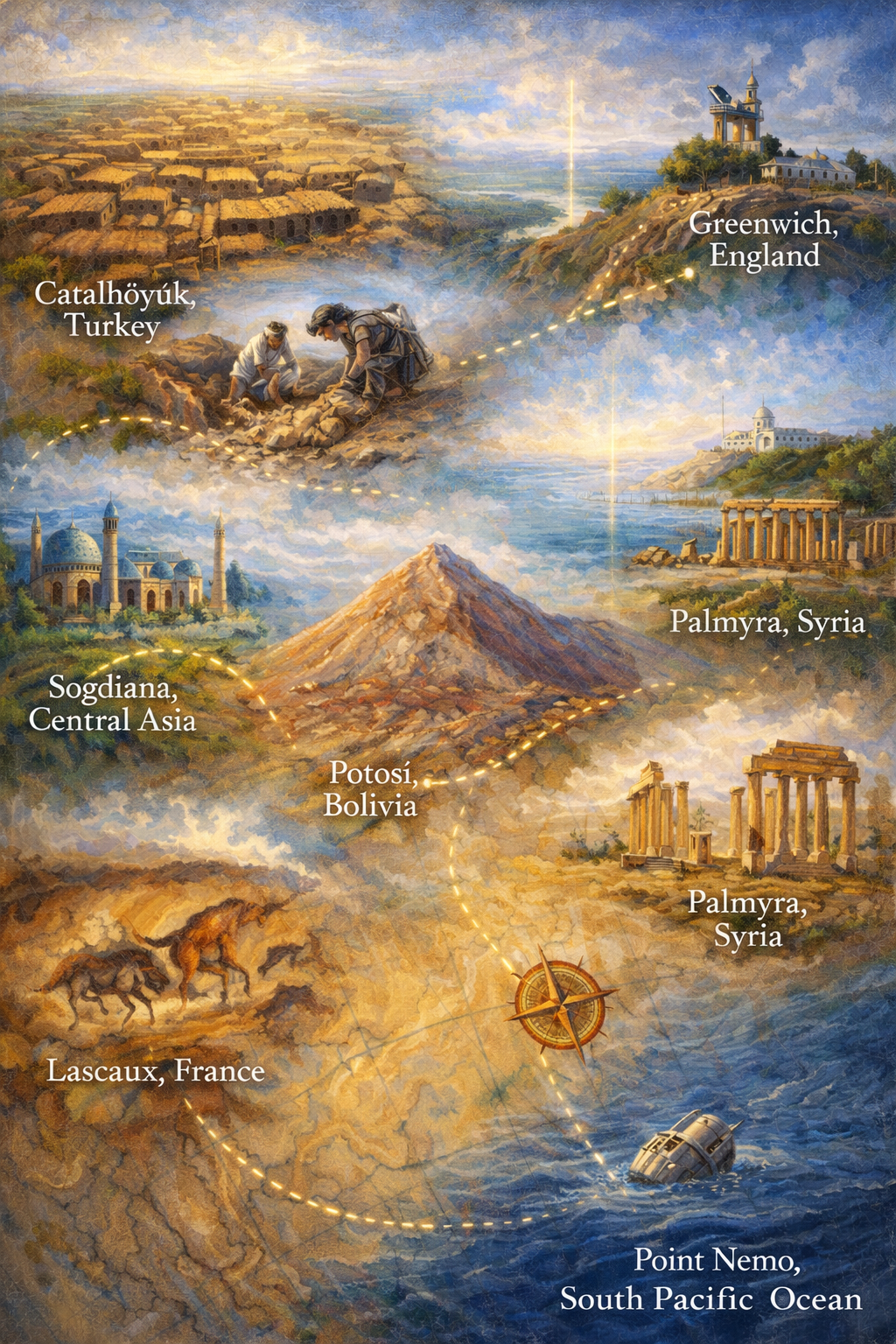
Unique places you’ve never heard of are often modest dots on the map whose stories shaped trade, language, science, and belief. They rarely appear in travel guides, yet they host turning points—thresholds where geography, history, and consciousness quietly rearranged how humans live and think.
Rethinking What Makes A Place Important
We are trained—by atlases, headlines, and airline routes—to believe that importance clusters in capitals, megacities, and tourist magnets. But the Earth’s history is full of modest harbors, river bends, laboratories, and villages that altered the trajectory of empires and ideas.
An airport departures board shows the world as a network of celebrity cities. Yet supply chains, languages, and scientific breakthroughs often hinge on towns most people could never find on a map. Importance, it turns out, is not the same as visibility.
This is an invitation to look again at the map, as if it were a palimpsest: beneath the bold names lie fainter inscriptions, places whose influence has seeped into your life without ever entering your awareness.
What Counts As An Important Place?
In this exploration, “important” does not mean glamorous, wealthy, or photogenic. Instead, these criteria guide the selection:
- Quiet systemic impact – The place anchors a trade route, scientific discovery, or cultural shift whose effects extend far beyond its borders.
- Relative obscurity – An educated, globally aware reader is unlikely to know much about it, if at all.
- Interdisciplinary resonance – Each location connects geography with at least one other domain: history, philosophy, science, language, or environment.
- Metaphorical power – Beyond facts, the place suggests a way of thinking about thresholds, networks, and the unseen forces shaping experience.
You will not find bucket lists here—no advice on where to stay or what to eat. Think of these as coordinates for contemplation: points on the planet that help connect larger patterns.
Eight Unique Places You’ve Never Heard Of
1. Çatalhöyük, Turkey – A City Before Cities
On a dusty plain in central Anatolia sits Çatalhöyük, a Neolithic settlement occupied around 7400–6200 BCE. From above, it looked less like a village than a honeycomb: houses pressed together, no streets, people entering through rooftop ladders.
Here, agriculture, ritual, and art converged in one of the earliest known dense settlements. Murals, figurines, and buried ancestors beneath floors suggest a world where home, shrine, and cemetery blurred into one.
Çatalhöyük reframes urban life as not just an economic shift, but a psychological experiment: What happens to human consciousness when we live wall-to-wall, sharing air, noise, and memory? Today’s high-rise apartments are distant echoes of this first crowded imagination.
2. Jebel Irhoud, Morocco – A New Edge Of Human Origins
For decades, East Africa held the spotlight as the cradle of our species. Then Jebel Irhoud, a rocky site in Morocco, complicated the picture. Fossils found there, dated to around 300,000 years ago, share key features with modern humans.
Geographically, Jebel Irhoud sits far from the usual origin stories. Conceptually, it stretches them. Instead of a single birthplace, we see a networked emergence of Homo sapiens across Africa.
The site acts as a reminder: origins are rarely a point; they are a field. On maps and in lives, we often seek one decisive beginning, when reality is usually a constellation of half-forgotten experiments.
3. Sogdiana, Central Asia – The Empire Between Empires
You will not fly to “Sogdiana”—it no longer exists as a country. Yet for centuries, this region (in parts of modern Uzbekistan, Tajikistan, and Kazakhstan) formed the connective tissue of the Silk Road.
Sogdian merchants carried silk, ideas, and scripts between China, Persia, India, and the Mediterranean. Their language left fingerprints across trade documents; their cities, like Samarkand and Bukhara, became crossroads of religion and science.
Sogdiana embodies the power of middle spaces. Empires claim glory, but intermediaries move meaning. Much of what we call globalization has always been stitched together by such in-between regions.
4. Potosí, Bolivia – The Mountain That Financed An Era
At over 4,000 meters in the Bolivian Andes rises Cerro Rico, “the rich mountain” overlooking Potosí. In the 16th and 17th centuries, it poured out silver on a scale so vast that a Spanish saying boasted one could build a bridge of silver from Potosí to Madrid.
Millions of Indigenous and enslaved African workers labored—and died—in its mines. The silver they extracted underwrote European wars, funded global trade, and helped create today’s world economy.
On most modern mental maps, Potosí is a blank. Yet every time we think in terms of global finance, resource extraction, or unequal exchange, we are moving through its long shadow. It is a reminder that wealth on one side of the world often has a specific, painful address on the other.
5. Palmyra, Syria – Desert Crossroads Of Memory
Palmyra, an oasis city in the Syrian desert, once linked East and West through caravan routes. Columns and colonnades rose among palms; Aramaic, Greek, and Arabic scripts shared stone and sky. It was a mesh of gods, styles, and stories.
Recent decades have seen Palmyra heavily damaged by war and iconoclasm. The ruins now embody both cosmopolitan past and fragile heritage—a place where the idea of civilization as shared inheritance meets the reality of loss.
Palmyra asks us: What happens when nodes of cultural memory are erased? Geography becomes not just space, but archive; to destroy such places is to edit human consciousness itself.
6. Greenwich, England – The Invisible Line You Live By
Greenwich is not exactly unknown, but its quiet authority is often unnoticed. From a hill above the Thames, observatory instruments once helped define the Prime Meridian and, later, Coordinated Universal Time.
That thin line—0° longitude—organizes world maps, time zones, and the way your calendar app syncs across continents. A local hill became a planetary metronome, turning a specific geography into a global reference frame.
Greenwich illustrates how conventions harden into reality. The world had to choose some meridian; it chose this one. Much of what feels “natural” in our mental maps is, at root, a negotiated decision nailed to a particular patch of ground.
7. Lascaux, France – A Cave Of Proto-Cinema
Hidden beneath southwestern France, the Lascaux cave complex holds Paleolithic paintings over 17,000 years old: bulls in motion, layered animals, flickering figures. When lit by torches, the images almost seem to move.
Archaeologists debate their purpose—ritual, teaching, storytelling—but few dispute their impact on how we imagine early human minds. Lascaux is a laboratory of attention, showing that long before screens, humans projected imagination onto walls.
This place collapses time. Our ancestors’ urge to represent movement, myth, and meaning in a confined dark space looks uncannily like an early version of our own media caves.
8. Point Nemo, South Pacific Ocean – The Middle Of Nowhere As Systemic Center
Point Nemo, in the remote South Pacific, is often called the oceanic “pole of inaccessibility”—the farthest point from any land. No permanent inhabitants, no monuments, only water and sky.
Yet this nowhere is strangely central. Space agencies target the region around Point Nemo as a spacecraft cemetery, dropping defunct satellites and stations into its depths. A spot defined by absence becomes a sink for the excess of our technological civilization.
Point Nemo is a mirror: when we look for the “middle of nowhere,” we often find the edge of our own systems—where we send what we cannot integrate elsewhere.
Patterns In The Quiet Places
These coordinates look scattered: a Turkish mound, a Moroccan hillside, a vanished Central Asian region, a Bolivian mining city, a Syrian oasis, an English hill, a French cave, a point in the Pacific. Yet certain patterns emerge.
Pattern | How It Appears In Places | What It Suggests About The World |
|---|---|---|
Thresholds | Çatalhöyük (village–city), Jebel Irhoud (old–modern humans) | Big shifts happen in liminal zones, not just famous events. |
Middle Spaces | Sogdiana, Palmyra | Intermediaries quietly carry culture more than dominant centers do. |
Hidden Infrastructure | Potosí, Greenwich | Systems of money and time rest on specific, often overlooked sites. |
Deep Time | Lascaux, Jebel Irhoud | Our present mind is layered over vast, older experiments in being human. |
Designed Forgetting | Point Nemo, Potosí | What we hide or discard geographically reveals what we avoid psychically. |
Looked at this way, geography becomes a map of relations, not just locations. These unique places you’ve never heard of are not random trivia; they are pressure points where networks, narratives, and norms clicked into new configurations.
Seeing Maps—And Yourself—Differently
What happens if we carry this way of seeing back to our everyday mental maps?
You may live near a logistics hub that silently feeds your city, an estuary that cleans its water, a research campus where an obscure experiment is slowly altering future medicine. High Mountain Asia: The Third Pole What is Point Nemo?
The pattern behind these places invites a shift in perception:
- Importance is often infrastructural. It lives in foundations, not façades.
- Visibility is a poor proxy for influence. Headlines spotlight noise, not necessarily signal.
- Thresholds shape us more than centers. We cross borders—physical, emotional, intellectual—more often than we stand at monuments.
Learning to notice obscure coordinates on the Earth is practice for noticing overlooked coordinates in your own life: the habits that quietly structure your days, the conversations that redirect your thinking, the forgotten teachers and small decisions that made you who you are.
Geography, in this sense, is an externalized psyche. Maps are mirrors. When we only value capitals and icons, we train ourselves to ignore the subtle workings of both planet and self.
Frequently Asked Questions
What are some examples of unique places you’ve never heard of that changed history?
Locations like the silver mines of Potosí or the remote trade junctions of the Silk Road represent unique places you’ve never heard of that redirected global wealth. These sites provided the raw materials or strategic positions necessary for empires to expand, despite their current lack of presence in modern travel itineraries.
What characteristics define unique places you’ve never heard of as historical turning points?
These locations typically function as geographical thresholds, such as mountain passes, river confluences, or remote islands. They serve as essential chokepoints for trade and migration. While they lack the population of megacities, their geographic necessity forced diverse cultures to interact, resulting in the quiet exchange of language, religion, and technology.
How do unique places you’ve never heard of differ from modern tourist landmarks?
Modern landmarks often represent the end result of historical shifts, whereas unique places you’ve never heard of are the origins. Landmarks focus on aesthetic appeal and preservation, while these obscure sites are defined by their functional utility—acting as the actual workshops or borderlands where global change was physically manufactured.
Why do the names of historically significant unique places often fade from memory?
Many unique places you’ve never heard of lose their prominence when technology or trade routes shift, such as the rise of aviation over maritime ports. Once their functional role as a network node is bypassed, their global influence becomes quiet, remaining embedded in the systems they helped create rather than maintaining fame.
What role do these obscure locations play in modern global supply chains?
Many unique places you’ve never heard of continue to anchor modern systems through undersea cable landings, satellite ground stations, or remote mineral deposits. While they remain invisible to the average traveler, these specific coordinates enable the global internet and energy grids, proving that geography still dictates the flow of power today.
Further Reading & Authoritative Sources
From thenoetik
- Sahara Desert Was Once a Sea — This article explores the geological history of the Sahara Desert, transforming a well-known location into a ‘unique place you’ve never heard of’ by revealing its past as a sea.
Authoritative Sources
- 10 Hidden Gems for Adventure Travel You’ve Never H — Adventure travel company blog highlighting geographically unique, lesser-known natural destinations around the world explicitly framed as hidden gems you’ve never heard of.
- Hidden Travel Gems: The Best Attractions You’ve Ne — Curated list of unusual, offbeat attractions and locations globally, explicitly described as tourist destinations you’ve likely never heard of.
- 12 Hidden European Gems: Off-the-Beaten-Path Wonde — Article focused on geographically important yet little-known European cities and regions, matching the theme of unique places you’ve never heard of.