
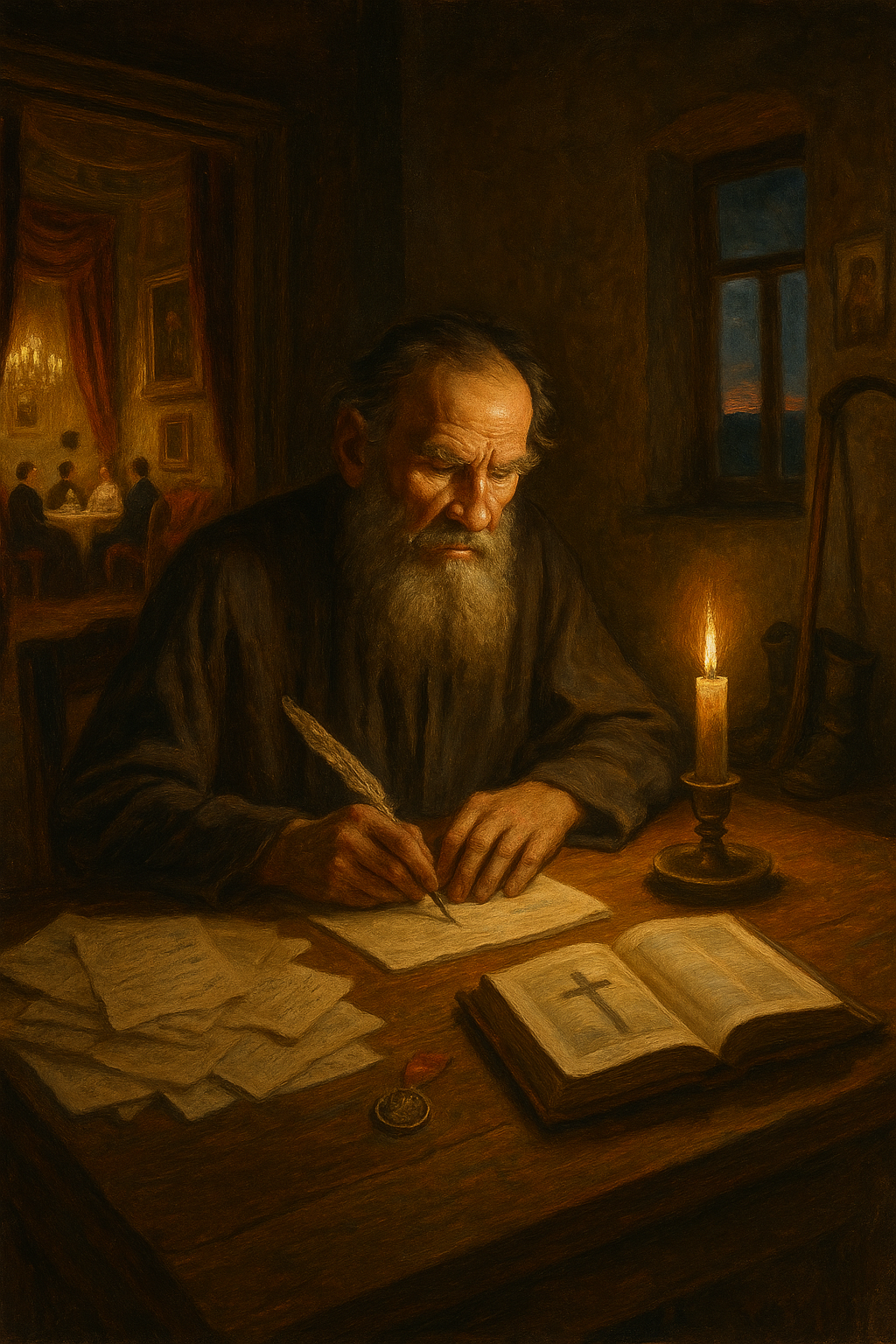
The Turning Point
Late one night after the applause for Anna Karenina settled, Leo Tolstoy asked a question that altered his life and work: what is the point of it all? This moment—commonly called the Tolstoy spiritual crisis—was not only personal but philosophical. Born of illness, insomnia, bereavement, and moral doubt, it produced Tolstoy’s philosophical conversion and reshaped his priorities: from panoramic psychological realism toward compact, ethical, and ascetic prose that sought to awaken conscience rather than merely depict society.
Understanding this conversion requires attention to both inner biography and public argument. Tolstoy did not simply change themes; he revised the moral telos of fiction. Where earlier novels probed motives and social pressures, his late works aim to move readers toward ethical clarity and practical change. That shift explains why the Tolstoy spiritual crisis is often treated as a turning point not only in his life but in modern literary history.
Timeline (Late 1870s–1880s)
- 1877–1878: After Anna Karenina, Tolstoy enters sustained self-questioning about meaning and the moral outcomes of his characters.
- 1879–1880: Persistent insomnia, illness, and deaths among acquaintances deepen his existential unease.
- 1880–1882: Culmination of searching in A Confession (1882), Tolstoy’s candid spiritual memoir.
- 1886: The Death of Ivan Ilyich (1886) appears as his first major artistic response to mortality and authenticity.
- 1889–1894: Systematization of his views in essays and The Kingdom of God Is Within You (1894).
- 1899: Resurrection (1899) integrates his moral critique into fiction centered on conscience and social justice.
- 1901: Formal censure by the Russian Orthodox Church and effective excommunication.
This timeline helps readers track how personal crisis moves into public doctrine; the pause between A Confession and the later polemics shows an incubation period in which Tolstoy reworked aesthetics to serve ethics.
Tolstoy’s Late Philosophy Explained
Tolstoy’s spiritual crisis reoriented him from art as representation toward art as moral transmission. Key elements include:
- Religious-moral rationalism: a faith grounded in ethical intuition and reason rather than ritual or clerical authority.
- Christian pacifism and Christian anarchism: rejection of state violence and of church–state collusion.
- Ascetic critique of materialism: championing simplicity and moral integrity over wealth and status.
- The claim that art must serve moral ends: aesthetic autonomy is subordinated to ethical clarity.
At the same time, he explicitly rejected Orthodox institutionalism and secular humanism without a moral anchor. These moves created both a doctrinal program and a new literary intention.
To grasp the philosophical contours of the Tolstoy spiritual crisis, consider the intellectual influences he absorbed: evangelical translations of the Gospels, Russian peasant piety, and European moralists who prized inward conscience. Tolstoy synthesized these into a radical insistence that truth is lived, not merely acknowledged.
Three Comparisons
Tolstoy’s conversion shows up in structure, voice, and purpose. Below are three concise textual comparisons that make the shift concrete.
1) War and Peace / Anna Karenina (pre-crisis) vs. The Death of Ivan Ilyich (post-crisis)
Pre-crisis epics offer panoramic psychology and moral ambiguity; The Death of Ivan Ilyich compresses this into a moral parable. Language grows leaner; the narrative aims at ethical revelation rather than ironic distance.
Case study: read the opening of Anna Karenina and then the opening of The Death of Ivan Ilyich. The former luxuriates in social detail and tangled motives; the latter begins with a single question about a man’s life and death, and every sentence moves toward a moral epiphany. The compression intensifies the ethical pressure on the reader.
2) A Confession (1882) — from autobiography to blueprint
A Confession is explicit, first-person philosophical testimony. Its honesty and argumentative thrust become the blueprint for late fiction, which dramatizes conversion, repentance, and moral experiment rather than maintaining aesthetic neutrality.
Expert insight: Literary historian Rosamund Bartlett notes that A Confession reads like a testimonial that seeks to convert its reader. The rhetorical form—open, argumentative, vulnerable—encouraged Tolstoy to construct fiction that functions as ethical demonstration.
3) The Kingdom of God Is Within You (1894) — polemic and praxis
Here Tolstoy turns to didactic rhetoric: nonresistance to evil, critique of state power, and rejection of institutional sacraments. The work reads as a manifesto and directly influenced later political movements.
Comparative note: Unlike Karl Marx, whose political writing organizes around class and material change, Tolstoy’s post-crisis politics insist on moral transformation as the basis for social reform. That makes his project paradoxically both radical and ascetic.
Tolstoy’s Late Philosophy Explained: Stylistic Consequences (Tolstoy’s Late Style and Didacticism)
- Simpler diction and biblical cadence; shorter sentences favor clarity.
- Didactic tone and parable form: stories function as moral exempla.
- Reduced psychological ambiguity: characters often embody ethical positions.
- Structural compression: novellas and short stories replace sprawling epics.
These changes illustrate how a spiritual conversion can redirect artistic technique and intention, often for both better and worse depending on the reader’s values.
Practical observation: Teachers and translators often debate how to preserve the plainness of Tolstoy’s later voice without stripping it of its moral intensity. Good translations therefore aim for rhythmic clarity rather than ornate diction.
The Kingdom of God Is Within You and Tolstoy Christian Anarchism
Tolstoy’s argument that the teachings of Jesus (not church ritual) are the core of Christian ethics led to his Christian anarchism. He argued that a true Christian must refuse to participate in institutional violence. This position influenced communities and movements committed to nonviolence and simple living.
Case study: Tolstoyan communes in the early 20th century attempted to live out this ethic—rejecting military service, refusing to pay certain taxes, and adopting simple agricultural livelihoods. Although most such communities were short-lived, their experiments reveal how literary conviction can become social practice.
Legacy: Tolstoy influence on Gandhi and Tolstoyan Movement History
Tolstoy’s later works had a disproportionate ethical and political impact. Most notably, Mohandas K. Gandhi credited The Kingdom of God Is Within You with clarifying the principle of nonviolent resistance (satyagraha). Tolstoyan communities and pacifist groups adopted aspects of his ascetic ethics and noncooperation with state violence, extending his reach beyond literature.
Expert quote: Gandhi wrote appreciatively to Tolstoy and later said that The Kingdom of God Is Within You “made a deep impression” on his thought. Scholars of political theology now trace a line from Tolstoy’s nonresistance to modern civil disobedience movements.
Comparative analysis: While Tolstoy’s influence on Gandhi is well-documented, his impact on Western pacifist thought and on later Christian thinkers (e.g., Dorothy Day) is often underappreciated. Where Tolstoy diverged from institutional Christianity, he nevertheless renewed interest in the ethical demands of the Gospel.
Key Takeaways: Lessons from Tolstoy’s Spiritual Memoir
- Practice radical self-inquiry: Tolstoy began by asking where meaning came from and what his work served.
- Translate conviction into craft: his beliefs reshaped tone, form, and narrative intention.
- Balance moral clarity with humility: Tolstoy’s certainty delivered power but also dogmatism.
- Use narrative as ethical experiment: short parables and novellas test moral claims in concrete situations.
Actionable tips: If you want to apply lessons from the Tolstoy spiritual crisis:
- Read A Confession slowly and annotate passages where Tolstoy shifts from doubt to conviction.
- Compare one chapter of Anna Karenina with The Death of Ivan Ilyich to see stylistic compression in practice.
- Try writing a short parable that dramatizes a moral choice: focus on clarity and ethical consequence rather than psychological nuance.
- Experiment with simple living for a week—reduce digital consumption or possessions—and journal the effects on attention and moral reflection.
Practical Applications: How This Matters for Writers, Readers, and Activists
- For writers: Tolstoy’s post-crisis shift suggests a method for integrating belief and craft: distill theme, simplify diction, and design scenes that ethically test characters.
- For readers: his late works function as moral mirrors—use them to interrogate your commitments rather than merely admire style.
- For activists: Tolstoy offers a model of persuasion rooted in moral example and noncooperation rather than coercion.
How to read Tolstoy’s late works (step-by-step guide)
- Start with A Confession to grasp the intellectual pivot.
- Read The Death of Ivan Ilyich as an artistic demonstration of the crisis.
- Move to The Kingdom of God Is Within You for doctrinal extension.
- Finish with Resurrection and The Kreutzer Sonata to see fiction and polemic intertwine.
- Keep a reading journal that records moments when the text presses you toward ethical reassessment.
Future trends and relevance: Tolstoy in the 21st century
Tolstoy’s insistence on inward moral authority and simple living resonates with modern movements: sustainable living, digital minimalism, and certain strands of spiritual-but-not-religious ethics. As political polarization grows, his call for nonviolent resistance and critique of institutional power may find renewed audiences among activists seeking principled alternatives to violent confrontation.
Predictions: Expect continued scholarly interest in Tolstoy’s ethical writings as interdisciplinary work grows between literary studies, religious studies, and political theory. Practical Tolstoyan experiments—intentional communities, nonviolent training, and ethical literacy programs—are likely to persist, though often in hybridized modern forms.
FAQ
What caused Tolstoy’s spiritual crisis?
A cluster of factors: post-epic exhaustion, insomnia and illness, deaths among friends, and dissatisfaction with institutional religion and modern secular answers. He narrates this search in A Confession (1882).
How did A Confession and The Kingdom of God Is Within You differ in purpose?
A Confession is autobiographical and diagnostic; The Kingdom of God Is Within You is polemical and prescriptive, applying Tolstoy’s conclusions to society and politics.
Did Tolstoy stop writing novels after the crisis?
No. He continued writing, but his fiction shifted toward short, didactic forms (The Death of Ivan Ilyich, The Kreutzer Sonata, Resurrection) that foreground moral inquiry.
What is Tolstoy’s Christian anarchism?
A position asserting that Jesus’s ethical teachings (not church hierarchy or state coercion) determine moral action; therefore, institutional violence is incompatible with true Christianity.
Is Tolstoy’s pacifism still relevant?
Yes. Tolstoy’s articulation of principled nonresistance influenced nonviolent movements worldwide and remains pertinent to discussions of conscience and civil disobedience.
How can writers incorporate Tolstoy’s late style without losing artistic subtlety?
Focus on clarity of ethical stakes rather than didactic summary; use parable forms to dramatize moral dilemmas; preserve psychological complexity where it deepens the ethical question.
Are there modern communities that explicitly follow Tolstoy?
There are small intentional communities and individual practitioners influenced by Tolstoyan ideals—commitments to nonviolence, simple living, and educational reform—though most adapt his principles to contemporary contexts.
Further reading and authoritative citations
Primary texts: A Confession (1882); The Death of Ivan Ilyich (1886); The Kingdom of God Is Within You (1894); Resurrection (1899).
Secondary: Rosamund Bartlett, Tolstoy: A Russian Life; A. N. Wilson, Tolstoy: A Biography.
Authoritative resources: Stanford Encyclopedia of Philosophy (Tolstoy entry) and Encyclopedia Britannica (Leo Tolstoy biography) provide reliable philosophical and biographical context.