
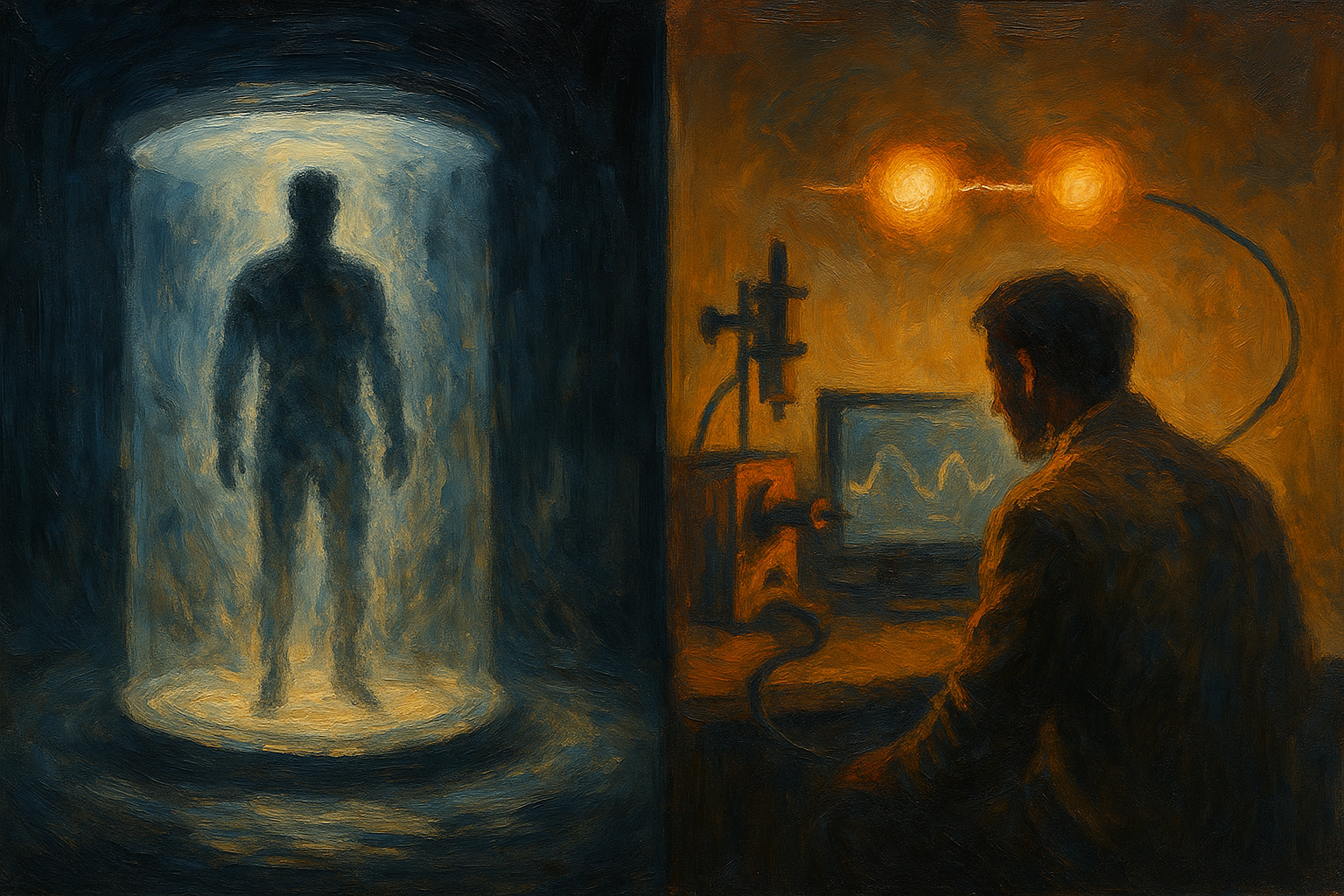
The cinematic roar of a transporter pad—someone dissolving and reappearing elsewhere—captures the imagination. Yet, in the lab, ‘teleportation’ means something far more precise: the transfer of quantum information (a particle’s quantum state) from one place to another, not the instantaneous movement of matter. Understanding teleportation in science vs sci-fi helps separate fiction from the real advances that matter for the quantum internet and secure communication.
Key takeaway: quantum teleportation transfers information, not bodies. It relies on quantum entanglement, a Bell-state measurement, and a classical channel, and thus does not enable faster-than-light messaging.
What is Teleportation in Science vs Sci-Fi?
In plain terms: real-world teleportation recreates the exact quantum state of a small system (for example, a photon’s polarization or an electron spin) at a distant node. The original system is not transported; typically it is measured and altered during the process. Thus, teleportation in science vs sci-fi is a contrast between information transfer and the physical, macroscopic transport shown in fiction.
Importantly, teleportation does not duplicate unknown quantum states (the no-cloning theorem forbids that), nor does it bypass relativity, because a classical message is required to complete the transfer.
To add historical perspective: the conceptual roots of modern quantum teleportation go back to foundational debates about entanglement. The 1935 Einstein-Podolsky-Rosen (EPR) paper questioned whether quantum mechanics was complete, and John Bell’s 1964 inequalities showed that entanglement produces correlations incompatible with local hidden-variable theories. Those theoretical milestones set the stage for the 1993 Bennett et al. protocol that explicitly showed how entanglement and classical communication enable teleportation of quantum states.
The core mechanism
Real quantum teleportation depends on three ingredients in the quantum state transfer protocol:
- Quantum entanglement — a shared resource: two particles are prepared so their properties are strongly correlated (quantum entanglement). This entangled pair is the channel for teleportation.
- Bell-state measurement (BSM) — the sender measures the unknown state together with one half of the entangled pair; this projects them into a joint Bell state and destroys the sender’s direct access to the original state.
- Classical communication — the measurement yields a few classical bits. The sender transmits these bits to the receiver, who applies a simple local correction to their entangled particle to recreate the original quantum state.
Thus, although entanglement establishes instant correlations, usable information cannot arrive until the classical bits are received; therefore teleportation respects causality.
Step-by-step, with an example (photon polarization):
- Create entangled photon pair A and B and send B to the remote node.
- Prepare photon X with an unknown polarization state you wish to teleport.
- Perform a Bell-state measurement on X and A at the sender’s lab; the measurement yields two classical bits.
- Send those classical bits to the remote node via ordinary telecommunications.
- The remote node applies a simple rotation or phase correction to photon B according to the bits, producing a photon whose polarization matches X.
This stepwise view shows why teleportation in science vs sci-fi is fundamentally about information reconstruction, not material transfer.
Quantum Entanglement, Decoherence and Measurement
Quantum entanglement underpins teleportation: entangled particles teleportation provides the nonlocal correlations that make state transfer possible. However, decoherence — environmental interactions such as thermal noise or stray photons — rapidly degrades fragile quantum states. Consequently, engineering robust entanglement distribution and protecting states with error correction are central technical challenges for quantum teleportation research.
Fidelity is the practical metric researchers use to judge teleportation quality. Fidelity quantifies how closely the received quantum state matches the original. Lab demonstrations routinely report fidelities well above classical thresholds (showing genuinely quantum transfer), but real-world deployments must maintain high fidelities across noisy channels and long delays.
Entanglement swapping is an important extension: by performing intermediate Bell measurements between entangled links, two distant nodes can become entangled without a direct physical link. This is the core idea behind quantum repeaters, which are required to scale teleportation over continental distances while controlling decoherence.
Timeline: Teleportation in Science vs Sci-Fi Milestones
- 1993 — Bennett et al. formulated the modern teleportation protocol (PRL), giving the theoretical basis.
- 1997 — First lab demonstration: photonic quantum teleportation of polarization states (Bouwmeester et al., Nature).
- 2000s — Teleportation extended to atoms, ions, and solid-state qubits, showing the protocol’s generality.
- 2012–2016 — Long-distance fiber and free-space experiments expanded range to tens–hundreds of kilometers.
- 2017 — China’s Micius satellite distributed entanglement and teleported states >1,200 km, setting a quantum teleportation distance record and demonstrating space-based links.
- 2020s — Prototypes of quantum repeaters and small quantum networks began to appear, advancing the path toward a quantum internet.
Case study: the Micius satellite experiments combined high-altitude free-space optical links with ground-based receivers. The mission demonstrated entanglement distribution over distances previously thought impossible for fragile quantum correlations. Such work provides a concrete example of teleportation in science vs sci-fi: spectacular distances and capabilities, yet still bound by classical signaling requirements.
Another instructive case is trapped-ion teleportation: by using ions as stationary qubits and photons for communication, labs have teleported quantum states between different physical platforms—an important step for heterogeneous quantum networks where memory qubits (ions, atoms, superconducting circuits) must interface with flying qubits (photons).
Applications and The Future of Teleportation Technology (10–30 year outlook)
While human or macroscopic teleportation remains science fiction, the near- to mid-term future holds practical, high-impact uses:
- Quantum internet and secure communications: teleportation is a core primitive for quantum key distribution (QKD) and linking quantum nodes. Teleportation-based protocols enable device-independent cryptography and networked key exchanges that are resistant to many side-channel attacks.
- Distributed quantum computing: teleportation moves qubits between nodes to stitch together larger computations. For example, small quantum processors could be connected by teleportation to act as a single, larger logical computer without physically moving electrons or chips.
- Quantum-enhanced sensing: entangled sensors and remote state transfer can improve clocks, telescopes, and navigation. Teleportation enables sensor data to be coherently combined across distances, boosting sensitivity in applications like very-long-baseline interferometry (VLBI) or distributed gravimetry.
Practical engineering steps and recommendations for organizations interested in the technology:
- Invest in photonic interfaces: efficient photon generation, coupling, and detection are common bottlenecks.
- Prioritize error-corrected memories: quantum repeaters need long-lived quantum memories to queue entanglement while classical signals propagate.
- Develop standards and interoperability layers: as with classical networks, heterogeneous quantum nodes will succeed if they agree on common protocols for encoding, timing, and error reporting.
Myths, Limits, and Philosophical Reflections (teleportation myths vs reality)
- Myth: teleportation is instantaneous and moves matter.
Reality: Teleportation in science vs sci-fi moves quantum information, not objects; it requires classical communication and thus cannot be instantaneous. - Myth: teleportation copies the original.
Reality: The no-cloning theorem prevents perfect copying; the sender’s measurement changes the original.
Philosophically, teleportation nudges us to think of identity in informational terms: if a state’s pattern is faithfully reconstructed elsewhere, what does that imply about continuity? While intriguing, such questions do not make bodily teleportation technically feasible or ethically straightforward.
Comparative analysis: sci-fi teleportation often assumes an energy-intensive disassembly/reassembly or matter-to-energy conversion with perfect continuity of consciousness. By contrast, teleportation in science vs sci-fi concerns abstract information patterns and requires destruction or irrevocable alteration of the original quantum carrier. From an engineering standpoint, recreating a macroscopic object with full atomic and quantum fidelity would demand information and control resources far beyond any foreseeable technology.
Practical takeaway
Teleportation in science vs sci-fi is a productive contrast: the laboratory achievement—quantum teleportation—is a verified method for moving quantum states and is foundational for secure quantum networks, distributed quantum computing, and precision sensing. Yet it remains emphatically not Star Trek: no macroscopic teleportation, no superluminal messaging.
If you’re building or investing in quantum technologies, focus on scalable entanglement generation, quantum memories for repeaters, and interoperable photonic links—these are the concrete engineering priorities that will turn teleportation science into a useful networked capability.
Further reading & authoritative sources
- Bennett et al. (1993), ‘Teleporting an Unknown Quantum State’, Phys. Rev. Lett. — foundational protocol.
- Bouwmeester et al. (1997), ‘Experimental quantum teleportation’, Nature — first photonic demonstration.
- Kimble (2008), ‘The quantum internet’, Nature — review on networks and long-range quantum links.
- Yin et al. (2017), Micius satellite papers (Science) — long-distance space-tested entanglement and teleportation.