
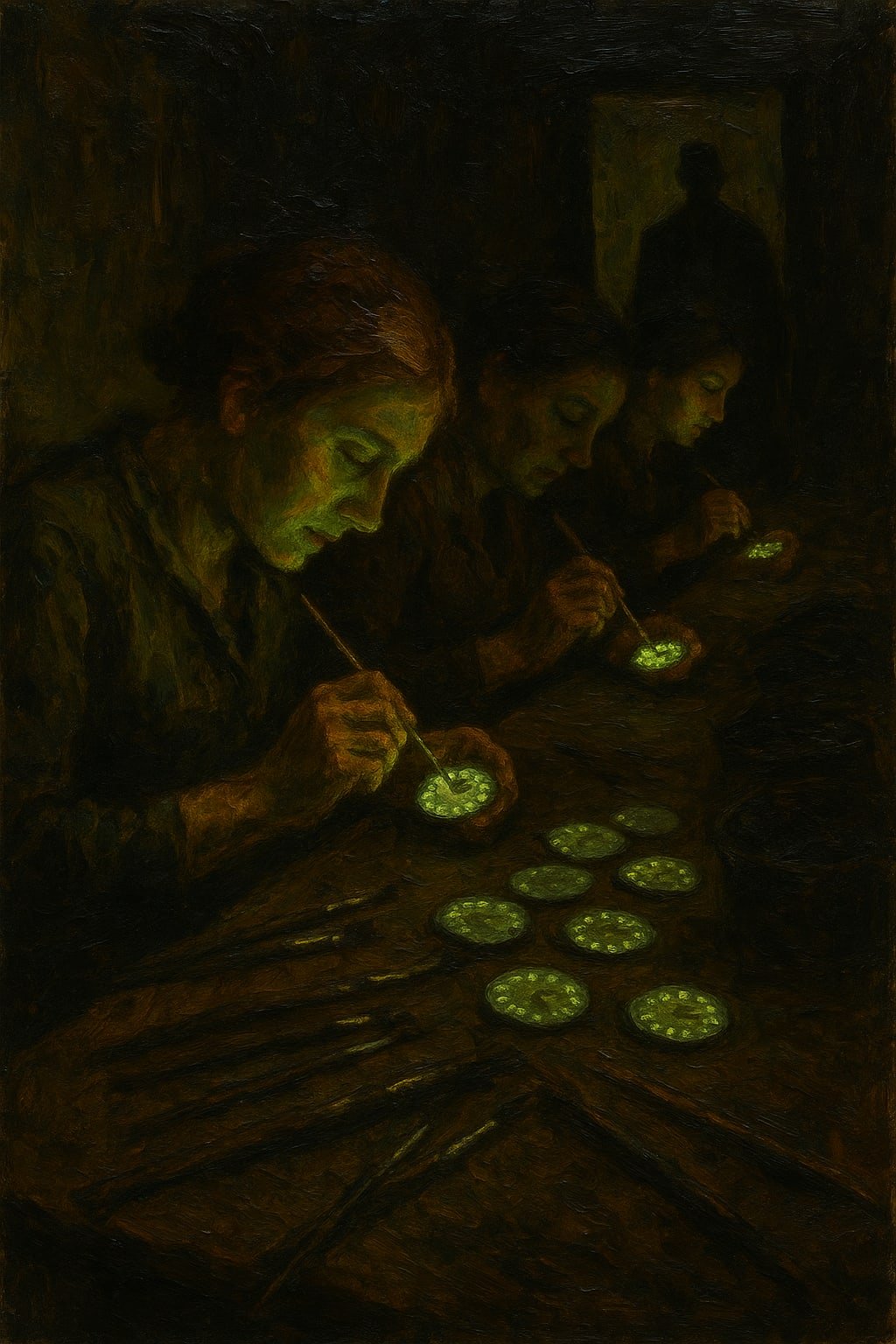
The Radium Girls watch dial painters were young women in the early 20th century who painted luminous radium-based paint onto clock and instrument dials. Their fatal exposure to radiation exposed deadly industrial practices, transformed worker protections, and became a powerful case study in the ethics of technology, profit, and human dignity.
Key Takeaways
- The Radium Girls turned invisible industrial harms into visible legal and moral questions.
- The allure of scientific “glow” masked systemic denial, doubt, and corporate self-protection.
- Their struggle still echoes in today’s debates over technology, labor, and responsibility.
A Glow in the Dark, and a Question
Imagine a dark room in 1918. On a bedside table, a small wristwatch glows with a ghostly green light. The owner sees only convenience and modernity: time, visible at midnight. What he cannot see is that this same light is already eating away at the bones of the young woman who painted the dial.
The story of the Radium Girls watch dial painters is not just a historical curiosity. It is a parable about what happens when technological wonder outshines caution, when corporate power outpaces regulation, and when the bodies of ordinary workers become the testing ground for progress.
Radium Mania: When Science Looked Like Magic
At the beginning of the 20th century, radium was a marvel. Discovered by Marie and Pierre Curie in 1898, this new element glowed without flame, warmed without fire, and seemed to radiate pure energy.
Radium quickly escaped the laboratory. It was marketed as a cure-all: added to tonics, toothpaste, cosmetics, and even chocolates. It appeared in advertisements as a symbol of vitality, luxury, and cutting-edge science. In medical circles, radium was used to shrink tumors and treat skin diseases; in popular culture, it became shorthand for the future itself.
From this cultural aura emerged a profitable niche: luminous paint. Mixed with zinc sulfide, radium created a self-glowing coating perfect for watch faces, airplane instruments, and military equipment. In a world rushing into mechanized war and around-the-clock industry, the idea that time could shine in the dark felt both practical and magical.
It is in this glow-soaked atmosphere that the Radium Girls took their places at the workbenches.
Inside the Dial-Painting Studios: Lip, Dip, Paint
In factories in places like Orange, New Jersey and Ottawa, Illinois, companies hired young women—often teenagers—to paint the tiny numerals on watch dials by hand. The work seemed ideal: clean, modern, and comparatively well paid. For many, it was a path to independence.
Inside the studios, the technique was simple and deadly. To achieve fine, precise lines, supervisors instructed the workers in what became known as “lip, dip, paint”:
- Shape the brush tip with the lips.
- Dip the moistened brush into radium-laced paint.
- Paint a number or a mark.
- Repeat hundreds of times per day.
The women were told the paint was harmless. Some were encouraged to paint their fingernails or teeth for fun before heading out dancing, their bodies glowing faintly in the night. Photographs of smiling dial painters circulated as symbols of modern femininity: young, stylish, literally radiant.
The glamour, however, concealed a one-way exchange. Radium particles lodged in their bones, where the body—mistaking radium for calcium—built it into the skeleton itself. Like invisible embers, the element would continue to burn from within.
Early Cracks in the Glow
At first, there was no obvious danger. Then small signs appeared. A toothache that would not heal. Persistent fatigue. A sore knee from a minor bump that turned into something more serious.
Unraveling the Mystery of a Slow, Shining Poison
By the early 1920s, symptoms among the radium dial painters grew both stranger and more terrifying. Jawbones weakened and crumbled; teeth fell out. Some women developed a condition later called “radium jaw,” where the bone in the jaw literally disintegrated. Others suffered anemia, spontaneous bone fractures, and painful, non-healing lesions in the mouth.
Doctors were puzzled. Radium was still widely celebrated as a medical breakthrough. The idea that it could be destroying these women from the inside clashed with the optimism of the era and the interests of powerful companies.
Denial as a Corporate Strategy
Initial responses from employers were defensive. Company doctors and consultants often attributed the illnesses to poor hygiene, syphilis, or unrelated infections. Questioning the safety of radium threatened not just profits but an entire cultural story about progress and scientific triumph.
Doubt became a weapon. If causation could be questioned, compensation could be delayed. If the women’s testimony could be discredited, the glow of radium could remain unsullied in the public imagination.
Here, we see a pattern that still feels familiar: when evidence of harm conflicts with economic interest, uncertainty is not a problem to be solved—it is a resource to be exploited.
From Suffering to Systemic Change: The Legal Battles
The suffering of the Radium Girls might have remained a series of local tragedies. Instead, a handful of women and their advocates transformed it into one of the most influential industrial safety cases of the 20th century.
In New Jersey, workers from the United States Radium Corporation began to seek legal redress in the mid-1920s. Many were already gravely ill. Their cases were hindered by short statutes of limitations that did not account for slow-developing diseases, and by the technical difficulty of proving that radium exposure caused their specific conditions.
Despite these obstacles, several lawsuits went forward. Publicity around the cases grew, particularly as journalists highlighted the contrast between the women’s frail bodies and the companies’ polished public statements.
In Illinois, another set of dial painters pursued their own legal battle. Over time, settlements were reached, though often for modest sums, especially given the irreversible harm. Yet the monetary awards were only part of the story.
How the Radium Girls Changed the Rules
The legal and public pressure around the Radium Girls catalyzed broader reforms in industrial safety and corporate liability. Among the consequences were:
- Recognition of occupational diseases: Courts and regulators increasingly accepted that workplace exposures could cause slow-acting, long-term illnesses.
- Extended liability periods: Laws began to adapt to the reality that some harms emerge years after exposure, stretching beyond traditional legal deadlines.
- Stronger workplace standards: The case helped fuel the development of formal health and safety regulations, including limits on radiation exposure and improved factory hygiene.
The Radium Girls did not just win individual settlements; they helped rewrite how societies understand and regulate industrial risk.
Pros and Cons Exposed: A Glowing Myth Meets Its Costs
To see the ethical stakes clearly, it helps to lay out the competing narratives of the time.
| Perspective | Perceived Pros | Overlooked or Denied Cons |
|---|---|---|
| Radium as Miracle Substance | Symbol of cutting-edge science; medical potential; luminous convenience for war and industry | Long-term radiation damage; bioaccumulation in bones; poorly understood risks |
| Employers’ View | Profitable product; patriotic contribution (especially during wartime); employment for young women | Duty of care to workers; suppression of safety data; resistance to accountability |
| Workers’ Experience | Respectable wages; status of modern factory work; sense of pride in contributing to technology | Hidden exposure; lack of informed consent; devastating health consequences |
The table reveals a structural dynamic that recurs whenever new technologies arrive wrapped in promise: benefits are counted loudly and early; costs are quiet, delayed, and often offloaded onto those with the least power.
Ethics in the Glow: What Do We Owe Those at the Edge of Innovation?
The ethics of the Radium Girls case turn on a few deceptively simple questions:
- Who bears the risk when a new technology enters the world?
- How much must workers be told, and when does ignorance become negligence—or even deliberate harm?
- What is the moral status of “not wanting to know”?
Informed Consent and Epistemic Injustice
The dial painters were not merely unlucky; they were uninformed. They were not told the paint was dangerous. In some instances, early medical warnings about radium’s harms were downplayed or dismissed by company-affiliated experts.
This is more than a failure of communication. It is a form of epistemic injustice: certain people (in this case, young working-class women) were denied access to the knowledge they needed to protect their own bodies. Their observations of their own symptoms were discounted relative to the authority of male scientists and managers.
The Cost of Looking Away
It is tempting to frame this story as a clear moral tale: greedy corporations versus innocent workers. But part of its enduring power lies in its complexity.
Many individuals involved may have genuinely believed the risks were minor. Others saw contradictory data and chose to emphasize the reassuring parts. Some surely understood the dangers and looked away because acknowledgment would demand costly change.
This gradient—from ignorance to self-deception to willful denial—reminds us that ethical failure is often not a single decision but a series of small accommodations, each one trading a little clarity for a little convenience.
The Shining Dial as Metaphor: From Radium to Data, AI, and Beyond
The luminous dial is more than an artifact of industrial history. It is a metaphor for any technology that glows with promise while pushing its true costs into the shadows.
Today, we might think of:
- Toxic supply chains that deliver sleek devices while exposing miners and factory workers to hazardous conditions.
- Data-driven platforms that feel frictionless and “free” for users but rely on invisible forms of surveillance, extraction, and precarious gig labor.
- Artificial intelligence systems that appear clean and immaterial, even as they consume vast energy, rely on low-paid data annotators, and raise questions about bias and accountability.
In each case, there is a visible glow—the polished product, the seamless interface, the impressive performance—and a hidden infrastructure of risk. The question the Radium Girls pose to us is not simply “How could they let that happen?” but “Where, right now, are we repeating the same pattern?”
Lessons for the History of Worker Protections
From a systems perspective, the Radium Girls helped expose the limits of relying on corporate benevolence or individual lawsuits to secure safety.
Their cases underscored the need for:
- Proactive regulation, not just post-hoc compensation.
- Independent science, insulated from corporate pressure, to assess harms.
- Collective protections, like workers’ compensation schemes and safety standards, that do not depend on each victim winning a personal legal battle.
These shifts are part of the broader history of worker protections—a move from seeing workplace injuries as private misfortunes to recognizing them as public, structural issues requiring systemic solutions.
Frequently Asked Questions
Why did the Radium Girls use the “lip, dip, paint” technique with radium paint?
Supervisors instructed the watch dial painters to shape their brush tips with their lips for a finer point, ensuring precision. The women were falsely assured the radium-based paint was harmless. This practice, known as lip-pointing, led to the direct ingestion of radioactive material, causing severe internal radiation poisoning.
What were the first health symptoms experienced by the Radium Girls?
Early symptoms of radium poisoning among the dial painters included severe fatigue, persistent toothaches, and loosening teeth. They also suffered from painful jaw infections and necrosis, a condition later termed “radium jaw.” Many developed anemia and spontaneous bone fractures as the radiation damaged their bone marrow and skeletal structure.
How did radium specifically damage the bones of the dial painters?
Because radium is chemically similar to calcium, the body deposited it directly into the bones of the Radium Girls. Once lodged in the skeleton, the radium’s continuous alpha radiation destroyed bone tissue from within, leading to necrosis, fractures, and bone cancers like osteosarcoma by disrupting cell production and weakening the bone matrix.
What was the outcome of the major Radium Girls legal cases?
The first major lawsuit was filed in 1927 by five New Jersey dial painters against the U.S. Radium Corporation, settling in 1928. Subsequent cases in Illinois during the 1930s against Radium Dial Company also found in favor of the workers. These landmark cases established legal precedents for employer liability for occupational diseases.
What lasting impact did the Radium Girls have on workplace safety?
The tragedy of the Radium Girls was a catalyst for major labor safety reforms. Their court battles led to improved industrial safety standards, the right of individual workers to sue for damages from labor abuses, and the establishment of the Occupational Safety and Health Administration (OSHA) decades later, influencing modern radiation protection protocols.
Further reading & authoritative sources
Authoritative sources
- history of the Radium Girls — Explore the heartbreaking true story of the dial painters and their fight for justice in this detailed archive.
- health effects of radium — Learn about the devastating medical consequences of radium exposure on the human body from scientific experts.