
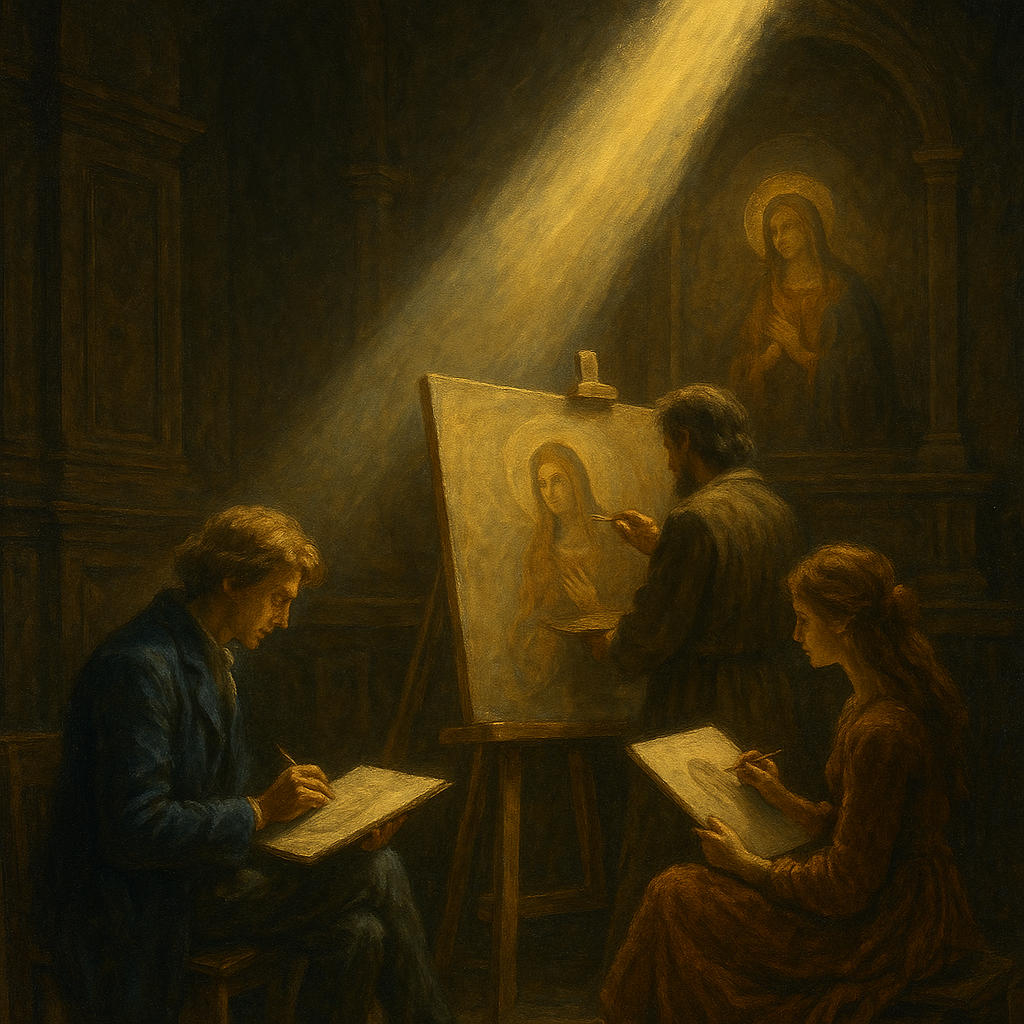
Imagine standing in a dim chapel as a single shaft of sunlight pierces incense haze. The beam lands on a worn pew and a single face, revealing micro-gestures the moment before they vanish. That instant—brief and electric—feels like revelation. Artists chase that revelation because light does what few elements can: it organizes experience, reveals form, and carries meaning.
Light as a Spiritual Metaphor in Art: A Short Thesis
When artists obsess over light as a spiritual metaphor in art they do three interrelated things: they tune the viewer’s visual system, compose an emotional response, and invoke symbolic traditions that link illumination with insight. In short, light becomes both a technical tool and a language of noesis—seeing that is also knowing.
Expanding this thesis: light is simultaneously physical phenomenon, instrument of composition, and cultural signifier. Physically it modulates luminance and color; compositionally it directs attention and constructs space; culturally it signals ideas—divinity, revelation, purification, presence, or simply focus. The potency of light as a spiritual metaphor in art comes from this multiplex function: viewers bring embodied visual habits, learned iconography, and personal associations, all of which an artist can orchestrate with tone, placement, and material.
Light as a Spiritual Metaphor in Art: Perception and Science
Research on the retina, contrast sensitivity, and color constancy shows why light is persuasive. Rods and cones parse luminance and color; the brain favors edges and contrast for shape recognition. Therefore, a bright beam or a small highlight will reliably draw attention and imply importance. Moreover, perceptual studies suggest that luminance and color temperature modulate mood: high-luminance scenes often lift arousal, while low-key light invites introspection. For accessible overviews of vision and retinal function, see Britannica and technical sources on visual perception [external links at article end].
Beyond basic physiology, cognitive neuroscience offers insights. Studies of visual attention show that sudden changes in luminance capture orienting responses; neuroaesthetic research links certain luminance patterns with feelings of awe or safety. For example, diffuse, warm light often elicits calm and social warmth, while sharp, cold highlights can increase alertness or tension. These findings explain why a soft dawn glow can read as benign revelation while a knife-edge spotlight reads as accusation.
Chiaroscuro techniques and how to paint light and shadow
Chiaroscuro, tenebrism, and glazing are technical strategies artists use to make light feel meaningful.
- Value-first workflow: start with a grayscale value study to lock the tonal architecture.
- Edge control: hard edges attract attention; soft edges create atmosphere and depth.
- Color temperature: warm highlights advance; cool fills recede. Mix them to make space hum.
- Glazing and translucency: layered paint or thin washes can create an inner glow (Vermeer and later practitioners).
How to paint light and shadow (practical steps)
- Block in three tonal bands: highlight, midtone, core shadow.
- Refine edges selectively—sharpen where the eye should rest, soften elsewhere.
- Add reflected light to sell materiality.
- Adjust color temperature last to unify mood.
If you work digitally, replicate glazing by using low-opacity layers and blending modes; for sculptors, directional LED can simulate chiaroscuro on volumetric form. Photographers should consider controlling light falloff and using flags to shape beams. These cross-medium techniques demonstrate how the same perceptual levers underpin the spiritual effect of light in different practices.
Studio lighting for painters and photographers
Use a single key light to study cast shadows; then introduce a cool or warm fill to test spatial complexity. When photographing references, bracket exposures or shoot RAW to preserve highlights for painting.
Add a practical checklist:
- Test three intensities: high-key, mid-key, low-key.
- Note color temperature differences: 2700K (warm), 4500K (neutral), 6500K (cool).
- Record shadow edge hardness: measured by distance between light and subject.
Case studies: art and light across history
- Caravaggio: tenebrism makes spiritual action literal; light selects protagonists and stages moral drama. In The Calling of St Matthew the beam becomes a theatrical finger, pointing moral agency toward revelation.
- Vermeer: quiet directional light models texture and inner life; small reflections (a pearl’s highlight) become narrative punctuation. In works like Girl with a Pearl Earring, the soft lateral light sculpts a silent presence.
- Turner: light becomes subject; form dissolves into luminous atmosphere and sensation. Turner’s seascapes use vaporous color and high key to suggest transcendence and the sublime.
- Rothko: fields of color act like meditative light—seeing becomes contemplative. His color-field paintings produce a luminous presence without direct depiction of a light source, turning canvas into an environment.
Comparative insight: Caravaggio and Vermeer use directed, source-driven light to narrate psychological or moral content; Turner and Rothko treat light as a field or force, moving the viewer into affective states. Tenebrism stages, while color-field painting envelops.
Extended case study: Contemporary installation artists such as Olafur Eliasson and James Turrell have translated these painterly strategies into experiential spaces. Turrell’s Skyspaces frame the sky as a luminous canvas; the viewer’s act of looking becomes ritualized. Eliasson manipulates color and reflection to produce shared, social experiences where light acts as both medium and message—a truly modern example of light as a spiritual metaphor in art.
Practical exercises: mastering light in painting
- Hourly light observation (7 days): five minutes at the same window; sketch values and note color temperature.
- 10-minute value study: one object, three tones—highlight, midtone, shadow.
- Photograph and re-grade: create high-key, low-key, and neutral versions to feel how light alters narrative.
- Installation exercise: design a small illuminated space using one dominant color temperature and one movable object; invite a peer to experience it and note their emotional response.
Actionable daily routine: spend 15 minutes alternating between studying natural light and practicing a technical skill (glazing, edge control, or exposure bracketing). Track how changing only one variable (intensity, temperature, edge hardness) changes perceived meaning.
A reflective takeaway
Light as a spiritual metaphor in art is not merely poetic: it is practice. Study perceptual science, learn technical tactics (chiaroscuro techniques, glazing, edge control), and test short exercises daily. In doing so, you train both eye and attention—so that illumination becomes a means of invitation: inviting the viewer into presence, insight, or reverence.
Practical recommendations:
- Prioritize value studies over color at the start of a piece.
- Use limited palettes to focus on the quality of light.
- When curating, sequence works by their dominant light strategies to guide emotional flow.
Expert insights and quotes
“Light is less a subject than a collaborator,” says a contemporary painter and teacher who runs workshops on perception. “When you treat light as an interlocutor, it tells you where the pictorial problem is.” Vision scientists also advise artists: replicable patterns of luminance and contrast reliably steer attention, which explains why certain configurations of light feel ‘sacred’ across cultures.
Conservators add a material perspective: pigments age and varnishes yellow, altering the original light-relations an artist intended. This is why conservation reports often reveal insights about how earlier audiences may have experienced a work’s spiritual dimension differently.
Future trends and predictions
- Immersive and participatory light installations will expand as LED, projection, and sensor technologies mature—expect more works that blur viewer and artwork.
- Augmented reality (AR) will allow artists to overlay ephemeral light-effects on real-world spaces, democratizing the creation of spiritual illumination.
- Interdisciplinary collaborations with neuroscientists may produce works engineered to trigger specific affective states via calibrated light patterns.
These trends suggest the metaphorical power of light will extend beyond canvas and gallery to urban and virtual environments, amplifying the role of light as a spiritual metaphor in art for broader publics.
Sources and further reading
- For vision and retinal basics: Britannica (see external links).
- For painting techniques and historical context: National Gallery resources on the use of light in painting (see external links).
Sources and further reading (continued)
If you want deeper entry points: look for exhibition catalogues on Caravaggio and Vermeer, Turrell monographs for experiential practices, and texts on neuroaesthetics for scientific context. Museum conservation journals often publish case studies showing how light perception changed as works aged.
Frequently Asked Questions
Q: Why is light so important in art?
A: Light structures visual information: it defines form via contrast and value, guides attention, and carries symbolic weight that can suggest knowledge, presence, or divinity.
Q: How does our visual system explain artists’ focus on light?
A: The retina separates luminance and color; the brain privileges edges and contrast for recognition. Artists use light and shadow to control legibility and mood.
Q: What is the difference between chiaroscuro and tenebrism?
A: Chiaroscuro refers broadly to using light and shadow to model form. Tenebrism is an extreme variant with large dark areas and concentrated bright light, often dramatic.
Q: Can light be spiritual without being religious?
A: Yes. Spirituality here refers to inner experience—light can evoke contemplation, presence, or insight without doctrinal content (e.g., Rothko).
Q: Which practical exercises help build skill with light?
A: Value studies, controlled lighting experiments, photographing the same scene under different exposure settings, and short daily observation practices build perceptual fluency.
Q: How do contemporary artists use light differently than old masters?
A: Old masters often relied on a single, depicted light source to model narrative or theology; contemporary artists may use light as medium—creating environments, fields, or dynamic systems that position the viewer within the phenomenon rather than simply depicting it.
Q: How can curators use light to affect interpretation?
A: Curators can sequence works by light quality, manipulate gallery lighting to emphasize intended reading, and provide mediation about how lighting choices influence reception. Simple changes—warmer bulbs, lower overall lux, or focused spotlights—alter viewers’ emotional responses.
Q: Are there ethical considerations in using light in art?
A: Yes. Extreme brightness, strobes, and certain color flickers can trigger seizures in sensitive viewers. Artists and curators should include content warnings and provide safe alternatives or controlled exposure.