
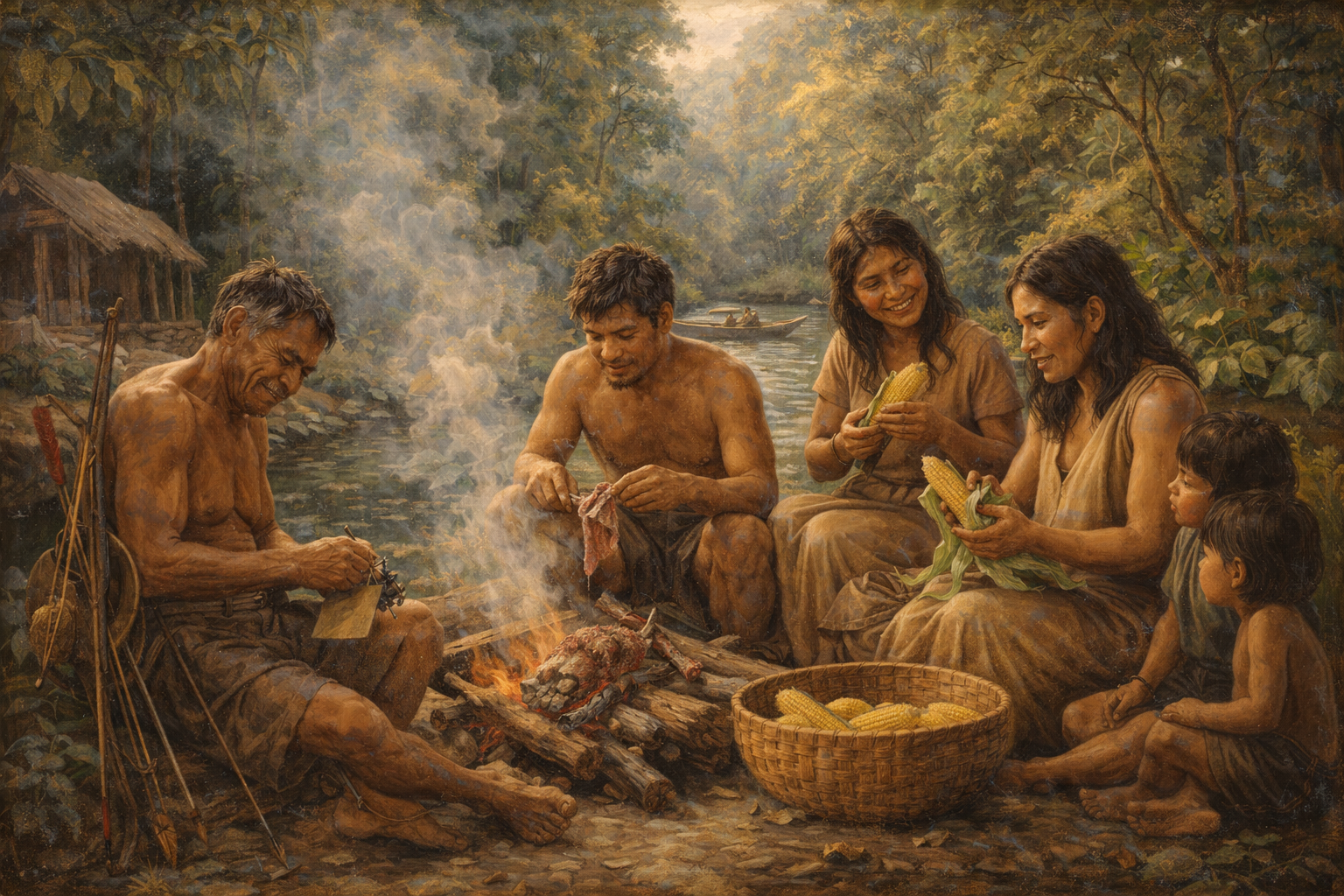
What we can learn from the Tsimane people is not a list of lifestyle hacks, but a deeper reorientation: health and meaning can emerge from embeddedness in land, community, and shared time, rather than from a wellness market built on products, metrics, and individual self-optimization. (What we can learn from the Tsimane tribe – the heart-healthiest population in the world)
- The Tsimane illustrate how health can emerge from lifeways, not purchased techniques.
- Western wellness often mirrors consumerism and performance, shaping how we define flourishing.
- Learning from the Tsimane means questioning our assumptions, not copying their lifestyle.
A Culture Well Without A Wellness Industry
The paradox is disquieting: in many Western cities, wellness is everywhere and hard to find. According to Bbc, this analysis holds true.
We count steps, track sleep, subscribe to mindfulness apps, and buy supplements wrapped in minimalist typography. An entire industry promises equilibrium while often intensifying anxiety about not being well enough.
Meanwhile, anthropological research on the Tsimane people of the Bolivian Amazon has drawn attention because they appear to exhibit striking physical health and strong social cohesion without anything resembling a formal wellness industry. (Tsimané of the Bolivian Amazon have world’s healthiest hearts, says study) Bolivian Tsimane people ‘have world’s healthiest hearts’ The Tsimane Health and Life History Project: Integrating anthropology and biomedicine
They do not attend yoga studios, own fitness trackers, or follow biohacking influencers. Yet their bodies, communities, and relationship to the land suggest forms of balance that our optimized lives struggle to approximate.
This contrast invites a philosophical question more than a lifestyle comparison: what if wellness is less an achievement of the self and more a property of how a life is situated—in time, place, and relation?
Who Are The Tsimane?
The Tsimane (often also spelled Tsimané) are an Indigenous people living primarily in the lowland forests of Bolivia. They are small-scale horticulturalists, fishers, and foragers who inhabit riverine and forest environments.
Anthropologists describe a social world organized around extended families, shared labor, and subsistence activities. Daily life weaves together gardening, hunting, fishing, gathering, and domestic tasks. Children participate early in these activities, learning through observation and involvement rather than through abstract instruction.
Academic attention has focused, among other things, on their physical health. Studies have reported very low levels of certain chronic conditions common in industrialized societies—such as specific cardiovascular diseases—within Tsimane communities. Their everyday practices, diet, and movement patterns seem to generate what Western societies try to engineer piecemeal through gym sessions and specialized diets.
Crucially, the Tsimane are not a monolithic symbol of harmony. They navigate pressures from surrounding societies, political and economic constraints, and the impacts of environmental change. Their lives contain conflict, hardship, and vulnerability. Any serious reflection must begin from this complexity rather than an idealized image.
The Western Wellness Paradigm As Industry And Ideology
In contemporary Western contexts, wellness has become both an economic sector and a worldview.
As industry, it comprises fitness clubs, meditation platforms, nutritional products, retreats, wearable devices, and a growing array of services promising optimization.
As ideology, wellness in many individualistic societies has come to mean an ongoing personal project: the self is something to be continuously tracked, corrected, and improved. Well-being is framed less as a byproduct of shared life and more as a measurable outcome of individual effort.
This paradigm is deeply entangled with consumer capitalism:
- Commodification: States of mind and body—calm, focus, resilience—are approached as things to be acquired or upgraded.
- Performativity: Wellness becomes something to display: the body sculpted, the morning routine narrated, the mental health journey curated.
- Metrics: Sleep scores, heart-rate variability, and productivity trackers turn inner life into dashboards.
The promise is control: if we purchase and perform correctly, we might finally inhabit the good life. Yet the very structure of this promise makes wellness perpetually deferred. There is always a next protocol, a more optimized version of oneself waiting on the horizon.
Embodied Wellness Without A Market
Against this backdrop, the Tsimane offer a different configuration. Their apparent “wellness” is not a project separate from life; it is woven into subsistence, kinship, and landscape.
Movement As A Byproduct Of Living
For many Tsimane, daily existence involves sustained, varied physical activity: walking to fields or rivers, carrying, paddling, digging, climbing, preparing food. Movement is not a compensatory activity scheduled to counteract sedentary work. It is simply what it means to inhabit that particular environment.
There is no conceptual split between “exercise” and “life”; the category of working body and living body coincide.
Food As Relationship Rather Than Program
Diet among the Tsimane is bound to their subsistence practices: what is grown, caught, or gathered in their local ecology. Food is less an object of nutritional anxiety and more an ongoing relationship with territory, seasonality, and shared labor.
This does not mean a perfect diet nor an absence of scarcity or difficulty, but it does indicate that eating is not primarily a site of personal moral struggle or optimization, as it often is in Western nutrition culture.
Social Fabric As A Health Resource
Tsimane villages are typically organized around extended family networks, shared child-rearing, and cooperative work. Social roles and obligations embed individuals within webs of reciprocity.
Loneliness—the quiet epidemic of many affluent societies—appears differently when daily life presupposes mutual dependence. Social support is not a scheduled group therapy session but the ordinary condition of survival.
Time As Continuity, Not Constant Acceleration
Daily rhythms follow subsistence cycles, environmental conditions, and communal needs more than abstract productivity targets. There is urgency where there must be—storms, harvests, illness—but less of the ambient pressure of constant acceleration.
In this sense, what we can learn from the Tsimane people is not how to slow down via better scheduling tools, but that time itself can be experienced as continuity when work, season, and community form a coherent whole.
Philosophical Contrasts In The Idea Of The Good Life
These differences reveal deeper philosophical tensions between worldviews.
Individualist Versus Relational Selves
Western wellness discourse largely presumes an individualist self: the self-contained subject managing its inner states and personal trajectory.
By contrast, life among the Tsimane is deeply relational. The self is not imagined as an isolated unit pursuing private flourishing but as defined through kinship, obligation, and collaboration. Well-being is less a property owned by an individual and more a pattern in the network of relationships.
Control Versus Attunement
Modern wellness often pursues control: control over aging, mood, productivity, and even mortality’s symbolic reach.
In Tsimane lifeways, humans negotiate with an environment that cannot be fully controlled: forests, rivers, weather, game. The task is attunement rather than domination—learning to live within cycles and limits, not to transcend them.
Abstract Metrics Versus Lived Experience
Western wellness is saturated with quantification. Numbers promise objectivity.
The Tsimane, by contrast, navigate health more through felt capacity—one’s ability to work, participate, fulfill obligations—than through abstract metrics read from devices. Knowledge is grounded in lived functionality, not in dashboards.
Wellness As Project Versus Wellness As Byproduct
Perhaps the starkest philosophical contrast: in industrialized societies, wellness is a project—something to be pursued. Among the Tsimane, what resembles wellness appears more as a byproduct of a life form: of how work, food, movement, ritual, and kinship cohere.
The Tsimane do not do wellness; they do life, and certain dimensions of wellness emerge from that form of life.
Comparative Table: Two Logics Of Wellness
Dimension | Western Wellness Paradigm | Tsimane Lifeways Perspective |
|---|---|---|
Primary Unit Of Concern | Individual self | Relational self (family, community) |
Main Mode Of Action | Planned interventions, programs, products | Everyday subsistence activities |
Relation To Environment | Often external resource to manage or escape | Inseparable context shaping identity and practice |
Understanding Of Health | Metrics, diagnostics, performance indicators | Functional capacity, ability to participate |
Experience Of Time | Accelerated, future-oriented optimization | Cyclical, seasonally and communally oriented |
Status Of Wellness | Explicit goal and industry focus | Emergent property of embedded life |
This table should not be read as a moral hierarchy but as a map of competing logics that shape how different societies conceptualize the good life.
Reimagining Wellness Beyond Products And Self-Optimization
The Tsimane do not offer us a path back. There is no return ticket to their forests that would not be, in itself, another colonial intrusion.
What they offer, indirectly and without consent, is a philosophical provocation.
Their lives reveal that health, balance, and meaning can arise not from a specialized sector of society but from the form of life as a whole—from how work, kinship, land, and time interlock.
Modern Western wellness culture, in contrast, tends to carve wellness out as a separate domain, mediated by markets and metrics, and assigned to the individual as a perpetual project.
To take this contrast seriously is to entertain a demanding thought: perhaps we cannot fully solve the unease of our wellness obsessions at the level of individual practice. Perhaps the disquiet many feel—even amid abundance of options—is an accurate signal that the surrounding form of life is misaligned with what human flourishing requires.
What we can learn from the Tsimane people, then, is not how to live as they do, but how strange our own assumptions appear when viewed from another way of being:
- That wellness might be less purchased than participated in.
- That meaning might be less discovered in solitary introspection than generated in shared activity.
- That a good life might be less about optimizing the self and more about right relation—to others, to place, to time, and to limits.
For philosophy-oriented readers, the invitation is not to adopt a new routine but to cultivate new questions: What kind of worlds make genuine well-being plausible? What forms of community, work, and environment would allow wellness to cease being a frantic project and become, once again, an ordinary consequence of how we live together?
In that sense, the most profound learning from the Tsimane may be this realization: the solution to our wellness crisis may lie less in doing more to ourselves, and more in reimagining the worlds we build around us.
Frequently Asked Questions
Why do the Tsimane have the world’s lowest rates of heart disease?
Research indicates the Tsimane possess remarkably healthy arteries due to a lifestyle centered on constant physical activity and a diet low in processed fats. Their cardiovascular health suggests that chronic heart disease is not an inevitable part of aging, but rather a consequence of sedentary, industrialized living conditions and refined food sources.
What are the primary differences between Tsimane and Western diets?
The Tsimane diet consists primarily of complex carbohydrates from gathered crops like plantains and cassava, supplemented by lean protein from wild fish and game. This high-fiber, nutrient-dense intake stands in stark contrast to Western diets, which often rely on processed sugars, refined grains, and saturated fats that necessitate external supplements.
How does the Tsimane approach to physical activity compare to gym culture?
Unlike Westerners who often rely on scheduled, high-intensity workouts, the Tsimane engage in hours of low-intensity functional movement daily. Their activity—walking, rowing, and farming—is woven into the fabric of survival. This consistent, “incidental movement” is often more effective for long-term metabolic health than the sedentary-active-sedentary cycle typical of modern life.
What role does communal living play in Tsimane wellbeing?
The Tsimane reside in extended family groups where labor, childcare, and food are shared. This social interdependence creates a built-in safety net that buffers against the stress and isolation prevalent in individualistic cultures. Their example shows that social connection is a biological necessity, acting as a primary driver of psychological and physical resilience.
How can modern individuals integrate Tsimane principles into daily life?
Integrating these principles involves prioritizing community-based movement and reducing reliance on wellness metrics or “biohacking” products. By focusing on whole foods, fostering reciprocal relationships, and increasing daily walking, individuals can shift their health focus from a market-driven project of self-optimization toward a more grounded, sustainable, and meaningful way of living.
Further Reading & Authoritative Sources
Authoritative Sources
- Tsimane People Have Very Low Risk of Heart Disease — TIME article that distills research on the Tsimane into clear takeaways on activity, diet, and behavior that others can apply to reduce heart disease risk.