
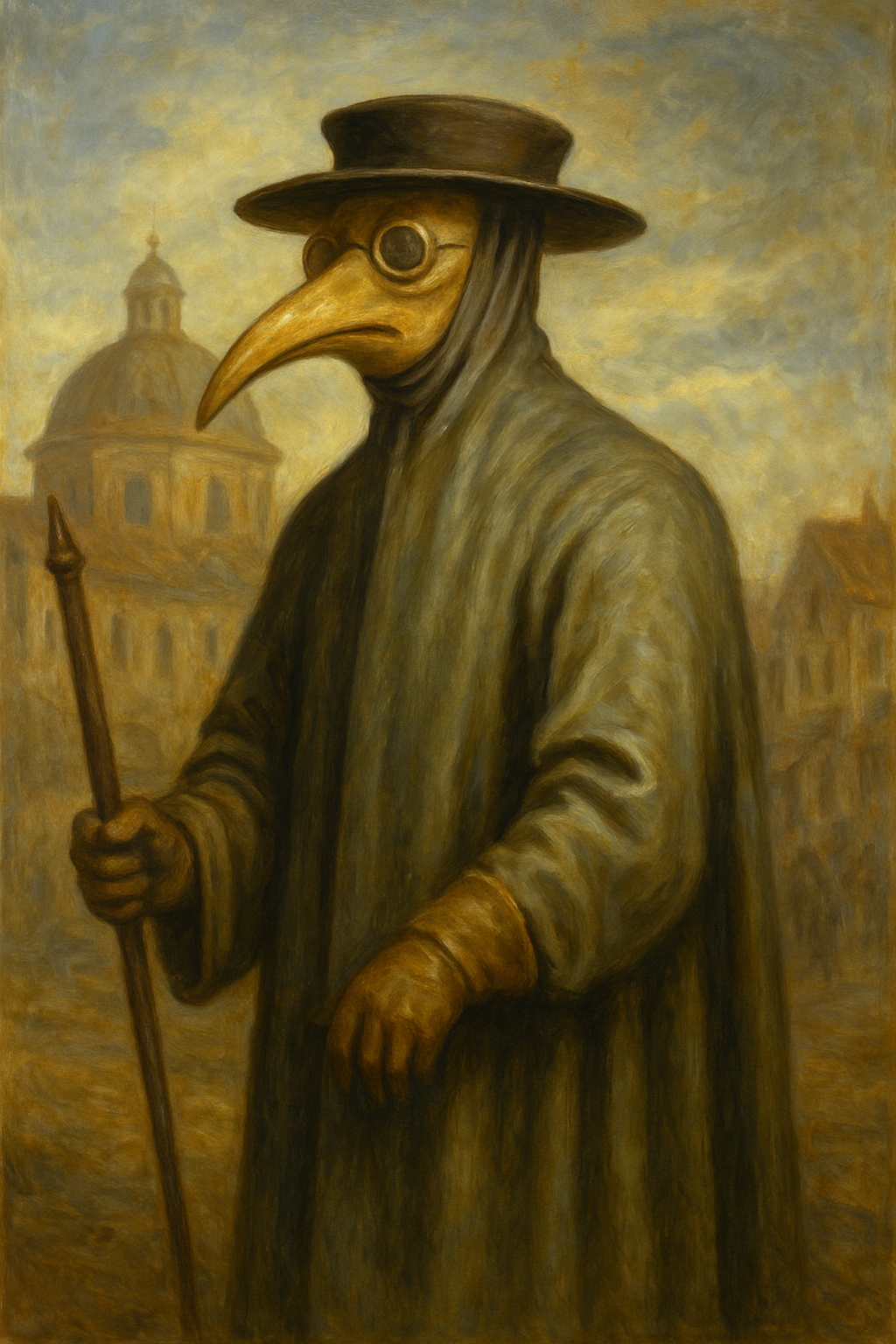
The history of plague masks is at once a study in early modern medical reasoning and a lesson in how objects accumulate cultural meaning. In this concise, reflective guide we trace the beak mask from its origins in miasma-era practice to its later life as a gothic and theatrical emblem. Along the way, we note how museum collections and digitized prints help separate myth from evidence (see Wellcome Collection and Gallica in Further reading).
History of Plague Masks: Key Moments
- Late 14th century: Major plague outbreaks prompt quarantines and civic health responses, but there is no reliable evidence for beak masks during the Black Death.
- Early 17th century (c. 1619): Protective ensembles associated with Charles de Lorme and others begin to appear in texts and prints; the beaked silhouette is documented in 17th-century engravings.
- 17th–18th centuries: Prints, municipal ordinances, and medical manuals show a full protective outfit—mask, gown, gloves, hat, and cane—used in some European cities.
- 19th–21st centuries: The beak migrates into theater, art, carnival, and subcultures, becoming a potent visual shorthand for death, contagion, and the uncanny.
These moments mark shifts in both material practice and symbolic resonance. Tracking the history of plague masks through these moments helps separate the practical intentions of historical actors from later myth-making.
History of Plague Masks — Miasma Theory and Purpose
To understand why the beak existed, first understand miasma theory: physicians believed “bad air” (miasma) carried disease. Consequently, the beak served two practical aims: to create distance between doctor and patient, and to hold aromatic materials thought to purify inhaled air. Although later shown ineffective against bacterial transmission, this design represented a reasoned response within contemporaneous medical logic.
Miasma and the Logic of Protection
Because people relied on smell to judge air quality, strong aromatics (e.g., camphor, rosemary) were thought protective. Therefore, the beak functioned as a primitive respirator and olfactory buffer, while leather or waxed gowns aimed to repel fluids.
Historians of medicine emphasize that these choices make sense when placed in the period’s epistemic framework: sensory perception and humoral balances were central to diagnosis and therapy. The beak and gown combined sensory management (blocking offensive odors) with behavioral measures (distance, avoidance) that lowered some exposure risks even if they did not target microbes directly.
History of Plague Masks: Materials, Design & Costume
A typical ensemble comprised several interlocking elements:
- Beak mask: stiffened leather or fabric with glass eyepieces; the hollow beak held dried herbs, spices, or vinegar-soaked cloth.
- Long gown or cloak: waxed canvas or leather to reduce permeation.
- Brimmed hat: signaled medical status.
- Gloves and boots: leather coverings to limit skin exposure.
- Cane or staff: to examine or direct without touch.
Surviving physical masks are rare; most evidence is pictorial or archival. Museums and digital libraries (e.g., the Wellcome Collection and Gallica) are primary resources for authenticated images and related documentation.
Construction Details and Practicalities
Leather was often the material of choice because it could be waxed to shed fluids. Glass eyepieces protected the eyes from droplets and allowed vision; however, fogging and limited peripheral sight were practical problems. The beak’s length varied by maker and purpose: longer beaks increased distance but reduced field of view and made communication more difficult.
Beak Mask History and Common Fillings
Common beak fillings recorded in period accounts and later reconstructions include lavender, rosemary, mint, cloves, myrrh, camphor, and vinegar-soaked sponges. These reflect an effort to counter perceived miasmas rather than an understanding of pathogenic microbes.
Practical notes: aromatic substances could have masked foul odors and made patient encounters less aversive, possibly reducing physician stress and helping maintain circulation of care. Vinegar has weak antimicrobial properties against some pathogens and was widely used in cleaning; its presence in lists of fillings shows a mix of ritual, sensory management, and empirical experimentation.
Venetian Plague Mask, Gothic Symbols Meaning, and Cultural Afterlife
The visual power of the beak led to theatrical adoption (Commedia dell’arte, Venetian Carnival) and, later, Romantic and Gothic artists who used it to evoke mortality and alienation. Today, the Venetian plague mask and related motifs surface in carnival costuming, film, literature, and visual arts where the figure often signals ritual, anonymity, or social dread.
The migration from utilitarian device to theatrical mask demonstrates how objects acquire layered meanings. A medical implement became a costume piece charged with symbolism: anonymity, the uncanny, and the boundary between life and death.
Modern Resonance: Steampunk, Cosplay, and Ethical Use
In recent decades the plague doctor mask appears in steampunk and goth aesthetics, cosplay, and collectibles. While such reuse can be historically informed and respectful, creators should avoid trivializing historic suffering. Context matters: historically grounded reenactment and museum displays differ ethically from spectacle during contemporary outbreaks.
Practical recommendations for reuse:
- If creating a replica, include interpretive material explaining historical context.
- Avoid using the mask as a prop in ways that mock victims of disease or public-health crises.
- When selling replicas, be transparent about materials and do not market them as protective PPE.
Case Studies: How the Mask Appeared in Specific Outbreaks
Case study 1 — 17th-century Italy:
Contemporary engravings from Italian cities such as Venice and Milan depict figures in full protective dress during recurring plague waves. Municipal edicts sometimes instructed medical attendants in hygiene and conduct; while these documents rarely prescribe a universal beak, they demonstrate that specialized attire became associated with medical work during epidemics.
Case study 2 — France and Charles de Lorme:
Charles de Lorme is often linked in secondary literature with early modern protective clothing. While primary sources do not conclusively show a single inventor of the beak, de Lorme’s broader efforts to systematize physicians’ dress point to professional attempts to codify protective measures. This example shows how practical concerns, urban governance, and professional identity coalesced around the costume.
These case studies underline the variable geographic and social uptake of beaked masks: they were not universal, but where adopted they became part of civic responses to contagion.
Comparative Analysis: Beak Masks vs Modern PPE
Comparing the history of plague masks with modern personal protective equipment (PPE) reveals continuities and contrasts:
- Shared aims: both aim to reduce exposure through barriers and to protect health-care workers.
- Different understandings of mechanisms: miasma theory prioritized smell and qualitative air quality; germ theory and modern microbiology target particles and pathogens.
- Materials and standards: modern PPE (N95s, surgical masks, gowns) relies on tested filtration standards and disposability, whereas historical ensembles used reusable leathers and aromatics.
This comparison shows how changes in scientific knowledge reshape material culture: as theory changes, so too do the design criteria for protective gear.
Practical Reconstruction Guide (step-by-step)
For historians, reenactors, and museum educators who want to make a historically informed replica (for display, not for infection control), here is a safe, step-by-step outline:
- Research: consult digitized prints (Wellcome, Gallica) and museum object records for visual reference.
- Materials: choose vegetable-tanned leather or waxed canvas for the gown; use breathable fabrics for linings to avoid heat stress for wearers.
- Patterning: base the mask on historical silhouettes—long beak, separate eyepieces, and an internal compartment for aromatic sachets.
- Lenses: use clear, non-breakable acrylic domes rather than glass for safety in public demonstrations.
- Assembly: stitch and rivet seams; seal leather with beeswax or modern leather sealants for period appearance.
- Interpretation: prepare signage or a short talk that explains the historical purpose, limitations, and the difference between a replica and modern PPE.
Safety note: replicas should never be used as substitutes for certified PPE.
Future Trends and Predictions
The cultural afterlife of the beak mask will likely continue in a few predictable directions:
- Museums and digital archives will produce more context-rich displays and 3D reconstructions that allow viewers to explore form and function.
- Contemporary designers may continue to borrow the silhouette for fashion and performance, increasingly with explicit historical notes to avoid trivialization.
- The mask as a symbol will feature in virtual and augmented reality projects that explore pandemic memories and civic resilience.
As public interest in pandemic history grows, expect more interdisciplinary projects that pair conservators, historians, and technologists to present the history of plague masks in layered, accessible ways.
Conclusion: What the History of Plague Masks Teaches Us
The history of plague masks shows how material design, medical theory, and cultural imagination interact. The beak began as a practical response to miasma-based reasoning and, over time, accrued symbolic meanings that continue to ripple through aesthetics and public memory. By attending to sources and context, we honor both historical ingenuity and the human cost behind the image.
Further reading (authoritative collections)
- Wellcome Collection — medical images and essays on plague doctors (see external links).
- Gallica (Bibliothèque nationale de France) — digitized 17th-century prints and treatises.
- Rijksmuseum — engravings and civic prints illustrating plague-related imagery.
FAQ
Were plague masks actually effective at preventing disease?
Plague masks were designed according to miasma theory, not germ theory. Aromatics and the costume likely offered some barrier against droplets or fleas, but they did not prevent transmission as modern PPE can. They are best understood within their historical medical logic.
Who designed the beak mask?
No single inventor is firmly documented. Charles de Lorme is frequently associated with early 17th-century protective ensembles in secondary accounts, and the beaked silhouette appears in 17th-century prints. The design probably emerged through practical experimentation among physicians and craftsmen rather than from a single origin point.
Why did plague masks have beaks?
The beak held aromatic substances intended to neutralize miasma. It also created distance between physician and patient, combining symbolic and practical aims under contemporary medical theory.
Is it appropriate to wear a plague mask as a costume?
Context determines appropriateness. Historically informed reenactment, museum interpretation, and theater generally give context and can be acceptable. Using the motif purely for shock or in times of active public-health crises can be insensitive. Always provide interpretive context when displaying or performing with such imagery.
Where can I see reliable images or originals?
Major repositories with digitized material include the Wellcome Collection, Gallica (BnF), and the Rijksmuseum. Physical masks are rare; most evidence is pictorial and archival.
How can I make a historically informed replica?
Follow the Practical Reconstruction Guide above: prioritize research, choose appropriate materials, and clearly label replicas as interpretive objects. Never substitute a replica for certified PPE.
What should museums emphasize when exhibiting these masks?
Museums should contextualize the artifacts within contemporary medical beliefs, municipal responses to plague, and the lived experiences of patients and caregivers. Dialogue around ethics and memory is also important.