
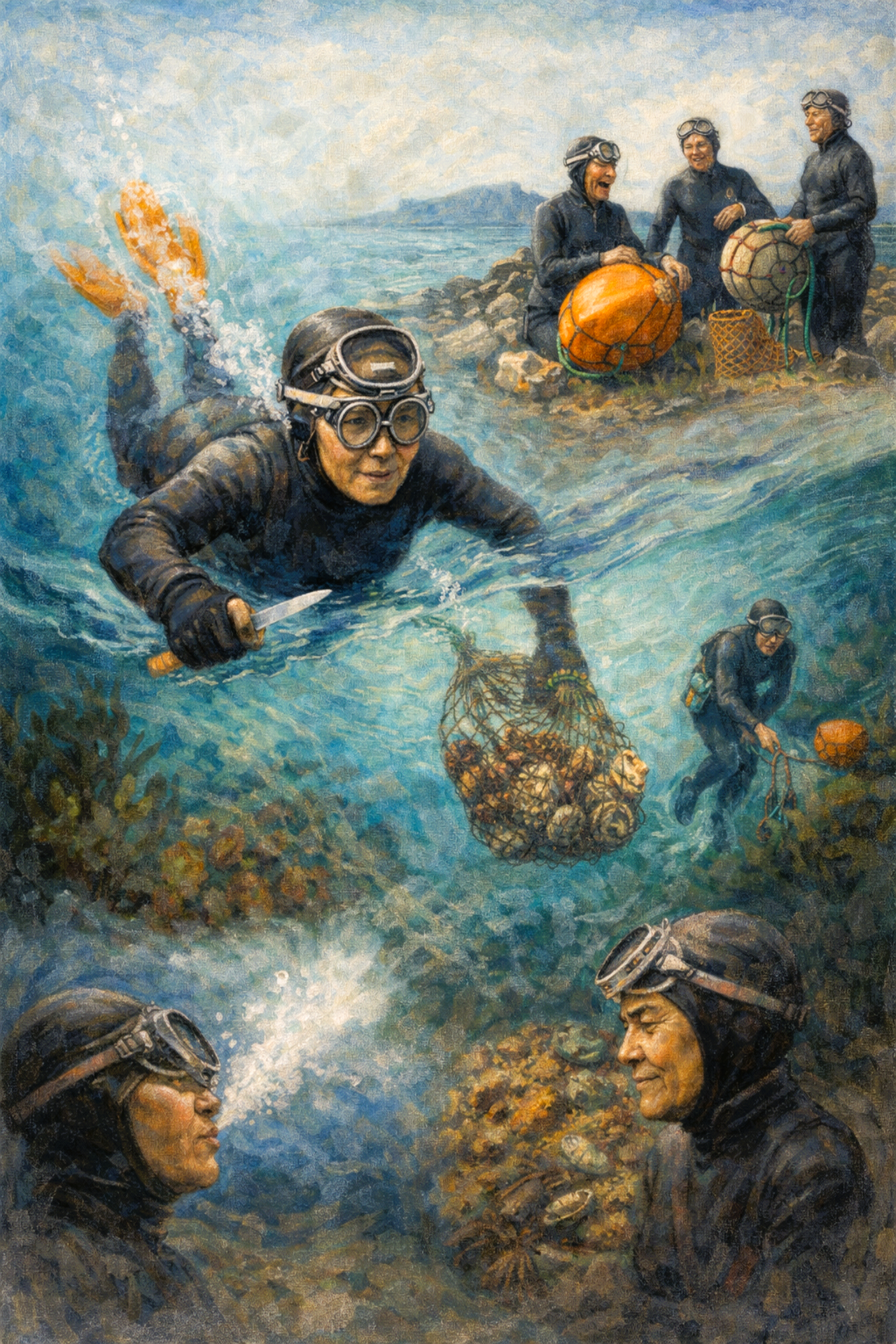
Haenyeo are elder women divers of South Korea’s Jeju Island who free dive without oxygen tanks to harvest marine life, practicing sustainable methods, communal labor, and an embodied wisdom that unites ecological knowledge, resilience, and an intimate, intuitive dialogue with the sea.
- Haenyeo embody a rare union of ecological skill, spiritual depth, and communal life.
- Their breath, rhythm, and risk-taking reveal an intimate, intuitive dialogue with the sea.
- They offer a living model for attention, resilience, and intellect-intuition union today.
The Grandmothers Of The Sea As Living Wisdom
To meet the Haenyeo is to encounter wisdom in motion rather than in books.
Clad in dark wetsuits, carrying simple nets and lead weights, these grandmothers of the sea descend again and again into cold water. Their classroom is the tide. Their library is the rocky seabed. Their philosophy is expressed not in treatises, but in breath.
For thenoetik, the Haenyeo are not only cultural figures; they are living metaphors for noesis – a direct, contemplative seeing of reality – and for the union of intellect and intuition. Their daily practice fuses knowledge, skill, and wordless attunement to currents, wind, and the cosmos.
They invite us to ask: What does it mean to know with the whole body? How might an elder diver, lungs burning under the waves, illuminate intellectual wellness for minds saturated by constant information yet starved of depth?
Historical And Geographical Context: Jeju Island And The Emergence Of The Haenyeo
Jeju Island, off Korea’s southern coast, is a volcanic world of black lava rock, wind-swept fields, and a sea that can turn from gentle to unforgiving within hours. This geography is not backdrop but co-author of Haenyeo culture.
For centuries, Jeju’s rocky soil offered limited agricultural security. The surrounding sea, however, held abalone, sea urchins, seaweed, and shellfish. Early diving was practiced by both men and women, yet over time women became the primary divers. Several historical factors converged: men’s conscription, maritime risks, and social expectations that allowed women to build an economy of the sea.
By the late Joseon period and into the twentieth century, Haenyeo divers formed powerful economic guilds. In some villages, their income surpassed that of men working on land. The sea became a space where gender roles were quietly renegotiated, and where women’s labor sustained families, funded education, and enabled a degree of autonomy rare in many agrarian contexts.
Jeju’s particular climate and currents demanded resilience. Winters were harsh; equipment was simple – initially cotton diving clothes, later neoprene wetsuits. The Haenyeo organized themselves into cooperatives, regulated harvest areas, and managed rights to particular coastal zones. Over generations, they cultivated an oral tradition of songs, rituals, and practical lore that fused maritime science with spiritual sensibility.
Today, the Haenyeo community is aging, and their numbers have declined. Yet they remain recognized in South Korea as bearers of intangible cultural heritage, representing both regional identity and a distinctive maritime civilization shaped by wind, stone, and water. (Culture of Jeju Haenyeo (women divers) – UNESCO Intangible Cultural Heritage)
Embodied Noesis: Intuition, Breath, And The Haenyeo’s Relationship With The Sea
When a Haenyeo inhales deeply at the shore’s edge, she is doing more than filling her lungs. She is entering a state of embodied noesis.
Without oxygen tanks, each dive is a negotiation with time. The Haenyeo study tides and weather; they cultivate lung capacity and mental calm. They descend perhaps ten to twenty meters, sometimes more, guided by memory of the seabed’s contours. A rope, a lead weight belt, a small knife, and a mesh net become extensions of their bodies. Culture of Jeju Haenyeo (Women Divers)
The characteristic sound that follows each dive, the sumbisori – a sharp, whistling exhale – is both physiological necessity and sonic ritual. It marks the threshold between immersion and return, between silent depths and shared surface. In this cyclical pattern of descent and ascent, breath becomes a teacher.
Intuition here is not vague feeling. It is a refined, tacit knowledge grown from thousands of dives: sensing subtle shifts in water temperature, reading wave textures, remembering where shellfish recover after past harvests. This is intellect-intuition union in practice – analytic understanding of seasons and species fused with an immediate, pre-verbal sensing.
The Haenyeo do not separate knowledge of the sea from being in the sea. Their epistemology is aquatic and embodied. In their discipline of breath-holding, we glimpse another way of thinking: not rapid and scattered, but rhythmic, cyclical, and rooted in the body’s dialogue with environment.
Ecology And Ethics: Sustainable Harvesting And An Intuitive Ecology
The Haenyeo’s livelihood depends on a fragile marine ecosystem. Long before sustainability became a global slogan, these grandmothers of the sea practiced a form of intuitive ecology.
They observe strict rules: minimum sizes for abalone, limitations on sea urchin harvests, seasonal closures to allow regrowth. Overharvesting is not only economically short-sighted; it violates a moral relationship with the sea, understood as both provider and unpredictable power.
This ecological ethic is community-enforced. Elders instruct novices in restraint: leaving young shellfish, avoiding breeding grounds, sharing information about depleted zones. The sea is approached as a partner in reciprocity rather than an inert resource to be extracted.
From the perspective of thenoetik, this reveals a union of marine science and intuitive noesis. The Haenyeo track changes in species distribution, water temperature, and storm patterns over decades. Their memories form a long-duration environmental archive that complements satellite data and formal research.
In a time when many humans encounter nature as scenery or data, the Haenyeo embody a participatory ecology. They remind us that every act of taking from the world is also an act of relationship – and thus, an ethical decision.
Intuitive Ecology In Practice: A Conceptual Overview
Aspect Of Practice | Haenyeo Expression | Ecological Meaning |
|---|---|---|
Harvest Limits | Leaving undersized shellfish, rotating harvest areas | Supports regeneration and long-term biodiversity |
Seasonal Rhythms | Diving aligned with spawning and growth cycles | Reduces disruption of reproductive patterns |
Communal Regulation | Village rules, cooperative decisions | Prevents competition-driven overexploitation |
Embodied Observation | Tracking currents, water clarity, and species behavior | Builds informal yet precise environmental record |
Spiritual Respect For Sea | Rituals, stories, and gratitude for marine abundance | Sustains ethical orientation toward ecosystems |
This table does not idealize the Haenyeo as flawless; rather, it clarifies how a lived, intuitive ecology can arise when survival, community, and environment are profoundly intertwined.
Gender, Age, And Resilience: Rethinking Strength, Labor, And Feminine Wisdom
The figure of the Haenyeo unsettles many assumptions about productivity, gender, and aging.
These are not young elite athletes sponsored by technology brands. Many are women in their sixties, seventies, or even eighties, still diving in cold water. Their bodies bear the marks of decades of labor: weathered skin, joint pain, hearing affected by pressure. Yet within their communities, they are recognized as pillars of competence and wisdom.
Historically, the Haenyeo inverted typical gender economies. Women’s ocean earnings often supported households and education, granting them a decisive voice in family and village affairs. Strength was defined by the capacity of female bodies to endure repetitive immersion, cold, and risk.
In the age of youthful productivity metrics, the Haenyeo offer another measure of value: accumulated, embodied expertise that ripens over time. An elder diver’s knowledge of currents, safe entry points, and how to calm a frightened novice cannot be downloaded or replaced by an app. It is transmitted through apprenticeship and shared dives.
Their example invites us to reimagine aging as a deepening of noesis rather than a simple decline of capacity. The aging female body, so often marginalized in dominant narratives, here becomes a site of autonomy, strength, and intergenerational guidance.
The Haenyeo As A Compass For Intellect-Intuition Union In Our Time
The story of the Haenyeo grandmothers of the sea is not a distant curiosity; it is a compass for our moment.
In their daily dives, we witness the union of intellect and intuition that thenoetik seeks to illuminate. Their knowledge is grounded in empirical observation and refined by generations, yet always open to the sea’s unpredictability. Their intuition is not opposed to reason; it is reason’s embodied partner, honed through repetitive practice, communal reflection, and intimacy with place.
They remind us that wisdom is not confined to academic institutions or digital archives. It can dwell in a weathered hand gripping a net, in lungs that have learned the exact threshold between staying and surfacing, in a community that holds both ecological data and ancestral stories.
To contemplate the Haenyeo is to ask ourselves:
- Where are we willing to dive deeply, again and again, until intuition becomes trustworthy?
- How might our own work – intellectual, creative, relational – mirror the rhythm of descent, engagement, and return?
- In what ways can we align our knowledge-seeking with the wellbeing of the ecosystems, human and more-than-human, in which we are immersed?
In an age that often prizes speed over depth and visibility over inner refinement, the Haenyeo stand at the shore like quiet sentinels of another possibility. Their lives suggest that true noesis arises when curiosity is patient, when intellect listens to intuition, and when the human heart acknowledges its place within a larger sea of life and cosmos.
In listening to these grandmothers of the sea, we are invited not only to observe but to reorient – to bring our own minds and bodies into a more harmonious conversation with the worlds we inhabit.
thenoetik recognizes in the Haenyeo a living answer to a timeless question: How can we think, feel, and act in ways that honor both the precision of intellect and the depth of intuition? Their reply, spoken through saltwater and breath, is simple and demanding: Dive, attend, and return, again and again, until knowing becomes a way of being.
Frequently Asked Questions
How deep do Haenyeo grandmothers of the sea dive without oxygen tanks?
Haenyeo grandmothers of the sea typically dive to depths of 10 to 20 meters while holding their breath for up to two minutes. Despite their advanced age, these divers rely on intense physical conditioning and specialized techniques to navigate the high pressure and cold temperatures of the Korea Strait without any mechanical breathing apparatus.
What is the meaning of the sumbisori whistle used by Haenyeo?
The sumbisori is a unique whistling sound made by Haenyeo grandmothers of the sea as they surface after a dive. This technique allows them to quickly expel carbon dioxide and inhale fresh oxygen. Beyond its physiological function, the sound serves as a vital safety signal, notifying other divers in the collective of their location.
What specific marine life do Haenyeo grandmothers of the sea harvest?
Haenyeo grandmothers of the sea primarily harvest high-value marine products such as abalone, conch, sea urchins, and various types of seaweed from the volcanic seabed. Their harvesting is strictly regulated by seasonal bans and size limits to prevent overfishing, ensuring that the Jeju Island coastal ecosystem remains productive for future generations of divers.
How are the diving ranks of Haenyeo grandmothers of the sea organized?
Haenyeo communities are organized into three hierarchical ranks based on experience and lung capacity: Hagun, Junggun, and Sanggun. The most experienced “Sanggun” divers mentor younger members and lead the collective decision-making process. This structure ensures that risk is managed effectively while maintaining the communal ethics and spiritual traditions of the diving group.
Why did women become the primary divers on Jeju Island?
Historical shifts during the 17th century led women to become the primary divers after men faced heavy taxation and conscription for naval service. As women became the primary breadwinners through diving, they established a unique matrifocal society on Jeju Island, overturning traditional gender roles and creating a resilient economic system based on female cooperation.