
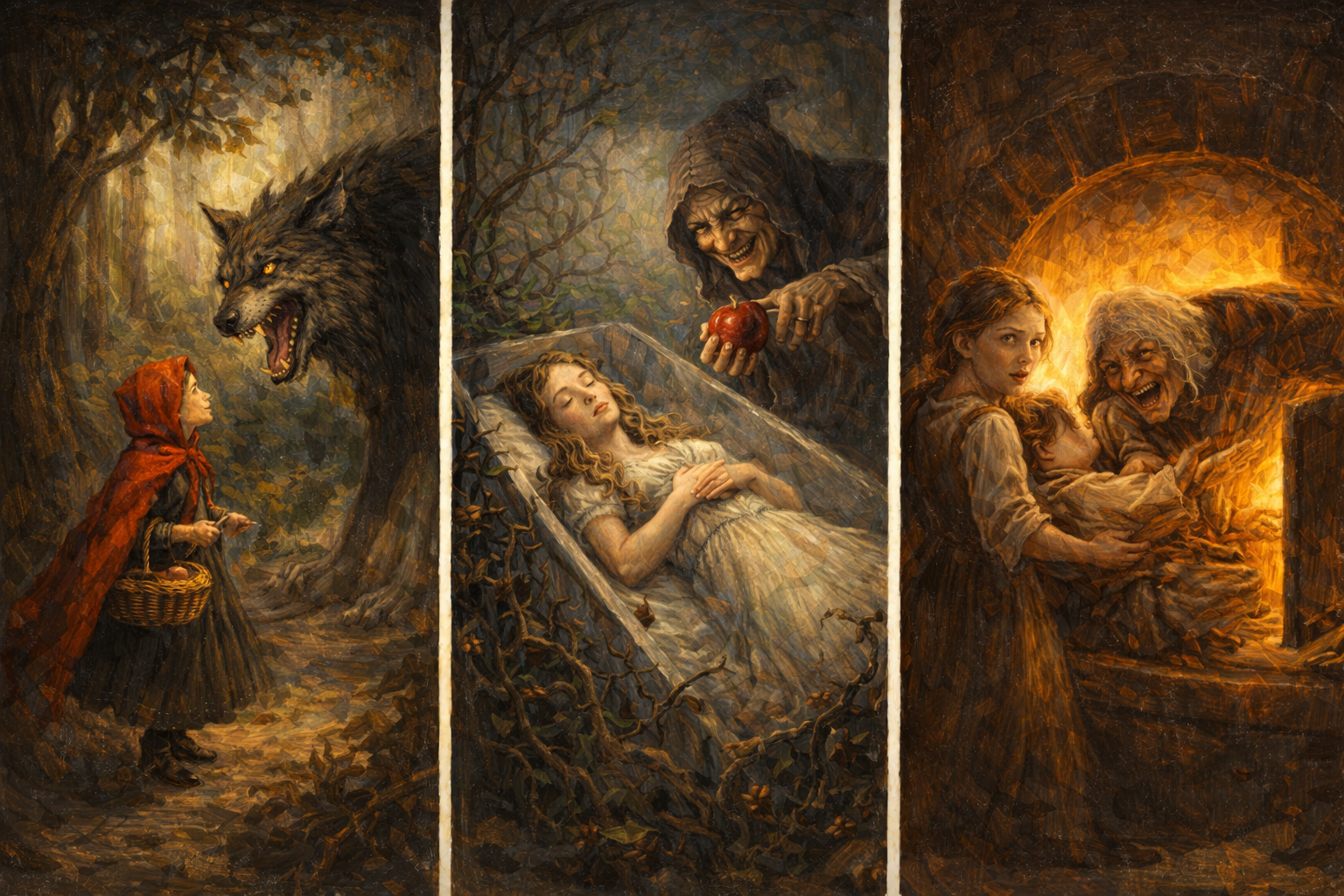
Fairy tales are dark because they arose from harsh worlds and speak in symbols, not realism. Their wolves, witches, and brutal punishments externalize fear, danger, and transformation so children can safely imagine, rehearse, and metabolize life’s hardest truths long before they face them directly.
- Dark fairy tales mirror harsh historical realities while translating them into symbolic form.
- Children usually experience brutal scenes as meaningful metaphors, not documentary violence.
- Removing all darkness can weaken stories’ power to build courage, boundaries, and inner wisdom.
The Modern Paradox: Brutal Stories for Small Children
Why are fairy tales so dark, and why do we keep handing them to children with soft blankets and warm milk?
Reading the original versions of Little Red Riding Hood or Snow White, many modern adults wince. Grandmothers are eaten. Evil queens dance to death in red-hot shoes. In Bluebeard, a husband hangs his previous wives in a hidden room.
It can feel like a mismatch: tender, unformed minds and stories filled with abandonment, mutilation, and death. No wonder many contemporary versions are sanded smooth into cheerful musicals and reassuring morals.
Yet for centuries, children have grown up on these same tales and drawn strength from them. The paradox invites a deeper question: what if the brutality of fairy tales is not a bug, but a feature—a symbolic technology that helps the young psyche rehearse danger, loss, and transformation.
Historical Roots: Tales Born in Harsh Worlds
Before fairy tales were printed in elegant volumes, they were told around hearths in eras of famine, plague, high infant mortality, and political violence. Life for “ordinary” people was precarious: forests were dangerous, hunger common, and authority could be arbitrary and cruel.
Stories like Hansel and Gretel make more sense in that light: abandoned children, a house made of food, a cannibalistic witch. To a pre-modern audience, this was a condensed mythic expression of real anxieties—scarcity, parental desperation, exploitation.
Oral traditions encoded survival knowledge and moral boundaries in vivid, unforgettable images:
- Don’t trust every stranger who promises comfort.
- The forest has rules; you can get lost there.
- Greed, cruelty, and envy have consequences, even if justice is delayed.
Violence mirrored the violence of the world, but in stylized, symbolic form. In a dangerous landscape, the sharpness gave the story weight; a gentle hint might not be enough to stay in a child’s memory.
Psychological & Symbolic Function: Brutality as Metaphor
From a psychological perspective, fairy tales function less like news reports and more like dreams.
Psychoanalytic and Jungian thinkers have long suggested that figures in fairy tales are externalized pieces of the psyche: the devouring witch, the dangerous stranger, the helpless child, the wise helper.
The brutality—wolves eating grandmothers, stepmothers ordering murders, princes locked in towers—does several things symbolically:
- Gives shape to formless fear.
A child’s anxiety about “something bad” becomes a wolf in the woods or a witch in a cottage. Anxiety that is pictured can be confronted, outwitted, even burned in an oven. - Stages separation and individuation.
Leaving home, losing parents, facing danger alone: these are emotional realities every child must navigate. Tales like Hansel and Gretel or Jack and the Beanstalk dramatize the leap from dependency to shaky self-reliance. - Marks boundaries and taboos.
Bluebeard’s forbidden room is not just a plot device; it represents the dark, secret side of adult sexuality and violence, and a warning against blind trust in power. - Represents inner transformation through outer danger.
Death and resurrection motifs—Snow White in the glass coffin, Sleeping Beauty’s century of sleep—mirror psychological passages: depression, latency, and awakening into new stages of life.
In this symbolic reading, violence is rarely random. It is the pressure that forces growth, the shadow that makes the hero’s courage meaningful. Without genuine danger, “happily ever after” becomes weightless.
Table: Brutal Scenes and Their Symbolic Work
| Tale & Dark Element | Surface Content | Possible Symbolic Function |
|---|---|---|
| Little Red Riding Hood – wolf eats Grandma | Predatory animal devours an elder | Stranger danger; threat of violation; loss of safe caregiver |
| Hansel and Gretel – witch cooks children | Adult plans to fatten and eat siblings | Fear of abandonment, exploitation, hunger, survival cunning |
| Snow White – queen orders murder, later punished | Envious stepmother seeks child’s death | Destructive jealousy; the cost of narcissism and cruelty |
| Bluebeard – room of murdered wives | Serial killer husband hides past victims | Taboo curiosity; danger of ignoring red flags in intimacy |
| Sleeping Beauty – century-long sleep | Princess pierced, kingdom falls into slumber | Developmental pause; transformation before sexual maturity |
The tales do not lecture about these themes in abstract terms. They embody them.
How Children Actually Process Fairy Tales
Adults often assume that children experience these tales as we do: with a fully developed sense of realism, empathy, and mortality. But children’s minds work differently.
Several developmental features matter here:
- Symbolic distance. Young children typically relate to fairy-tale figures as “story people,” not realistic individuals. A witch in a cottage is closer to a game-piece than a documentary human.
- Binary moral imagination. Classic tales often draw clear lines: good/evil, hero/villain. This clarity allows children to project vague inner conflicts (anger at a parent, jealousy of a sibling) onto external characters without being overwhelmed by guilt.
- Repetition as digestion. Children love to hear the same story over and over. Each repetition is a kind of emotional rehearsal: the fear rises, is managed, and resolves. Over time, the child internalizes a felt sense of “I can go through this and come out the other side.”
Bettelheim argued that fairy tales give children something they secretly crave: honest acknowledgment that the world contains danger, death, and unfairness—but also helpers, resilience, and surprising reversals.
Many children, when asked, are less disturbed by the dark parts than adults expect. They often focus on the resourceful hero, the clever trick, the ultimate safety. What haunts the adult—say, the idea of a cannibalistic stepmother—may for the child be a satisfying image of evil punished and order restored.
This doesn’t mean all children respond the same way, or that any tale is appropriate at any age. It does suggest that we should be cautious about projecting our adult sensibilities back onto the child’s symbolic universe.
Modern Sanitization: What We Change—and What We Lose
Compare the Grimms’ versions with many modern retellings or animated films, and you see a pattern: deaths softened, punishments erased, villains redeemed or turned comical.
- In some retellings, the wolf doesn’t really eat Grandma; she hides in a closet.
- Step-mothers are replaced with vaguely mean relatives.
- Bluebeard disappears entirely from many children’s shelves.
On one level, this is understandable. No one wants to traumatize children for entertainment’s sake. Yet when every sharp edge is blunted, the story’s psychological work can weaken:
- Reduced stakes, reduced courage.
If nothing truly terrible can happen, bravery becomes performance, not necessity. - Blurred moral contours.
Nuance about good and evil is crucial later, but young children often benefit from clearly drawn lines before they can navigate moral gray zones. - Silenced difficult truths.
Sanitized tales can collude with adults’ wish to avoid topics like death, cruelty, or betrayal—leaving children alone with questions they sense but cannot voice. - Thinner symbolism.
When the witch is merely “bad” but not truly dangerous, she stops carrying the full weight of the devouring, boundary-violating forces children sense in themselves and others.
The goal is not to sneer at gentle retellings or idealize every “original” version. It is to notice how changes in darkness change the story’s inner function—and then choose consciously rather than reflexively.
Practical Reflection for Adults: Sharing Dark Tales Consciously
How can parents, educators, and creatives engage with brutal fairy tales without either overprotecting or overwhelming children?
Here are guidelines, not rigid rules:
- Match the tale to the child, not just the age.
Some five-year-olds can delight in Hansel and Gretel; others may feel flooded. Pay attention to the child’s reactions during and after the story more than to generic age charts. - Respect the symbolic frame.
Present the tale as a story-world, not as a hidden documentary: “In this story, wolves can talk, and witches live in candy houses.” This preserves symbolic distance. - Don’t over-explain—but be available.
Let the story work on its own. If a child asks, “Did the witch really die?”, answer simply and calmly, then invite feelings: “Yes, in this story she did. How does that feel to you?” - Use repetition as a diagnostic and a tool.
If a child repeatedly asks for a dark tale, it may indicate that the story is helping them work through something. If they become increasingly anxious, it may be time to pause or shift. - Avoid sensationalism.
Dark elements should be told plainly, not with relish. The storyteller’s tone teaches the child how to hold the material—curious and steady, not gleeful or terrified. - Bridge to real life with care.
You might gently connect themes (“In the story, the children get lost. Have you ever felt lost or alone?”) without collapsing symbol into literal fear.
Instead of asking, “Is this tale too dark?” we might ask, “How can I be a grounded guide while this tale does its work?”
Conclusion: Brutal Fairy Tales as Gentle Training Grounds
The brutality in traditional fairy tales may be one of the gentlest tools we have for introducing children to life’s hard truths.
Instead of confronting loss, danger, and betrayal nakedly, the child meets them first as wolves and witches, as poisoned apples and forbidden rooms. The stakes feel real enough to matter but distant enough to be survived, again and again, in imagination.
Adults remain curators, interpreters, and companions. The task is less to erase darkness than to accompany children through it thoughtfully.
Before we soften a tale beyond recognition, we might pause and ask ourselves:
Which dark story stayed with you from childhood—and what secret strength, boundary, or question did it plant in you?
Frequently Asked Questions
Why are fairy tales so dark in their original versions compared to modern retellings?
Original fairy tales come from eras of famine, disease, and violence, so their plots reflect real historical dangers. Modern versions often remove killings, torture, and cruel punishments to suit contemporary sensibilities, but the earliest tellings used darkness to acknowledge how precarious everyday life truly was.
Why were dark fairy tales told to children?
Storytellers used dark fairy tales to help children grapple with fear, separation, and death in symbolic form. Witches, wolves, and murderous step-parents turn vague anxieties into clear images, allowing young listeners to “practice” facing danger and develop inner courage in a safe, imaginary space.
What real-life fears are behind stories like Hansel and Gretel?
Stories like Hansel and Gretel emerged from communities facing real hunger, child abandonment, and predatory adults. The extreme plot of a witch fattening children to eat them exaggerates real threats into a stark warning and a moral map for survival, caution, and recognizing hidden dangers.
How do children process the violence in dark fairy tales?
Children typically process fairy-tale brutality as exaggerated symbols rather than realistic gore. A swallowed grandmother feels more like a nightmare image than a news report. Psychological research suggests that, in safe contexts, these metaphors can help children verbalize fear instead of suppressing it, building emotional resilience.
What is lost when modern fairy tales are sanitized?
Removing the darkest elements can weaken themes of courage, justice, and transformation. Sanitized tales often keep the magic but lose real stakes, making danger feel trivial. When villains never truly threaten, children get fewer chances to imaginatively explore fear, resilience, and moral consequences.
Further reading & authoritative sources
Authoritative sources
- evolution of Grimm’s fairy tales — Explore how the Brothers Grimm originally collected their stories and why they evolved from blunt, tragic oral traditions into the versions we know today.