
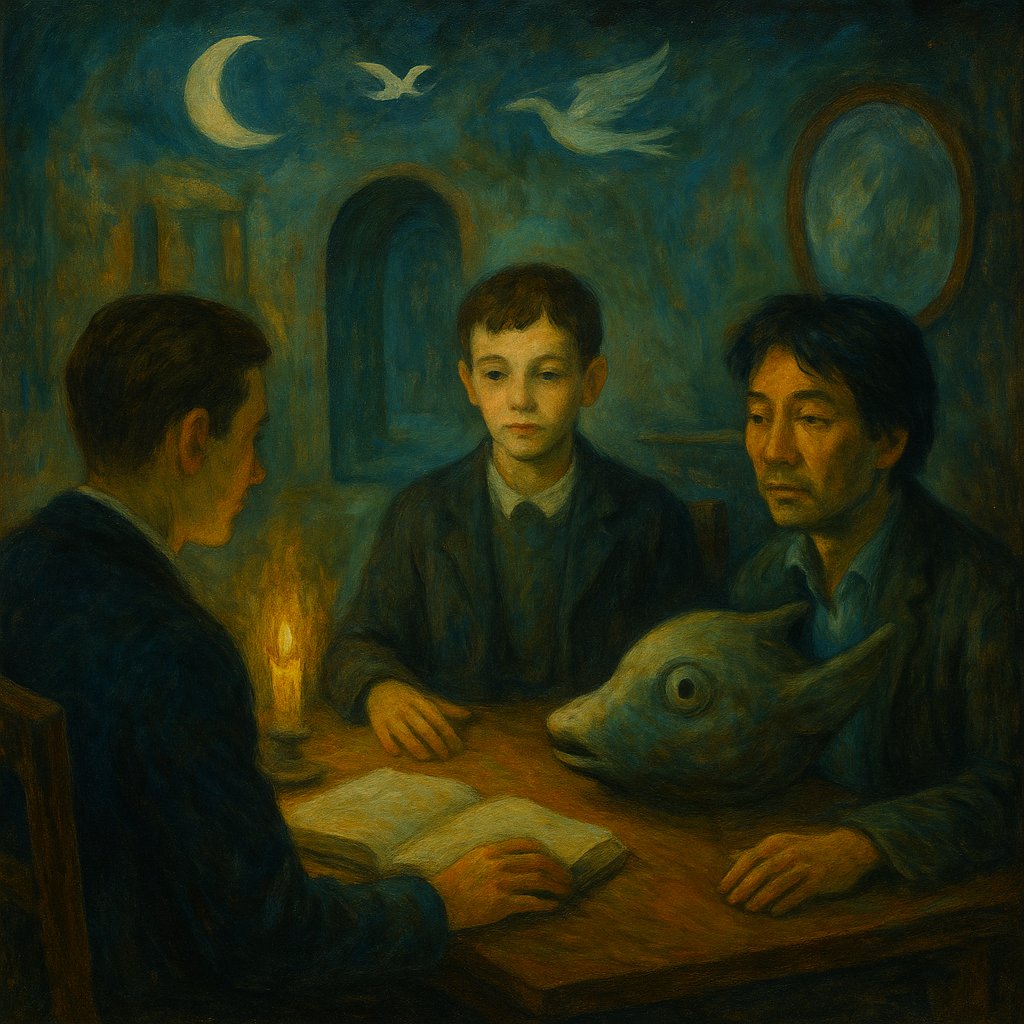
Introduction: dream logic in literature and the uncanny
Imagine waking on a familiar city street and noticing the lampposts have shifted an inch to the left—yet no one else seems to register it. The coffee you held tastes suddenly of a distant, unnamed memory. That tiny, persistent dislocation is a good way into understanding dream logic in literature. In short, dream logic in literature (oneiric fiction) is not mere spectacle; rather, it is an aesthetic technique that destabilizes everyday perception and invites readers to think with feeling.
Dream logic in literature operates on the level of expectation: it disrupts causal continuity, reorders priorities of meaning, and privileges affective association over linear explanation. Historically, writers have used this approach to probe ethics, epistemology, politics, and personal subjectivity. From early modern fantastic tales to 20th-century modernism and contemporary postmodern experiments, the oneiric mode keeps reappearing because dreaming is both universal and methodologically flexible.
What Is Dream Logic in Literature? (Oneiric Fiction Explained)
Dream logic in literature refers to narrative strategies that mirror the associative, non-linear, and affect-driven structure of dreaming. Unlike straightforward surrealism, these dreamlike narratives rely on subtle continuity, normalized uncanny events, and emotional resonance so that the impossible reads as inevitable.
Key mechanics include:
- Normalization of the uncanny: impossible events are treated as routine.
- Associative causality: scenes link by mood, motif, or symbol rather than strict cause-and-effect.
- Liminal spaces: doors, libraries, wells, train stations as portals to altered ontologies.
- Recursive motifs: mirrors, labyrinths, and repetition create dreamlike loops.
Moreover, this mode overlaps with related terms—oneiric literature, surrealism in fiction, and fantastical realism—but it specifically centers subjective perception and the uncanny.
Scholars of narrative theory note that dream logic in literature uses the reader’s pattern-seeking instincts against them. Instead of resolving patterns, dreamlike fiction proliferates them, asking readers to dwell in possibility rather than closure. As Sigmund Freud observed, “dreams are the royal road to the unconscious,” and oneiric fiction adopts this road for literary ends—allowing symbol, displacement, and condensation to carry philosophical weight.
Kafka Dream Analysis: dream logic in literature inside bureaucracy
Franz Kafka is often shorthand for modern anxiety, yet read closely he is a master of dream logic in literature. In The Trial, Kafka uses a matter-of-fact tone and gradual accretion of oddity—arrest in the middle of a workday, procedural absurdities—to make systemic absurdity feel dreamlike. As a result, readers experience the social world as if it were governed by opaque, shifting rules.
Techniques to note:
- Slow accretion of oddity so the uncanny is procedural.
- Neutral narrative voice that treats impossibility as administrative fact.
Case study: the opening scene of The Trial. Josef K. is arrested without being told the nature of his crime. Kafka’s strategy is to treat the arrest as if it were ordinary and technical—paperwork, late-night visitors, bureaucratic formalities—so the reader’s sense of outrage is diverted into bewilderment. This mirrors the feeling of dreams where bizarre events are accepted and only later do their implications surface. Kafka’s deadpan voice functions like a dream’s unquestioning register: the world is wrong, and you must learn its rules by stumbling through them.
Therefore, Kafka’s dream logic destabilizes social reality by folding the extraordinary into everyday systems (a hallmark of Kafkaesque themes). His famous injunction, often paraphrased as “a book must be the axe for the frozen sea within us,” captures how dreamlike fiction aims to cleave rigid assumptions.
Borges’ Dream Literature: oneiric labyrinths, mirrors, and metafiction
Jorge Luis Borges channels dream logic into conceptual and metafictional plays. His short fictions are intellectual dreams in which ideas—libraries, mirrors, infinite books—become literal, and form echoes content. For instance, “The Library of Babel” literalizes infinity as a hexagonal library containing every possible book; this conceptual literalization creates epistemic vertigo.
Distinctive techniques (Borges dream literature):
- Conceptual literalization: abstract puzzles made material.
- Labyrinthine form: story structure that loops, bifurcates, or nests.
- Metafiction and dreams: stories within stories that unsettle authorship.
Case study: “The Garden of Forking Paths.” Borges creates a literary model of time as branching possibilities—each narrative choice creates its own reality. The story reads like a lucid dream about decision and consequence, where each imagined path is as real as the one experienced. Borges famously said, “I have always imagined that Paradise will be a kind of library,” an image that doubles as a dream and an epistemological claim: knowledge itself can be oneiric.
Borges’ oneiric technique invites readers to inhabit paradox and to interrogate the stability of meaning. His short fictions function like intellectual dreams—tight, intense, and recursive—inviting multiple re-readings as one would revisit a vivid dream to catch missed details.
Murakami’s Dreamlike Novels: oneiric narratives, liminality, and pop culture
Haruki Murakami adapts dream logic into a contemporary, pop-inflected idiom. His novels blend suburban banality with surreal intrusions—talking cats, other worlds accessed via wells or forests—so ordinary objects (songs, canned coffee) anchor the uncanny.
Murakami techniques (Murakami dreamlike novels):
- Liminal settings: bars, train stations, and apartments as portals.
- Pop-cultural anchors: music and brands tether the oneiric to the familiar.
- Emotional interiority: dream events refracted through loneliness and longing.
Example: Hard-Boiled Wonderland and the End of the World splits narrative frames between a noirish Tokyo and a fable-like internal town separated by an unexplained cognitive barrier. Murakami uses music (Beatles, jazz), food, and quotidian rituals as touchstones so that a surreal rupture—such as memory partitioning—feels intimate rather than purely metaphysical.
Expert insight: Murakami has noted in interviews that he writes from a sense of loneliness and curiosity; this emotional core explains why his dream logic in literature often foregrounds affect. Readers are not merely puzzled; they feel alongside the characters, making the uncanny emotionally persuasive.
Consequently, Murakami’s oneiric fiction makes the extraordinary feel domestically plausible and emotionally true.
Comparative Analysis: dream logic in literature across three writers
Across Kafka, Borges, and Murakami we find shared mechanics and distinct aims.
- Shared: normalization of the impossible; associative causality; liminality as structural device.
- Different: Kafka’s procedural, juridical uncanny; Borges’ philosophical and metafictional puzzles; Murakami’s intimate, pop-cultural porosity.
Comparative case study: approach a single motif—the mirror. Kafka’s mirror, if present, tends to reflect institutional identity crises; Borges’ mirrors may multiply reality ad infinitum and become metaphors for authorship; Murakami’s mirror will often refract personal memory and longing, revealing emotional doubles. Reading similar motifs across authors demonstrates how the same dream logic device performs divergent tasks: social critique, epistemic thought experiment, or interior therapy.
In effect, dream logic in literature can either diagnose social systems (Kafka), probe epistemology (Borges), or reshape personal reality (Murakami). Together they show how narrative can hack our predictive models of experience and rewire what we consider plausible.
Creative Toolkit: how to write dreamlike narratives (oneiric fiction prompts)
Try these concise techniques and prompts to practice dream logic in literature:
Techniques
- Normalize the impossible: present an impossible event as routine; avoid explanation.
- Use associative transitions: link scenes by motif, sound, or smell rather than causal steps.
- Center thresholds: make a doorway, library, or train station the axis of change.
- Condense and displace: let details stand in for larger meanings, as dreams often condense multiple concerns into a single image.
Step-by-step guide to drafting a oneiric scene
- Choose a mundane setting: kitchen, office, train station.
- Introduce a single anomaly: a ticking clock that runs backward, a neighbor who never blinks.
- Describe reactions as if the anomaly is unremarkable.
- Use associative links—music, smell, an old photograph—to move between images rather than logical transitions.
- End with a paradoxical closure: a loop, a reversed action, or an unresolved door.
- Revise for tone: aim for neutrality in voice if you want Kafkaesque effects; use lyrical precision for Borgesian intensity; add pop-cultural detail for Murakamiesque intimacy.
Prompts
- “A Complaint Against Time”: write a 500-word vignette where someone files a formal complaint about time’s behavior—keep a procedural tone (Kafka dream analysis practice).
- “Mirror Library”: describe a commune gym whose mirrors reflect alternate lives (Borgesian oneiric twist).
- “Doppelgänger Playlist”: a song shifts a character into an alternate memory-world (Murakamiesque mood).
Micro-exercises
- 10-minute associative paragraph: start with a broken watch and free-write nonlinearly.
- Threshold inventory: list ten liminal spaces in your city and imagine one impossible rule for each.
- Swap tones: write the same scene in Kafkaesque, Borgesian, and Murakamian voices to study how tone shapes dream logic.
How Dream Logic in Literature Changes Reading and Perception
Reading dreamlike narratives trains tolerance for ambiguity and heightens sensitivity to symbolic resonance. Instead of primarily asking “What happened?”, attentive readers learn to ask “What does this feel like?” or “Which hidden rule governs this world?” Consequently, dream logic in literature supports the Noetik aim of combining intellect and intuition—noesis—by making feeling an epistemic tool.
Expert insight: literary critic Elaine Scarry and narrative theorists argue that certain forms of fiction cultivate what cognitive scientists call “counterfactual thinking”—the ability to hold multiple potential realities simultaneously. Dreamlike fiction is a laboratory for such thinking: it invites readers to simulate alternate rules and thus expands cognitive flexibility.
Practical application: educators and therapists have used oneiric texts to prompt reflective writing and dream analysis exercises. Because dream logic foregrounds metaphor and association, it can help readers surface hidden anxieties or creative hypotheses about their lives.
Oneiric Fiction Reading List: books about dreams and reality
- Franz Kafka — The Trial; The Metamorphosis (recommended translators: Michael Hofmann, Stanley Corngold).
- Jorge Luis Borges — Labyrinths; Selected Fictions.
- Haruki Murakami — Hard-Boiled Wonderland and the End of the World; Kafka on the Shore.
- Sigmund Freud — “The Interpretation of Dreams” and “The Uncanny” (foundational theoretical background).
- Mark Solms — The Neuropsychology of Dreams (bridges neuroscience and dreaming).
- Italo Calvino — Invisible Cities (for poetic, dreamlike cityscapes).
Each of these texts offers a different lesson in how dream logic in literature can be deployed: Kafka for social diagnosis, Borges for conceptual play, Murakami for emotional access, Calvino for poetic mapping.
Conclusion & Noetik Nugget
Dream logic in literature is a method as much as a mood: it disrupts predictive models of reality to surface alternative modes of seeing. Kafka diagnoses systemic opacity; Borges maps intellectual paradox; Murakami makes the everyday porous. Each invites us to mix intellect with feeling—thus expanding perception.
Actionable recommendation: try one micro-exercise above, then journal for a week about recurring motifs that appear in your waking life. You may find that practicing dream logic in literature sharpens both creative writing and everyday noticing.
References (authoritative sources cited for framing and further study): Stanford Encyclopedia of Philosophy (dreams) and Britannica (Sigmund Freud). See external links below for details.