
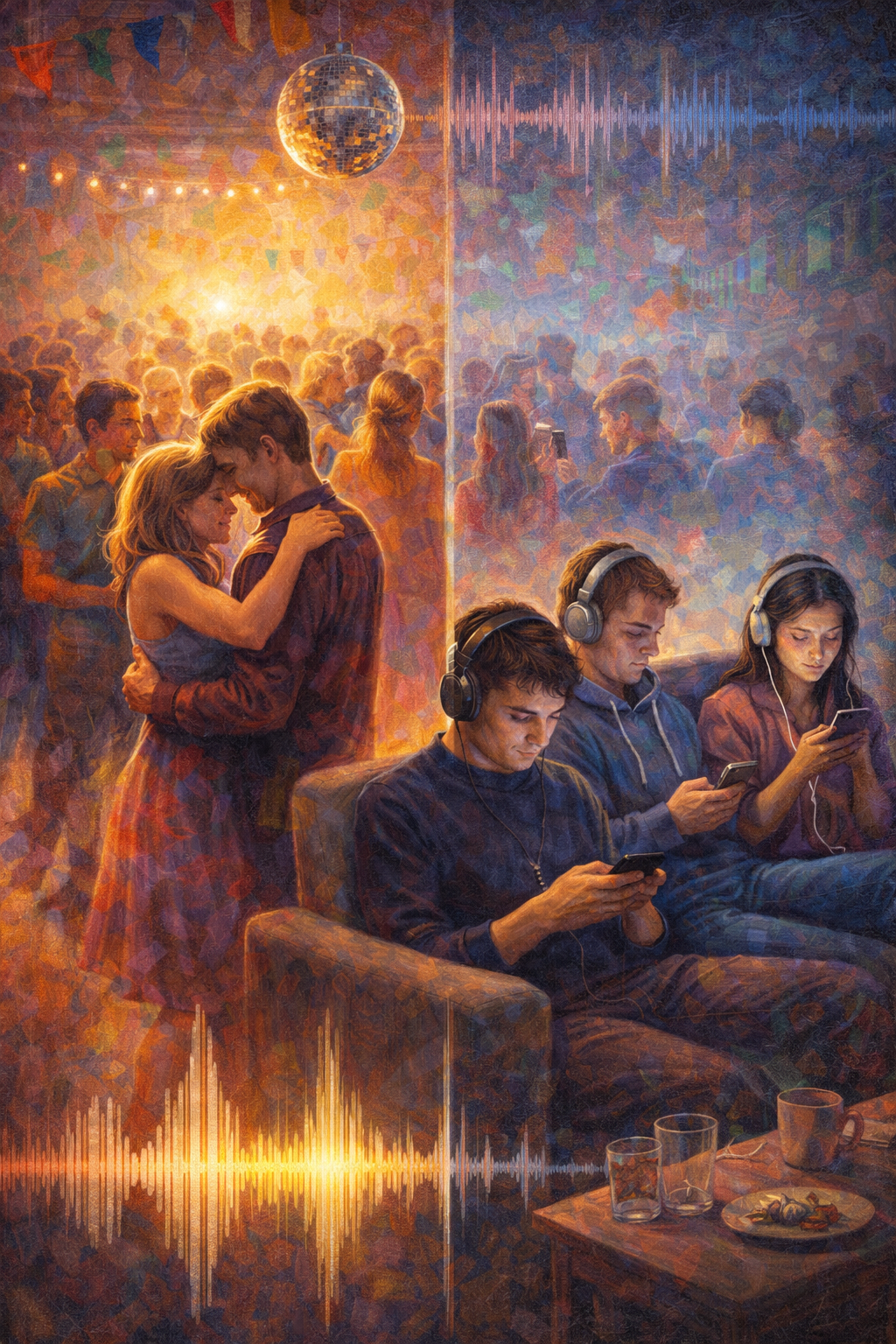
The decline of shared music experiences describes how fragmented media, personalized algorithms, and endless choice have reduced the songs and moments almost everyone knows. As common musical touchstones fade, our ways of forming connection, memory, and meaning shift—from automatic cultural synchrony to more fragile, intentional forms of togetherness.
- Shared songs once acted as cultural campfires, synchronizing strangers into a temporary “we.”
- Personalized media weakens common reference points while enabling diverse, niche communities.
- Conscious, noetic curation can transform lost monoculture into deeper, chosen forms of connection.
A Dance Floor Then, Headphones Now
Imagine a school gym in the late twentieth century. The lights drop, a slow song begins, and an entire room recognizes the first note. Conversations pause. Some people rush to the dance floor, some pretend not to care, but everyone knows the song and what it means in that moment.
Now picture a living room today. Three friends sit together, each scrolling on their own device. One is absorbed in a niche ambient playlist, another in regional rap, the third replaying a soundtrack discovered via a short-form video clip. All are listening, but not to the same thing. There is no single song to cue a shared memory, no obvious soundtrack for the evening.
The contrast is not simply about nostalgia. It points to a larger cultural shift: the quiet, ongoing decline of shared music experiences—and with them, an easy, almost taken-for-granted sense of “we were there, together.”
What We Used To Share
For much of the broadcast era, music moved through narrow channels. A handful of radio stations, a few televised music programs, later a limited set of music video outlets. Scarcity did not mean uniform taste, but it did mean overlapping horizons. There were songs you might not love, but you could not avoid.
Those songs became social coordinates. A summer hit might mark your first job, a school dance, a long bus ride. Because so many others heard the same tracks, these private memories were also part of a wider story. You could mention the chorus at a party years later and watch eyes light up in instant recognition.
Shared songs functioned as rites of passage. The first concert “everyone” went to. The soundtrack that seemed to belong to an entire year of adolescence. The track that unified a stadium, not only in sound but in feeling. Even those who disliked the dominant music still defined themselves in relation to it.
This did something quiet but profound. It wove a loose fabric of collective memory. Our individual timelines had common chapters, written in the language of melodies and lyrics. To say “Remember when that song was everywhere?” was to invoke not just a sound, but a season of life.
The Age Of Infinite Choice
Today, we live in abundance. Streaming platforms and digital libraries offer more music than any one person could hear in a lifetime. Algorithms learn our preferences, separating our listening into highly individualized streams.
The result is cultural fragmentation. Instead of one large river of mass culture, we get countless tributaries: micro-genres, fandoms, playlists tailored not just to a mood but to a data profile. The odds that you and a stranger share the same sonic landscape shrink dramatically. The Death of the Shared Musical Experience
This shift transforms how memory works. A popular broadcast song once acted like a temporal landmark: it helped you remember when something happened and linked your life to others through that reference. In the age of infinite choice, your personal soundtrack may be meaningful to you, but it is rarely legible to the wider world.
Moments still have music, but fewer of those tracks become universal shorthand. Instead of “our generation’s anthem,” we have parallel anthems, each powerful within its own bubble. The common cultural sky fractures into constellations visible only inside particular apps, subcultures, or algorithmically sorted groups.
This is not a story of simple loss. It is also a story of access and representation: voices that would once have been excluded can now be heard and find their communities. The question is how we live with both the gain in diversity and the erosion of effortless shared memory.
Memory, Meaning, And Noesis
Music is not just entertainment; it is a carrier of time. A few notes can collapse decades, returning you to a room, a feeling, a version of yourself. Philosophers of memory might call this a bridge between past and present consciousness—a lived example of how experience is stored and reawakened.
When many people share that same song-bridge, it becomes a piece of collective memory. We remember not only as individuals but as a group: “we met at that concert,” “we all sang that chorus at the top of our lungs,” “the city felt different when that album came out.”
From a noetic perspective—the union of intellect and intuition—these shared songs act as symbols that connect inner life with outer world. Intellect recognizes structure: verses, harmonies, genre. Intuition feels the texture: longing, joy, defiance, tenderness. When we gather around the same music, our inner and outer worlds briefly synchronize.
The decline of shared music experiences, then, is not just a market trend. It touches how we experience ourselves as part of a larger field of consciousness. Without common songs, our inner lives risk becoming more private, harder to translate. We may feel deeply, but we lack ready symbols that others immediately understand.
At the same time, the noetic lens reminds us that meaning is not given only by mass systems. Inner wisdom can also guide us to curate and create new shared symbols—more intentional, less dictated by broadcast power.
Gains And Losses In A Fragmented Soundscape
What we lose:
- A common language of reference. It is harder to assume that a casual musical reference will land with a mixed group.
- Effortless bonding. Singing along to the same chorus in a crowd once created instant, low-friction connection among strangers.
- Shared nostalgia. Generational identity becomes fuzzier when there is no single soundtrack that “everyone” recognizes.
What we gain:
- Diversity of voices. Niche genres and marginalized artists can find listeners without passing through a single cultural gate.
- Finer-grained belonging. Micro-communities form around specific sounds, scenes, and aesthetics that resonate deeply.
- Creative autonomy. Listeners and artists alike are less constrained by mass expectations.
The tension between nostalgia and progress is real. Monoculture could be exclusionary and flattening, yet it gave us common ground. Fragmentation liberates and isolates at the same time. The question becomes: how do we keep the richness of pluralism while reclaiming some of the connective power of shared experience?
Pros And Cons Of Shared Versus Fragmented Music Culture
| Dimension | Shared Broadcast Era | Fragmented Personalized Era |
|---|---|---|
| Cultural Touchstones | Few, widely recognized songs and artists | Many, mostly known within niches |
| Sense Of “We” | Strong, but often centered on dominant groups | Weaker overall, stronger within micro-communities |
| Representation | Limited diversity, gatekeeper-driven | Greater inclusion, algorithm and community-driven |
| Memory Anchors | Common soundtracks mark eras and events | Highly personal soundtracks, fewer collective anchors |
| Creative Constraint | Artists shaped by mass-market expectations | Artists freer to explore, but harder to reach everyone |
From Passive Sharing To Conscious Connection
In the broadcast age, shared music experiences were largely passive. You heard what the station played; you watched what the channel aired. Collective memory arose almost as a side effect of centralized distribution.
Today, that automatic synchrony has weakened. But this absence can be read as an invitation rather than a verdict. If shared songs no longer arrive pre-packaged, we are called to become more conscious curators of our own common ground.
This is aligned with a noetic approach: instead of letting algorithms silently decide the soundtrack of our days, we can bring awareness to how music shapes perception, mood, and relationship. We can ask: What do we want to remember together? What sounds could hold that memory?
The decline of shared music experiences shifts us from being receivers of culture to participants in its ongoing composition. Connection becomes less about consuming the same thing at the same time and more about intentionally weaving threads between inner life, others, and the wider world.
Noetic Practices For Shared Memory
Re-enchantment does not require grand gestures. Small, thoughtful rituals can gently rebuild shared musical spaces.
1. The Weekly Listening Circle
Choose a recurring time—perhaps one evening a week—where a small group gathers, in person or online, to listen to one album or curated set of songs from start to finish. Phones aside, notes welcome. Afterward, share what images, memories, or questions arose.
This simple practice restores attention to music as an event, not background noise, and lets different inner worlds meet around a common soundtrack.
2. Intergenerational Playlist Exchanges
Invite an older and a younger person in your life—family, colleagues, neighbors—to exchange playlists of ten songs that mattered deeply in their formative years. Listen with care, then talk about the stories behind the tracks.
Here, music becomes a bridge across time. Instead of lamenting “kids these days” or idealizing “back then,” you create a shared archive of feeling and experience.
3. Soundtracking Shared Moments
When planning a gathering, consider not only food and logistics but also the sonic memory you are creating. Choose one or two songs to mark the beginning or end—a track that, if heard years later, might bring people back to that evening.
This is not about manufacturing meaning, but about honoring that sound can carry it. You are composing future memory with intention.
Closing Reflection And A Noetic Question
We may never again live in a world where a single song unites an entire generation. The era of monoculture is unlikely to return, and perhaps it should not. Yet the human need that those shared songs addressed—the desire to feel part of a story larger than a single life—remains.
If shared music experiences no longer arrive automatically, we are invited to participate more consciously in how they arise. The question is not only what we are listening to, but with whom, and to what end.
What songs, if any, are quietly becoming the shared soundtrack of your relationships right now? And how might you, with a bit of inner listening and outward courage, help compose the memories that others will one day say, “We were there for that”—and mean it?
Frequently Asked Questions
What technological shifts are primarily causing the decline of shared music experiences?
The decline of shared music experiences stems from the transition from communal broadcasting (radio and TV) to private, on-demand streaming. Personalized algorithms and high-fidelity headphones isolate listeners into individual “sonic bubbles,” replacing universal cultural touchstones with fragmented, niche content that rarely achieves the broad social reach once seen in the analog era.
How does the fragmentation of music listening impact collective cultural memory?
When musical experiences are individualized, society loses “cultural campfires”—songs that define specific eras or seasons for everyone. Instead of shared nostalgia anchored in a few massive hits, memories become hyper-personalized. This makes it harder for different generations or social groups to find common ground through universally recognized auditory milestones.
What is the difference between musical “monoculture” and today’s niche listening communities?
A musical monoculture relies on a few gatekeepers (radio DJs, MTV) to synchronize public taste around specific hits. In contrast, today’s niche communities are formed through intentional, algorithm-driven discovery. While the monoculture provided automatic social cohesion, modern niche listening offers deeper personal connection to specific genres but lacks broad, societal synchronization.
How can individuals reintroduce synchronized listening into a fragmented media landscape?
Rebuilding shared music experiences requires intentional effort, such as hosting dedicated album listening parties or creating collaborative playlists for social gatherings. By agreeing to put down individual headphones and engage with a single “house soundtrack,” groups can restore the communal “noetic” curation that was once a natural byproduct of public radio and television.
Why do personalized recommendation algorithms reduce the likelihood of “everyone knows this song” moments?
Algorithms prioritize individual user behavior over broad demographic trends, creating unique “Filter Bubbles” for every listener. This hyper-personalization ensures that two people standing next to each other likely have entirely different soundtracks. Consequently, the statistical probability of a single song reaching “mass saturation” across all social strata has plummeted significantly.
Further Reading & Authoritative Sources
From thenoetik
- nostalgia as a cultural phenomenon — This post explores how shared nostalgia acts as a cultural anchor, directly relating to the decline of shared memories in music.
Authoritative Sources
- The ‘Song of the Summer’ Is Dead. Thank God for Th — Explores the disappearance of universally shared hits like the ‘song of the summer’ and argues that algorithmic feeds and fragmented listening have eroded common musical touchstones and shared experiences.
- ‘Streaming has killed the mainstream’: the decade — Analyzes how streaming and cultural overload weakened the pop monoculture, making it harder for people to share the same songs and artists—directly addressing the decline of shared music experiences.