
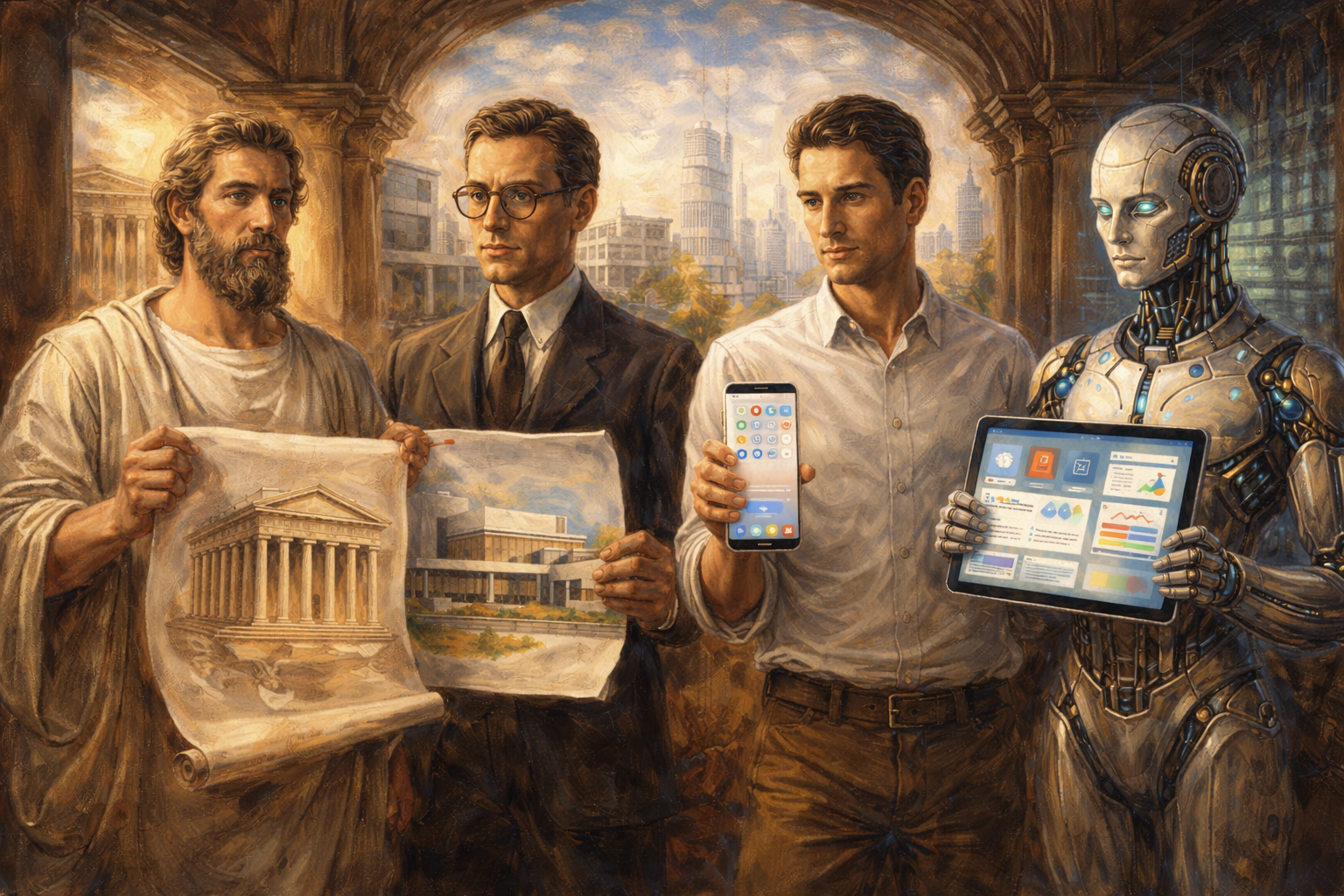
Clean design trends are never purely technical styles but mirrors of their eras’ desires for order, purity, and control. Each period declares its own visual language the cleanest, revealing shifting ideas about truth, progress, and what must be simplified, erased, or quietly left outside the frame.
- Clean design trends are historically relative, not timeless laws of visual order.
- What we call cleanliness often hides cultural, class, and technological assumptions.
- Questioning cleanliness in design can open space for more honest, situated aesthetics.
The Confidence Of Every Age In Its Own Cleanliness
Stand in almost any era and listen closely: you will hear some variation of the claim, “At last, we have cleared away the clutter.” Classical architects said it about harmonious proportions; modernists said it about the machine aesthetic; today’s interface designers say it about minimalist apps and frictionless user journeys. Bauhaus, 1919–1933
Each generation looks back at previous styles as visually noisy, morally confused, or technologically primitive. Gothic becomes “excess”; baroque, “overwrought”; skeuomorphic interfaces, “dated and busy.” The present feels like the moment when we have finally discovered the truly clean line, the honest surface, the pure interface.
But this confidence is fragile. Give it a few decades and our own clean design trends will likely seem quaint, maybe even suffocating. This cycle is not a failure of taste. It suggests that cleanliness in design is less an objective endpoint and more a recurring cultural dream: the dream that the mess of history, ambiguity, and difference can be smoothed into a single, clear form.
A Brief Genealogy Of Clean Aesthetics
If we trace a loose genealogy of visual cleanliness, we do not find a single straight line toward simplicity, but a pattern of redefinitions.
Classical Harmony And Ordered Complexity
In many classical traditions, cleanliness did not mean emptiness. Greek temples, Roman forums, and similar structures valued proportion, symmetry, and legible structure. Ornament existed, but it was ordered, subordinated to an ideal of rational harmony.
Clean, here, was the opposite of chaos. What mattered was that the viewer could sense an underlying logic, a cosmos of relations.
Enlightenment Grids And Printed Order
The rise of printing and the Enlightenment intensified the link between visual order and rational clarity. Typefaces were refined; page layouts disciplined into grids. Scientific diagrams and encyclopedias sought a visually ordered representation of an ordered world.
Clean design trends in this era expressed faith that reality itself could be sorted, indexed, and made legible – an epistemological cleanliness.
Modernism, Bauhaus, And The Moral Line
In the twentieth century, movements such as Bauhaus, International Style architecture, and later Swiss graphic design radicalized the idea of cleanliness. Ornament, famously, became “crime.” The clean line, the unadorned surface, and the absence of decoration were cast as ethical and rational. (The Evolution of Minimalism in Graphic Design)
Clean meant functional, honest, industrial. To strip away embellishment was to align with progress, efficiency, and a universal visual language presumed to transcend culture and class. The sparse room, the sans-serif typeface, the undecorated façade: these promised a morally purified world.
Minimalism, Consumer Tech, And Digital Flatness
Late twentieth- and early twenty-first-century consumer technology bent modernist cleanliness toward desire. Sleek devices, monochrome palettes, and ultra-simplified interfaces became aspirational. Companies wrapped minimal aesthetics in narratives of innovation and lifestyle.
Flat UI, generous white space, and restrained color schemes were praised as clean because they suggested effortlessness. The interface disappeared so the experience could feel frictionless. The story of cleanliness shifted again: not just rational or moral, but seamless and invisible.
Across these shifts, one pattern holds: cleanliness is whatever visual language allows an age to imagine itself as more lucid, more advanced, and more in control than what came before.
The Psychology Of Cleanliness And Purity
Behind these historical turns is a quieter psychological dynamic. Humans are drawn to order not just for comfort but for meaning. Cleanliness feels like a promise: that the world is intelligible, that we can sort signal from noise.
Simplicity As Truth
When a design is sparse, we are tempted to believe that nothing important is being hidden. A single bold line, a monochrome space, an uncluttered interface all seem to say, “This is the essence.”
This intuition echoes philosophical minimalism: the belief that truth lies in the reduction to fundamentals. But what feels like essence may simply be what has been chosen and what has been discarded.
Order, Anxiety, And Control
Visual order also calms anxiety. In a world saturated with information and stimuli, clean design offers a kind of psychic breathing room.
There is comfort in the empty margin, the quiet palette, the predictable grid. But comfort is not neutral. It often aligns with a desire to control what enters the field of attention – and, by extension, which aspects of reality we are willing to engage.
Progress And The Shedding Of Skins
Every new wave of cleanliness casts itself as a shedding of unnecessary skin. We feel we are moving closer to the “real thing.” This sense of progress is deeply flattering; it reassures us that our own time has finally matured past the confusion of earlier eras.
Yet this very confidence should make us suspicious. If each age feels this certainty and later sees it as naivety, perhaps the feeling of having arrived is itself part of the cycle.
Technology, Interfaces, And The Shape Of Clean
What counts as clean is never independent of the tools with which we see and make.
Print, Industrial Production, And Standardization
The printing press made typographic consistency possible. Industrial manufacturing enabled identical products. These technologies encouraged a belief that cleanliness meant repeatability, alignment, and standard form.
Cleanliness became measurable: straightness, uniformity, the absence of visible labor. The machine’s aesthetic bled into architecture, graphic design, and product form.
Screens, Pixels, And Interaction
The rise of screens transformed cleanliness again. Early graphical interfaces borrowed from the physical world: simulated textures, glossy buttons, three-dimensional shading.
Later, as users internalized digital conventions, flat design and iconographic abstraction felt cleaner. Clutter shifted from “too much detail” to “too many elements.” Icons, whitespace, and motion replaced material illusionism as markers of cleanliness.
Algorithms And Generated Aesthetics
With AI and generative tools, a new kind of cleanliness emerges: endlessly smooth gradients, perfectly aligned compositions, and pattern-rich minimalism. Imperfections can be removed with a click; asymmetries can be algorithmically corrected.
Here, cleanliness risks becoming a statistical average: the composite of countless preferences ironed into a generic, inoffensive visual order. What is lost in this smoothing is not just noise but idiosyncrasy, locality, and the visible trace of time.
Power, Culture, And What Gets Erased
To call something clean is always, implicitly, to call something else clutter. That judgment is never purely aesthetic; it carries social, cultural, and political weight.
Whose Order, Whose Noise?
The white, sparse interior often celebrated in design magazines is not merely a neutral style. It quietly encodes assumptions about space, ownership, and labor: who can afford emptiness, who maintains it, whose objects are allowed to be visible.
Similarly, “busy” visual cultures – vibrant signage, layered patterns, dense typography – are often dismissed as chaotic or unrefined. But what appears as noise from one vantage point may be a rich code of meaning from another.
Minimalism As Gatekeeper
When a specific aesthetic of cleanliness becomes the standard of professionalism or sophistication, it can marginalize other visual languages. Cultural motifs, vernacular ornament, and signs of everyday life may be deemed unclean, unfit for serious spaces.
In this sense, cleanliness becomes a soft instrument of exclusion. Complexity is not eliminated; it is displaced.
Erasure Of Imperfection And History
Clean design trends also tend to hide traces of wear, repair, and improvisation. Patina, graffiti, hand-corrected labels, and overlapping posters tell stories of time and use. To erase them in pursuit of visual purity is to curate memory itself.
What we call clutter may be the visible record of lives lived in and through space. When we scrub that record away, we are not only designing; we are editing reality.
Table: Myths And Realities Of Clean Design
Myth About Clean Design | Underlying Reality |
|---|---|
Clean design is timeless and neutral | It reflects specific historical, cultural, and technological assumptions |
Less visual content means more truth | Reduction also removes perspectives, histories, and inconvenient complexities |
Cleanliness is purely aesthetic | It encodes class, power, and ideas about whose presence is acceptable |
Simplicity equals better usability | Over-simplicity can obscure options, context, and user differences |
We are closer to final purity today | Every era believes this; each is later seen as partial and dated |
Embracing Situated, Honest Designs
If there is wisdom to be gained from the rise and fall of clean design trends, it may lie in this: designs are most alive when they acknowledge where they come from.
A design that reveals its historical lineage, its cultural influences, and even its compromises feels different from one that pretends to be simply “the way things should look.” Visible seams, contextual references, and even gentle inconsistencies can remind us that we inhabit a living, plural world.
Rather than chasing an abstract, timeless cleanliness, we might seek clarity that coexists with texture; simplicity that does not disown complexity; minimal forms that still leave traces of the hands, cultures, and negotiations that shaped them.
In doing so, we do not reject cleanliness. We place it among other values instead of above them. We allow design to be not a final purification, but an ongoing conversation between order and overflow, between the wish to streamline and the reality that life, in all its forms, resists being fully tidied away.
Frequently Asked Questions
Why does each generation perceive its own clean design trends as the most objective?
Every generation views its clean design trends as objective because they align visual simplicity with contemporary definitions of truth and progress. By framing previous styles as cluttered or “dishonest,” current designers justify their aesthetic choices as a final clearing of debris, even though their definition of cleanliness remains a culturally situated preference rather than a timeless law.
How do historical clean design trends differ from modern digital minimalism?
Historical clean design trends, like Greek architecture or Enlightenment grids, focused on mathematical harmony and ordered ornamentation. Modern digital minimalism prioritizes visual reduction, utilizing high-resolution screens and flat interfaces to eliminate friction. This transition reflects a shift from valuing structured complexity to equating empty space with technological efficiency.
Which psychological factors drive the popularity of clean design trends?
Clean design trends satisfy a psychological need for cognitive ease by reducing visual noise and decision fatigue. Simplistic layouts, high-contrast typography, and predictable patterns signal safety and competence to the brain. By creating a sense of artificial order, these aesthetics provide a temporary refuge from real-world complexity, ambiguity, and digital information overload.
How does modern technology dictate the evolution of clean design trends?
Modern technology defines the boundaries of cleanliness through hardware capabilities like pixel density and software tools like design systems. High-speed networks allow for large amounts of “white space” without sacrificing load times, while automated CSS frameworks standardize layouts. These technological constraints push designers toward frictionless, flat aesthetics that favor machine-readability and interface speed.
What are the social and cultural risks of universal clean design trends?
Clean design trends risk marginalizing diverse cultures by enforcing a singular, often Western-centric “universal” aesthetic. By standardizing neutral palettes and rigid grids, these styles can exclude non-standard languages, accessibility needs, and socioeconomic realities. This process hides ideological biases behind a veneer of objective simplicity, prioritizing the “ideal” user over human variety.
Further Reading & Authoritative Sources
From thenoetik
Authoritative Sources
- Minimalism – The Art of Simplicity — Explains minimalist aesthetics as a clean, simple, content‑driven design trend, tracing its mid‑20th‑century origins and its recurrence in contemporary graphic and digital design.