
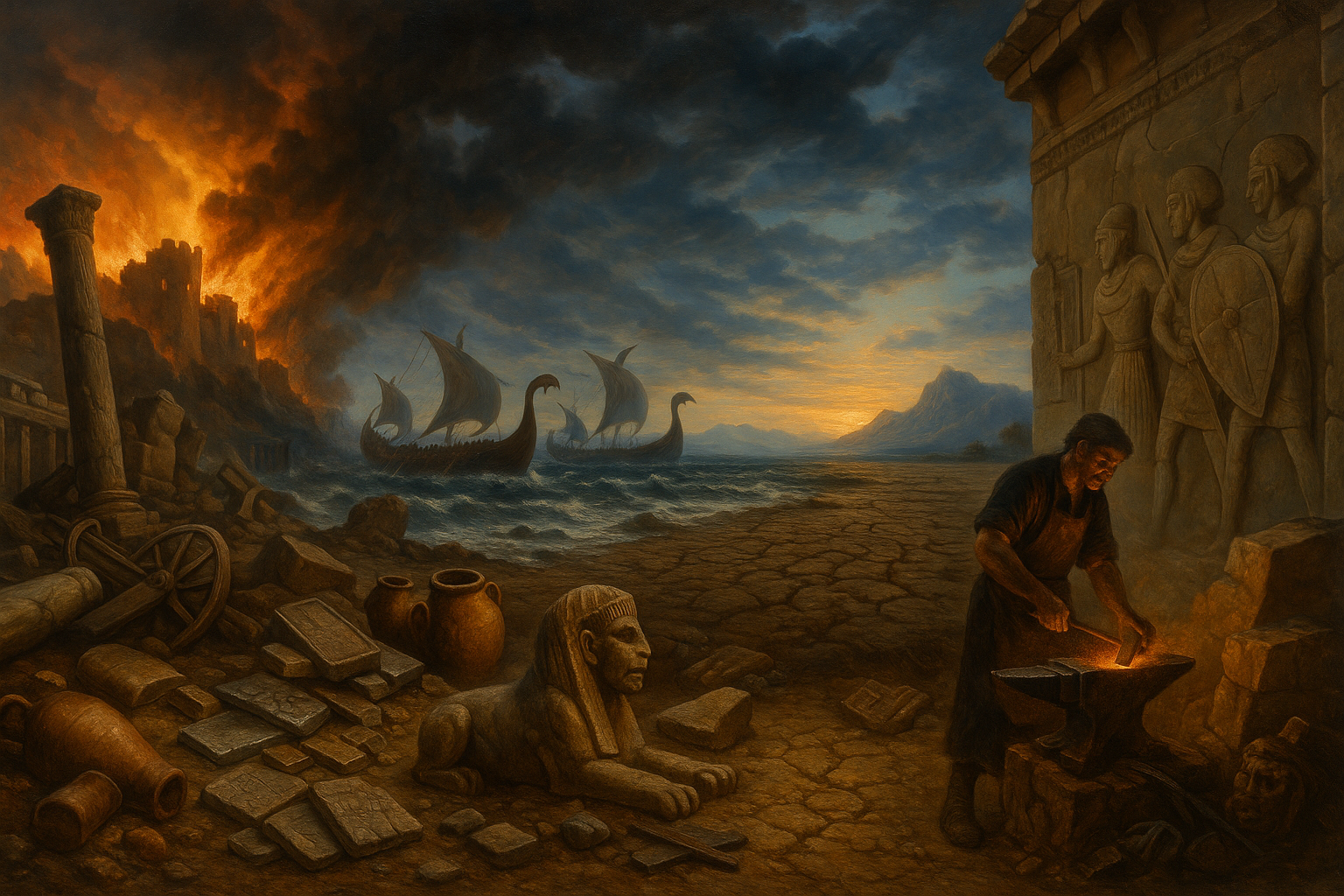
The Late Bronze Age, spanning from approximately 3300 to 1200 BCE, represents a pinnacle of early civilization development. It was a transformative period in Bronze Age history, characterized by stunning advances in metallurgy, sprawling trade networks, and complex social organization. This era witnessed the rise of mighty empires in the Near East, the Aegean, Egypt, and the Indus Valley. The creation of bronze tools and weapons marked a technological revolution that fueled agricultural productivity and sophisticated warfare, allowing these ancient civilizations to expand and thrive. However, this interconnected world proved to be incredibly fragile. The sudden and violent end of this era, known as the Bronze Age Collapse, is one of the most significant and debated historical collapse events, offering timeless lessons on the fragility of complex societies.
The significance of the Bronze Age lies not just in its achievements but in its intricate web of trade and cultural exchange, which fostered wealth and the flow of ideas. It laid the foundation for historical record-keeping, religion, and legal systems, shaping the future of both Western and Eastern civilizations. Understanding the subsequent fall of civilizations during this period is crucial for comprehending the roots of our modern world.
Key Takeaways
* The Bronze Age Collapse was a rapid, systemic failure of major civilizations around 1200 BCE in the Aegean, Eastern Mediterranean, and Near East.
* A “perfect storm” of causes, including climate change (droughts), migrations (the “Sea Peoples”), internal rebellions, and disruption of Bronze Age trade networks, is blamed for this civilization decline.
* Key empires like the Mycenaeans and Hittites were completely destroyed, representing a dramatic ancient civilizations collapse, while others like Egypt survived but were severely weakened.
* The collapse led to a “dark age” but also paved the way for the Iron Age, ushering in new societies, technologies like ironworking, and different political structures.
Unraveling the Mystery: The Causes of the Bronze Age Collapse
The Late Bronze Age Collapse, which climaxed around 1200 BCE, involved a cascade of failures that led to the rapid decline of multiple interconnected ancient civilizations. Why did this happen? The reasons are extensively debated, but the archaeology of the Bronze Age points to a complex interplay of environmental, social, and economic factors that created a domino effect, showing how civilizations fell with shocking speed.
1\. Environmental Factors: A Changing Climate
Climate Change and Drought: A leading theory points to a sustained period of severe drought that afflicted the Eastern Mediterranean. Evidence from paleoclimatology, including sediment core samples and pollen analysis, suggests a significant shift in climate patterns. Reduced rainfall would have devastated agricultural output, leading to widespread famine, social unrest, and one of the primary environmental effects on civilizations of the era.
Natural Disasters: The region is geologically active, and earthquakes are another potential factor. The archaeology of the Bronze Age reveals destruction layers at cities like Mycenae, Troy, and Ugarit consistent with seismic activity. While an earthquake alone might not destroy an empire, a series of them—an “earthquake storm”—could have crippled infrastructure and destabilized already stressed societies.
2\. Social and Sociopolitical Factors in the Bronze Age
Political Turmoil and Internal Instability: Many Bronze Age empires were highly centralized, bureaucratic states that were susceptible to internal strife. As environmental and economic pressures mounted, conflicts over dwindling resources like water and food likely intensified. The collapse of empires like the Mycenaean palace-states shows a breakdown in central authority, fostering localism and contributing to their downfall.
Migration in the Bronze Age: The “Sea Peoples”: Egyptian records famously describe invasions by a mysterious confederation of peoples from the sea, dubbed the “Sea Peoples.” These groups are credited with wreaking havoc across the Levant, Anatolia, and Cyprus. While their exact origins are debated, these movements of peoples disrupted trade routes, sacked major cities, and catalyzed the collapse of established powers, adding significant military pressure that tipped the scales towards societal collapse.
3\. Economic Factors in Antiquity: Trade and Dependency
Trade Disruption: The Bronze Age civilizations were powered by extensive trade networks. The crucial components of bronze—tin and copper—were often sourced from distant lands. The collapse of these trade routes due to piracy, conflict, or the fall of key trading partners would have had catastrophic effects. This sudden loss of trade crippled economies, severely limited access to essential raw materials, and worsened existing tensions, highlighting the fragility of their globalized economy.
Systemic Dependency: The over-reliance on bronze and specific trade goods created a systemic vulnerability. As agricultural production fell due to climate change, states lost their primary export goods. This created a vicious feedback loop of economic despair that undermined social structures and the ability of governments to function, demonstrating a key cause of societal collapse.
The Fall of Empires: Case Studies in Historical Civilization Decline
Mycenaean Greece
The Mycenaean civilization, renowned for its formidable palatial states and the Linear B script, was profoundly affected. Archaeological findings at sites like Mycenae, Pylos, and Tiryns show widespread destruction around 1200 BCE. As agricultural yields plummeted and trade routes vanished, their complex social structure eroded, leading to the abandonment of palaces. This fall of civilizations in Greece led to a “Dark Age,” characterized by a regression to smaller, more localized, and less complex communities.
The Hittite Empire
In Anatolia, the mighty Hittite Empire experienced a swift military and economic collapse. The arrival of the Sea Peoples and constant endemic warfare weakened their borders. Hittite texts from the final years plead for grain shipments, highlighting the severe famine that attended the turmoil. As the central government in Hattusa fragmented, the empire disintegrated, leaving a power vacuum and a politically fragmented region for centuries.
Ancient Egypt’s Resilience
In contrast, Egypt showcased remarkable civilizational resilience. While the Late Bronze Age saw the decline of the New Kingdom—with Pharaoh Ramesses III documenting major conflicts against the Sea Peoples—Egypt managed to repel the invaders and preserve its core culture. However, the cost was immense. The empire’s social and economic order was severely challenged, leading to the loss of its territories in the Levant and a period of instability and division known as the Third Intermediate Period.
From the Ashes: The Iron Age and the Impact of the Bronze Age Collapse
The aftermath of the Bronze Age Collapse marked a dramatic transition into the Iron Age, fundamentally altering the trajectory of human civilization development. The destruction of old empires and trade networks led to a period of localization and the emergence of smaller, decentralized political entities.
This era saw crucial innovations, most notably in ironworking. Iron was more accessible than the components of bronze, and this technological shift played a pivotal role in re-establishing trade and new social hierarchies. Furthermore, the period underscores the importance of adaptability. Emerging societies, such as those in Archaic Greece and Phoenicia, developed new political models, alphabets, and economic systems that would eventually lay the groundwork for the rise of later civilizations, including Greece and Rome.
Conclusion: Key Insights and Relevance Today
The Bronze Age Collapse serves as more than a fascinating chapter in civilization history; it’s a cautionary tale about the vulnerabilities of interconnected global systems. The interplay of environmental stress, political instability, economic fragility, and social upheaval provides invaluable lessons for today.
As modern civilization confronts global challenges like climate change, economic interdependence, and geopolitical tensions, the lessons from this ancient civilizations collapse are more relevant than ever. It reminds us that complexity can breed fragility. Understanding historical events like this emphasizes the critical importance of sustainability, resilience, and international cooperation to prevent a similar fall of civilizations in our time.
Frequently Asked Questions (FAQ)
What defines the Bronze Age period?
The Bronze Age is a historical period, roughly 3300 BCE to 1200 BCE, defined by the widespread use of bronze (an alloy of copper and tin) for tools, weapons, and art. Bronze Age history is marked by significant technological advancements and the rise of the first major empires and cities.
What combination of factors caused the Bronze Age collapse?
The collapse was not due to a single cause but a convergence of factors. The leading causes of the Bronze Age collapse include severe, prolonged drought (climate change), invasions and migrations by groups like the Sea Peoples, internal rebellions, the disruption of international trade routes, and systemic failures in overly complex and dependent societies.
Which ancient civilizations were most affected by the collapse?
The Mycenaeans in Greece and the Hittites in Anatolia were among the most severely affected, with their civilizations completely collapsing. Other major powers, like the New Kingdom of Egypt and the Assyrian Empire, were significantly weakened but managed to survive in a diminished form. This period saw a widespread ancient civilizations collapse across the Eastern Mediterranean.
What were the long-term impacts of this historical collapse event?
The long-term impact of the Bronze Age collapse was transformative. It led to a “dark age” with depopulation and loss of literacy in some areas, but it also cleared the way for the rise of new powers in the subsequent Iron Age. Key effects include the shift to iron technology, the development of new alphabetic scripts, and the emergence of new political entities that would shape classical antiquity.
Why is studying how civilizations fell in the Bronze Age relevant today?
Studying this collapse highlights the complex interplay between climate, economics, and social stability in a globalized system. It serves as a historical case study on the potential for rapid, systemic collapse, emphasizing the need for modern societies to build resilience, manage resources sustainably, and foster robust diplomatic relations to navigate contemporary global challenges.