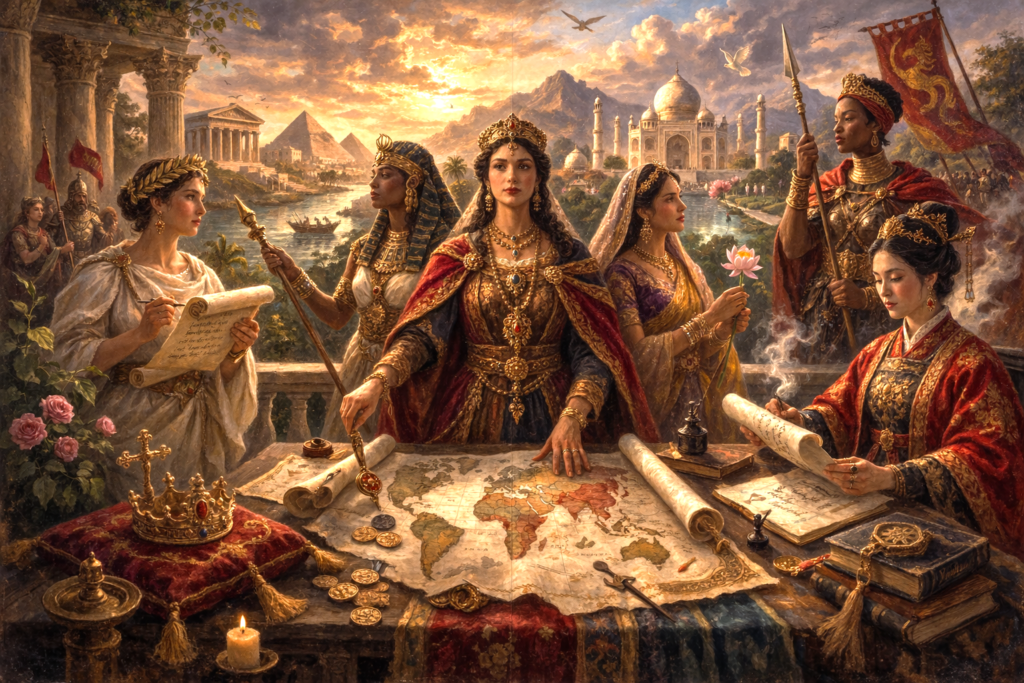

Women who ruled empires often did so in the half-light of history: regents, counselors, mothers, and “consorts” whose decisions shaped wars, successions, and cultures, even as chronicles minimized their names. Recovering these forgotten empresses reframes what ruling means—and who is allowed to be seen as sovereign. (How Much Do You Know About These Women Who Ruled?)
Doorways Into Power: Forgotten Empresses As A Lens
Open most history books and you will find familiar names: Augustus, Charlemagne, Akbar, Napoleon. The story of women who ruled empires is usually confined to a small canon—Cleopatra, Elizabeth I, Catherine the Great—figures dramatic enough to pierce a resistant record. According to Metmuseum, this analysis holds true.
Yet in the shadows of those narratives stand other empresses and power-brokers: regents signing edicts in a child’s name, mothers orchestrating court alliances, consorts translating spiritual authority into political leverage. Their influence was real, but their visibility carefully contained.
This essay, in the spirit of thenoetik, treats these “forgotten empresses” not as historical trivia, but as doorways into deeper questions:
- What counts as “ruling”?
- Who gets written into the memory of empire, and who remains peripheral?
- How do we, centuries later, train our attention differently?
The Noesis Framework: Seeing Power With Conscious Curiosity
thenoetik approaches history through what we might call a noetic lens—a practice of noesis, or attentive insight, that moves beyond data accumulation toward synthesis and meaning. Byzantine Women
Applied to women who quietly ruled, this lens asks us to:
- Hold Interdisciplinary Perspectives
Blend political history, gender studies, art, and the philosophy of memory. A regent’s decree, a mural in a palace, a monastic donation: each becomes a fragment of a more complex story of rule. - Honor Intuition Without Abandoning Rigor
When the record is partial—often the case for women—intuition helps us sense patterns of silence and erasure. We do not fill gaps with fantasy; instead, we ask what the gaps themselves reveal. - Practice Conscious Curiosity
Rather than rushing to judge, we linger with ambiguities: a queen both pious and ruthless, a mother both protective and power-seeking. - Seek Synthesis Over Accumulation
The goal is not an exhaustive list of women who ruled empires, but a synthesis: patterns in how authority moves through bodies, relationships, and stories.
In this frame, each empress becomes both a historical person and a mirror for how we understand leadership now.
Empress Theodora Of Byzantium: Power In Partnership
In sixth-century Constantinople, Empress Theodora rose from marginal origins—possibly an actress or performer—to co-rule the Byzantine Empire with Emperor Justinian I. Officially, he was the sovereign. In practice, Theodora’s influence is unmistakable.
- During the Nika riots in 532, when Justinian considered fleeing the city, Theodora is recorded as delivering a decisive speech, refusing to abandon the throne. Her resolve helped salvage an empire on the brink of collapse.
- She championed legal reforms that improved protections for women, including in marriage and trafficking.
Yet Theodora is often framed as consort, not co-sovereign: the passionate wife, the exotic former performer, the morally ambiguous partner. Her political clarity is acknowledged, but her status as a ruler remains qualified.
From a noetic perspective, Theodora shows how partnership can itself be a mode of rule—and how patriarchal historiography prefers a single visible sovereign rather than shared authority.
Empress Dowager Lü Of Han China: Regency And The Architecture Of Fear
In early imperial China, Empress Dowager Lü (Lü Zhi) stepped into power after the death of her husband, Emperor Gaozu of Han, in the 2nd century BCE. Her son, the new emperor, was young and politically fragile. Lü became the effective ruler of the Han court.
- She placed her own relatives in strategic posts, building a lattice of loyalty around the throne.
- She is depicted as ruthless, especially in her treatment of rival consorts and their families.
Traditional chronicles present her as a warning: a woman’s rule equated with disorder and cruelty. Yet if we step back, we see a familiar pattern common to many founding dynasties—violent consolidation of power—simply coded differently when the central actor is female.
Lü’s story highlights a recurring theme among women who ruled empires: when they use the conventional tools of power, they are often remembered less as state-builders and more as moral cautionary tales.
Nur Jahan Of The Mughal Court: The Empire Through A Screen
In the Mughal Empire of the Indian subcontinent, Nur Jahan (“Light of the World”) emerged as a formidable political figure in the early 17th century. Married to Emperor Jahangir, she became, in many respects, the effective governor of the state as his health declined.
- Imperial documents were issued bearing her name and imperial seal.
- She orchestrated marriage alliances, engaged in diplomatic negotiations, and patronized architecture and the arts.
- Coins were minted in her name—an extraordinary sign of recognized sovereignty.
Yet later narratives often treat Nur Jahan as a seductress whose influence weakened the empire, or as a romantic anomaly: power through beauty, not intellect. The material record tells a different story—of administrative competence and political tact, exercised from behind the screens of the harem.
Queen Mother Yaa Asantewaa: War, Memory, And The Edges Of Empire
Shifting to West Africa at the turn of the twentieth century, we meet Yaa Asantewaa, Queen Mother of Ejisu in the Asante (Ashanti) Empire, in what is now Ghana.
When British colonial authorities exiled the Asante king and attempted to seize the sacred Golden Stool, Yaa Asantewaa led the War of the Golden Stool in 1900.
- She is remembered as rallying the chiefs with the challenge: if the men would not fight, the women would.
- Although the war ultimately ended in British victory and her exile, Yaa Asantewaa’s leadership became a symbol of both anti-colonial resistance and female authority.
Unlike other figures here, she is sometimes celebrated, but often as a folk heroine more than as a sovereign strategist. Yet she embodied a form of rule that fused spiritual guardianship, military leadership, and communal stewardship.
Her story stretches the phrase “women who ruled empires” to include those who defended a threatened polity at its outer edge, where empire and resistance collide.
Isabel Of Portugal: The Regent In The Spanish Habsburg Court
In sixteenth-century Spain, Isabel of Portugal, wife of Charles V (Holy Roman Emperor and King of Spain), served repeatedly as regent while Charles was away on imperial campaigns.
- She presided over the Council of State, corresponded with ambassadors, and made critical decisions on finances and policy.
- Under her regencies, the Spanish heartlands remained relatively stable despite external wars and internal complexity.
Yet Isabel tends to appear in historical memory as a pious, devoted spouse, the “ideal empress” in a domestic sense. Her political capabilities are acknowledged in specialist histories but rarely foregrounded in broader narratives of empire.
Isabel’s life foregrounds a recurring mode of quiet rule: governance framed explicitly as caretaking rather than sovereignty, even when the practical effects are indistinguishable.
Patterns Of Quiet Rule: How Women Governed From The Margins
Across these empresses and power-brokers, certain patterns recur. They offer a conceptual map of hidden female rulers:
- Regency And Substitution
Women rule “in place of” someone—usually a son or absent husband. The title emphasizes substitution, not sovereignty, yet their decisions often shape the long-term architecture of the state. - Relational Legitimacy
Authority flows through roles—wife, mother, daughter, queen mother. These identities both grant access and justify constraint: power is recognized but also narratively contained. - Spiritual And Cultural Authority
Patronage of temples, churches, mosques, shrines, or artistic projects allows women to inscribe their presence into the sacred and aesthetic fabric of empire. - Diplomatic And Domestic Networks
While kings meet on battlefields, empresses often govern through networks: marriages, correspondence, ceremonial hospitality, and the quiet pressure of court factions.
A useful way to crystallize these patterns is through a comparative table:
Figure | Primary Mode Of Power | Official Title Emphasized | How Records Minimized Her Rule |
|---|---|---|---|
Theodora (Byzantium) | Co-decision, legal reform | Empress / consort | Focus on origins, morality, sexuality |
Empress Dowager Lü | Regency, elite placement | Dowager, mother | Cast as tyrant and anomaly |
Nur Jahan (Mughal) | Administration, diplomacy | Favorite wife, consort | Romanticized, blamed for imperial “decline” |
Yaa Asantewaa | Military and spiritual lead | Queen Mother | Treated as folk figure, not full political actor |
Isabel of Portugal | Regency, fiscal governance | Empress, wife | Remembered as pious spouse, not as stateswoman |
The pattern is stark: women govern; texts recode.
Toward A Series Of Forgotten Figures
For thenoetik, these glimpses of women who quietly ruled are more than isolated stories. They announce a potential mini-series of visual and textual “noetic portraits”:
- An “Empress In The Shadows” visual essay: a sequence of images pairing latticework screens, marginal notes in chronicles, and architectural details commissioned by women.
- A “Politics Of Remembrance” carousel: short vignettes of rulers, scholars, and artists whose work underpins empires of knowledge but rarely headlines our histories.
The aim is consistent with the core mission of thenoetik: to cultivate clarity, perspective, and connection through concise yet deep content. Each forgotten figure becomes a focal point for interdisciplinary reflection—where history meets philosophy, and where memory becomes an active, ethical practice.
As you move back into the noise of daily information, you might carry a simple noetic principle from these empresses:
Power is not only what is seen. It is also what is sustained, stewarded, and remembered.
To choose what—and whom—you remember is itself a subtle act of rule.
Frequently Asked Questions
How did Empress Theodora influence the Byzantine Empire without holding the title of sole ruler?
Empress Theodora of Byzantium exercised power through her partnership with Justinian I, directing court councils, religious negotiations, and legal reforms. By managing petitioners and church leaders, she transformed her proximity to the throne into decisive political leverage, fundamentally shaping imperial policy despite her status as a consort rather than a monarch.
How did Empress Dowager Lü maintain control over Han China during her regency?
Empress Dowager Lü secured her authority by governing through a series of young heirs and appointing members of her own clan to critical military and court positions. She eliminated political rivals through strategic executions and patronage, creating a durable power structure that dictated the empire’s trajectory long after her formal regency ended.
How did Nur Jahan direct Mughal policy while observing the purdah screen?
Nur Jahan managed the Mughal Empire by building powerful court alliances, issuing imperial decrees in her own name, and commissioning coinage featuring her titles. Utilizing the purdah screen as a strategic political stage, she controlled royal successions and steered government policy during the final years of Emperor Jahangir’s reign.
Why were many women who ruled empires historically categorized as consorts rather than sovereigns?
Historically, patriarchal chroniclers often framed powerful women as consorts or mothers to protect the cultural ideal of male-only sovereignty. Despite commanding armies and issuing official decrees, these women saw their authority minimized through legal terminology and ritual titles designed to portray them as supporting figures rather than independent political leaders.
Which forgotten empresses led military campaigns or commanded armies?
Several forgotten empresses, such as the Trung Sisters of Vietnam and Zenobia of Palmyra, personally led military forces against major empires. These women transitioned from symbolic figures to battlefield commanders, organizing indigenous resistance and seizing territory, demonstrating that female leadership frequently extended into direct martial command and sovereign military strategy.