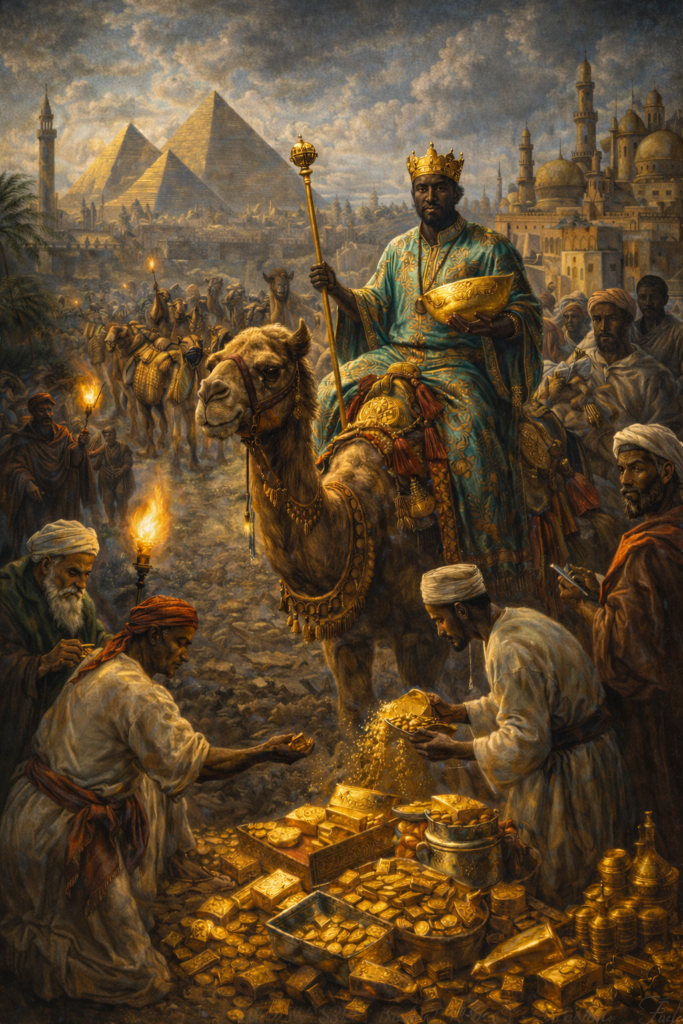

The story of how Mansa Musa broke the economy begins with his 1324 pilgrimage to Mecca, when the emperor of Mali moved so much gold across the Sahara—and spent and gifted so lavishly in Cairo—that he distorted local prices, exposed the fragility of money, and rewrote how the world imagined West Africa.
Key Takeaways
- Mansa Musa’s pilgrimage revealed how concentrated resource wealth can destabilize monetary systems.
- A single journey reshaped maps, chronicles, and perceptions of West Africa’s power and sophistication.
- Economic shocks are also narrative events, where stories and expectations amplify material effects.
A Caravan At The Edge Of Myth
Picture the Sahara before dawn. A ribbon of torchlight moves across the dunes: thousands of attendants, soldiers, scholars, and slaves; camels heavy with gold dust and ingots; banners of Mali’s crescent moon catching the first light. At the center rides a ruler whose generosity, chroniclers would later claim, bent prices for years.
When we ask how Mansa Musa broke the economy, we are really asking how this spectacle of piety and power—one ruler on the road to Mecca—became an economic event for Cairo, a cartographic event for Mediterranean mapmakers, and a psychological event for how the world imagined African wealth.
Who Mansa Musa Was And Why His Gold Mattered
By the early fourteenth century, the Mali Empire stretched across a wide swath of West Africa, anchoring the southern end of the trans-Saharan trade. Gold from the Bambuk and Bure fields, and further south in the forest zones, flowed north toward the markets of North Africa and, from there, into the Mediterranean world.
Mali sat on this river of metal. That is what made Musa—who came to the throne around 1312—extraordinary. He did not invent Mali’s gold, but he presided over its consolidation. Under his rule, cities like Timbuktu and Gao grew as nodes of scholarship and commerce, binding Islamic learning to African wealth.
The historian al-‘Umari, writing in Cairo not long after Musa’s visit, never met the emperor himself. Yet his informants spoke of a ruler so rich that comparison failed. In a world where money meant metal, controlling the mines that fed the Mediterranean’s coins meant holding a quiet lever on the broader economy.
The Pilgrimage As Procession Of Power
In 1324, Mansa Musa decided to make the hajj—the pilgrimage to Mecca required of Muslims who are able to undertake it. But he did not travel as a private believer. He moved as an empire.
Arab chroniclers describe a caravan of astonishing scale. Later numbers—60,000 attendants, 12,000 slaves, each carrying gold bars—are probably inflated, but the pattern is clear: this was an intentional display. Hundreds of camels reportedly carried gold dust. Officials, soldiers, and scholars traveled alongside singers and servants, collapsing court and road into a single moving city.
The journey served many purposes at once:
- Religious: To fulfill a pillar of Islam and present Mali as a fully Muslim power.
- Diplomatic: To meet rulers in Cairo and Mecca, forging ties with the wider Islamic world.
- Reputational: To show that the lands south of the desert were not a vague hinterland, but a center of power in their own right.
Cairo was the pivot. Then under the Mamluks, it was a capital of trade and scholarship, a gateway between the Mediterranean and the Red Sea routes. When Musa entered the city, the desert caravan suddenly met one of the era’s great financial and intellectual hubs.
A Brief Table Of The Pilgrimage’s Key Moments
| Phase | Approximate Location | Main Purpose | Economic Relevance |
|---|---|---|---|
| Sahara Crossing | West Africa–Sahara | Move imperial court and wealth | Concentrates gold in mobile form |
| Arrival In Cairo | Egypt | Diplomacy, ritual entry | Sudden gold inflow into a major market |
| Stay And Spending In Cairo | Egypt | Gifts, charity, provisioning | Depresses gold value, distorts prices |
| Journey To Mecca | Hijaz | Fulfill pilgrimage duties | Displays Mali’s wealth to wider networks |
| Return Route | Via Cairo and Sahara | Honor debts, more exchanges | Partially absorbs earlier price distortions |
When Generosity Distorts A Market
So, how did Mansa Musa break the economy?
Al-‘Umari reports that Musa distributed gold so freely in Cairo—through gifts to the sultan, alms to the poor, and payments for goods and services—that the metal’s value fell. Ibn Khaldun, writing later but drawing on the same tradition, echoes this: the price of gold dropped, and did not fully recover for years.
We should not picture a dramatic market collapse in the modern sense. Instead, imagine a city where gold is both currency and commodity—used in jewelry, hoarded as wealth, and traded across regions. Its value depends on relative scarcity.
When an emperor appears with enormous quantities and begins spending:
- Supply increases: More gold circulates in local markets.
- Relative scarcity falls: Each unit of gold becomes less special.
- Prices adjust: What previously cost one dinar might now cost more, because each dinar buys slightly less.
This is the core of the gold shock. Musa’s generosity dislocated the careful balance of scarcity and trust on which monetary systems rest. Gold did not disappear; it became temporarily less powerful as a store of value.
Later reports even suggest that when Musa returned through Cairo, he tried to borrow gold at high interest to soak up some of the excess he had created. Whether or not this detail is perfectly accurate, the story itself captures a real mechanism: once you flood a system with liquidity, it is hard to gather the water back.
Maps, Stories, And The Geography Of Awe
If prices in Cairo recorded one kind of disturbance, maps and chronicles recorded another. The pilgrimage turned West Africa from a hazy margin into a place of fascination.
On the mid-fourteenth-century Catalan Atlas, a lavishly painted map produced in Majorca, we see a crowned African ruler seated on a throne. He holds a gleaming gold nugget and a scepter, facing north toward the Mediterranean. An inscription identifies him as the king of Mali, richest in gold.
This image is not an ethnographic portrait. It is an icon of value. For European viewers, the south of the Sahara becomes legible through the figure of the gold king. Geography and economics merge into a single, memorable silhouette.
Arab writers perform a similar transformation in text. Al-‘Umari’s description of Musa dwells on his piety and his largesse. The emperor of Mali enters the mental geography of the Islamic world as both devout and incomprehensibly rich—a paradoxical figure who prays in humility while scattering metal that bends markets.
Here, perception becomes infrastructure. Merchants, scholars, and rulers plan their actions not only around actual mines and roads, but around stories of a distant sovereign whose lands shimmer with possibility. The pilgrimage is as much a narrative event as a financial one.
Between Legend And History
The phrase how Mansa Musa broke the economy invites exaggeration. So do the medieval sources themselves. We are told of tens of thousands of followers, mountains of gold, price effects lasting a decade or more. What can we reasonably infer?
- The exact numbers—how many camels, how many slaves, how many tons of gold—are uncertain and probably inflated.
- The direction of the economic effect is credible: a sharp, localized increase in gold supply would push its value downward.
- The duration of that effect is harder to pin down. Years, perhaps, but not an unending crisis.
Critical reading does not drain the story of wonder; it refines where the wonder lives. The astonishing fact is not that one man permanently ruined an economy, but that a single, finite journey could ripple through prices, texts, and maps from Cairo to Catalonia.
Myth thickens around a historical core. What remains solid is the pattern: concentrated wealth, suddenly mobile, can expose how thin the line is between stability and shock.
Wealth, Value, And The Fragility Of Systems
Step back from the desert for a moment. The story of how Mansa Musa broke the economy is strange only if we forget how often sudden flows of capital have destabilized societies.
Consider:
- Resource booms: A new oil field or lithium deposit can flood a country with revenue, push up local prices, distort politics, and leave lasting imbalances once prices fall.
- Quantitative easing: When modern central banks create money to stabilize markets, asset prices can soar, deepening inequalities and inflating bubbles.
- Sudden foreign investment: Rapid inflows into emerging markets can strengthen currencies and fuel growth—until sentiment shifts and the money rushes out again.
Across these examples, the pattern echoes Cairo in 1324. An influx of value, however well-intentioned, meets a structure with limited ability to absorb it evenly. The system lurches.
Mansa Musa’s pilgrimage is a medieval illustration of this universal tension. His gifts were acts of devotion and prestige, not speculative finance. Yet they operated through the same underlying principle: value is relational, not absolute.
The Noetik Thread: How Stories, Maps, And Markets Co‑Create Reality
What, then, does this episode reveal when we look through the lens of noesis—the meeting of intellect and intuition?
Intellect tells us that gold is a metal with certain properties, that prices move when supply shifts, that empires sit on trade routes. Intuition notices something subtler: that the world Musa moved through was woven of expectations, images, and words as much as of dunes and dinars.
- A mapmaker in Majorca, hearing of Musa’s pilgrimage, paints an African king with a nugget of gold. That image travels, shaping how readers imagine an entire region.
- A chronicler in Cairo chooses titles and adjectives—“the richest,” “most generous”—that crystallize into legend.
- A merchant in Alexandria adjusts prices not only because more gold exists, but because he believes others will treat gold differently after the emperor’s visit.
In each case, material reality and narrative perception loop into one another. The caravan across the Sahara becomes a caravan across consciousness.
Perhaps that is the deepest sense in which Mansa Musa “broke” the economy. He did not destroy it. He revealed its constructedness. He showed that money is at once rock and rumor, mine and metaphor.
To trace his path is to see how history, geography, art, and language collaborate in making worlds. A ruler rides into Cairo with camels of gold. Prices flicker, stories ignite, a tiny figure in a crown appears on a painted map—and centuries later, we still turn toward that shimmering moment to understand our own age of sudden booms and invisible capital flows.
Frequently Asked Questions
How did Mansa Musa break the economy of Cairo during his 1324 pilgrimage?
Mansa Musa broke the economy of Cairo by flooding the market with an estimated 18 tons of gold. By gifting and spending such vast quantities, he increased the local money supply beyond available goods. This surplus caused gold prices to plummet, devaluing the currency and driving up living costs for over a decade.
How much gold did Mansa Musa distribute during his journey to Mecca?
Historical accounts suggest Mansa Musa’s caravan included dozens of camels each carrying up to 300 pounds of gold dust, alongside thousands of attendants carrying golden staffs. While exact figures vary, he reportedly distributed thousands of kilograms of gold across major trading hubs like Cairo, fundamentally shifting regional wealth distribution and currency values.
Why did the influx of Malian gold devalue Mediterranean currencies?
During the fourteenth century, Mediterranean economies relied on gold-backed currency. When Mansa Musa introduced an unprecedented volume of gold into the Egyptian market, he disrupted the established ratio between gold and silver. This sudden oversupply lowered the intrinsic value of gold coins, stripping purchasing power from merchants who held traditional gold-based savings.
What historical evidence exists for Mansa Musa’s impact on European mapmaking?
The 1375 Catalan Atlas provides clear evidence, depicting Mansa Musa sitting on a throne holding a gold nugget. Before his pilgrimage, West Africa was often marginalized in European cartography. His display of wealth changed global perceptions, leading mapmakers to represent the Mali Empire as a central hub of global trade and immense mineral riches. Mansa Musa (Musa I of Mali) Mansa Musa – Stanford History Education Group
What was the long-term economic effect of Mansa Musa’s spending on North Africa?
The long-term effect was a decade-long economic depression in regions like Egypt, where the devaluation of gold kept prices unstable. However, the pilgrimage also established lasting trade links. It encouraged scholars and architects to travel to Timbuktu, eventually transforming the Mali Empire into a world-renowned center of Islamic learning and sophisticated urban development.
Further Reading & Authoritative Sources
From thenoetik
- Catherine the Great and Potemkin — This article discusses Catherine the Great, another historical ruler associated with immense power and displays of wealth (specifically the ‘Potemkin villages’), providing a comparative perspective to Mansa Musa’s genuine, economy-disrupting wealth.
- The Noetik — The Noetik explores history, philosophy, and culture, offering a broader intellectual context for analyzing historical events like Mansa Musa’s pilgrimage and their lasting economic impacts.
Authoritative Sources
- Mecca Pilgrimage of Mansa Musa: When Generosity Ca — University-based article (Universitas Gadjah Mada) that analyzes Mansa Musa’s pilgrimage using economic theory, explaining how his massive gold distribution led to inflation and long‑lasting economic distortions in Egypt, effectively showing how his actions ‘broke’ the economy.