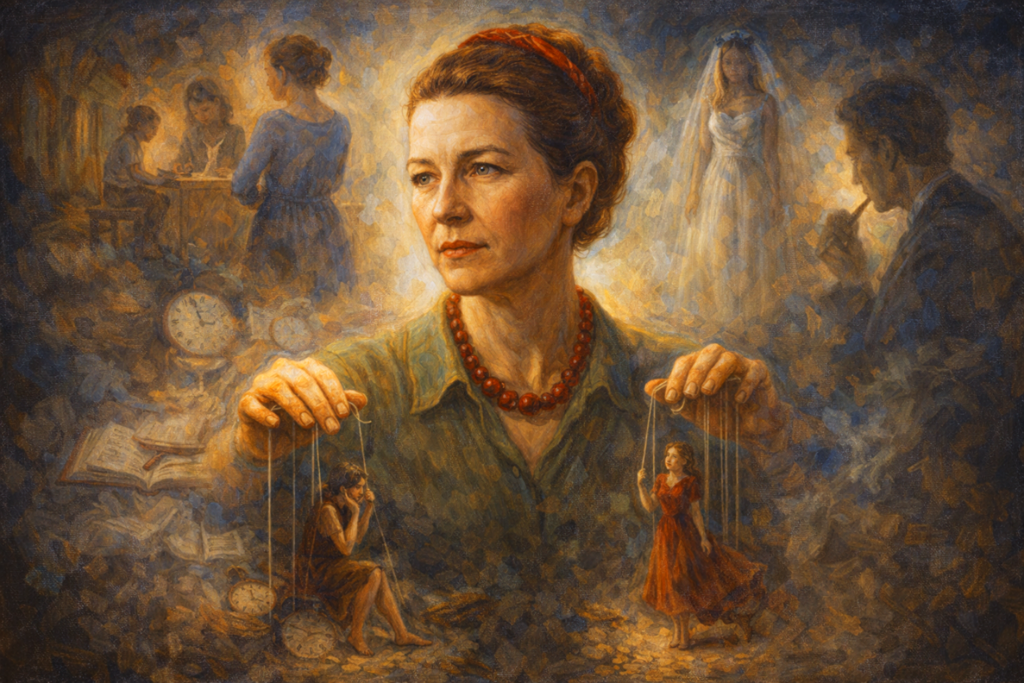

Becoming Woman, and the Self You Didn’t Choose
Simone de Beauvoir’s idea of “becoming woman” names how we are shaped by history, gender norms, and situations we never chose, yet still remain responsible for what we make of that shaping. Her existentialism holds facticity and freedom together, inviting a lucid, ongoing project of authentic becoming.
- We become who we are through forces we never consciously chose or designed.
- For Beauvoir, freedom means responding creatively to those conditions, not erasing them.
- Authenticity is an ongoing project: small, lucid acts of re-becoming in everyday life.
Waking Up as Someone You Didn’t Exactly Choose
There are mornings when the mirror feels like a stranger.
You catch your reflection and suddenly see not just a face, but a whole script: the career you followed because it was “sensible,” the gendered habits you absorbed without question, the tone of voice that sounds suspiciously like a parent or boss.
You might think, quietly: I have become someone I never exactly chose.
This is the territory Simone de Beauvoir helps illuminate—especially through her famous line from The Second Sex: “One is not born, but rather becomes, woman.” Beneath the phrase “becoming woman” lies a wider existential insight: none of us is simply born as a ready-made self. We are always, already, in the middle of becoming—shaped by forces beyond us, and yet not reducible to them.
Simone de Beauvoir and the Existential Idea of Becoming
Simone de Beauvoir was a central voice in existentialism, a philosophical current that asks what it means to exist without a fixed, predetermined essence.
For existentialists, there is no timeless, inner blueprint—no prewritten “true self” we only have to discover. Instead, existence comes first. Who we are is continually written through our choices, our relations, and our responses to circumstances.
When Beauvoir speaks of “becoming woman,” she is not describing a biological fact. She is naming a social and existential process: being formed into a certain kind of subject by education, images, laws, expectations, and repeated situations.
More broadly, Beauvoir’s thought centers on several key ideas:
- Situation: We are always in a concrete world—family, body, history, class, gender.
- Facticity: The given facts of our lives (where, when, and into what we are born).
- Freedom / Transcendence: Our capacity to go beyond what is given, to interpret and reshape it.
- Ambiguity: The inseparable tension between being shaped and being free.
We are never pure freedom, never pure determination. We are ambiguous beings, stretched between what has been made of us and what we can still become.
Facticity and Freedom: What Is Given, What We Do With It
Beauvoir’s distinction between facticity and freedom offers a precise way to think about the self you did not choose.
- Facticity includes your body, early upbringing, language, cultural background, economic situation, and the historical moment into which you were born.
- Freedom is your capacity to respond, reinterpret, and act within and sometimes against those conditions.
We often feel the weight of facticity when we say things like:
- “In my family, we don’t talk about feelings.”
- “People like me just don’t end up in that kind of career.”
- “As a man/woman/non-binary person, I’m expected to…”
These are not illusions; they are real structures that frame what is considered possible.
Yet for Beauvoir, freedom is not the fantasy of starting from zero. It is the quieter work of taking responsibility for how we inhabit what is already there.
A useful metaphor: life as a play whose script we did not write. We enter halfway through, with costumes already chosen and stage directions in place. Facticity is the script as received. Freedom is the ability to improvise our lines, shift our tone, even reframe what the scene means—without pretending the stage itself does not exist.
How Social Roles Script Us Without Our Explicit Consent
In The Second Sex, Beauvoir shows how a person “becomes woman” through layers of expectation and training:
- Childhood: being praised for softness, care, or beauty rather than initiative or power.
- Adolescence: learning to monitor one’s body through others’ eyes, internalizing a constant self-surveillance.
- Adulthood: facing assumptions about who will sacrifice for family, whose career is optional, whose anger is “unfeminine.”
“Becoming woman” is a vivid example of a broader phenomenon: we are all offered roles—gendered, racialized, classed, professional—that begin shaping us long before we know what is happening.
You might recognize this in your own life:
- The eldest child who becomes the “responsible one,” long before they consent.
- The son taught not to cry, who later struggles to locate his own tenderness.
- The worker who absorbs the company’s values so deeply that rest feels like guilt.
These patterns are not just personal quirks. They are social structures at work inside us, turning expectations into habits, and habits into identities.
Myth vs. Reality: How Identity Is Scripted
| Dimension | Common Myth about Identity | Beauvoir-Inspired Reality |
|---|---|---|
| Origin | “I was born this way; it’s just my nature.” | You are born into situations that strongly shape who you become. |
| Agency | “If I were really free, none of this would affect me.” | Freedom works through conditions, not outside them. |
| Gender | “Woman/man is a natural, fixed essence.” | One is not born but becomes woman/man through social processes. |
| Change | “If I change, I betray my true self.” | Authenticity is an ongoing re-interpretation, not a static core. |
| Blame | “It’s all my fault I’m like this.” | You did not choose your starting point, only how you respond now. |
This myth-versus-reality lens invites a gentler, more lucid relationship with the person you have become so far.
“This Isn’t Really Me”: Bad Faith, Evasion, and Lucidity
When we realize how scripted we are, a common reaction is rejection: This isn’t really me.
Existentialism calls bad faith the temptation to deny either our facticity or our freedom. It shows up in two main ways:
- Denying facticity: Pretending we are pure choice. “My upbringing didn’t shape me; I’m totally self-made.”
- Denying freedom: Pretending we are pure victim. “I am nothing but what happened to me; I have no say.”
Both positions protect us from discomfort: one avoids vulnerability, the other avoids responsibility.
Beauvoir instead invites lucidity—a clear-eyed acceptance that:
- Much of who you are was formed without your explicit consent.
- From here, you are still responsible for how you relate to that formation.
Responsibility here is not self-accusation. It is the recognition that your next gesture, however small, still matters.
So instead of “This isn’t really me,” lucidity might sound like:
- “This part of me was learned; I can look at it, question it, reshape it.”
- “I see how my reactions were trained; I can experiment with responding differently.”
Lucidity does not erase pain or injustice. It simply refuses to leave your freedom out of the story.
Identity as an Ongoing Project of Becoming
Beauvoir’s existentialism dismantles the idea of a fixed, inner essence we either live up to or betray. Instead, identity is an ongoing project.
You are not a static noun; you are a verb in the present continuous: becoming.
This has two liberating implications:
- There is no single, decisive moment when you “choose who you are.” There are many moments, layered over time.
- You are not bound forever to the self that earlier choices and circumstances produced. You can revise, reinterpret, and redirect.
To “become otherwise” does not necessarily mean dramatic reinvention. Often, it looks like subtle shifts in how you inhabit roles you still occupy:
- Bringing more honesty into a relationship, even if you stay in it.
- Speaking up once in a meeting where you usually remain silent.
- Allowing yourself to rest in a culture that equates worth with productivity.
From Beauvoir’s perspective, authenticity is less about “finding your true self” and more about owning that you are always in the act of making yourself, within conditions you did not choose.
Reflective Prompts: Where Do You Feel Unchosen—and Still Free?
Consider these questions as invitations to conscious curiosity:
- Where in your life do you feel most scripted?
- Is it a family role, a gendered expectation, a professional identity?
- Which phrases in your inner monologue sound like someone else’s voice?
- A parent, teacher, cultural narrative? How did that voice become yours?
- What small act of improvisation is available inside that script?
- A slightly different response, tone, boundary, or gesture of care toward yourself.
- How do you talk to yourself about your past choices?
- Do you lean more toward erasing your facticity (“I should have known better”) or erasing your freedom (“I had no choice at all”)? What would lucidity sound like instead?
- If identity is an ongoing project, what is one subtle way you’d like to “become otherwise” this year?
- Not a total reinvention, but a direction, a quality, a way of relating.
Even formulating honest answers is an act of freedom—a way of stepping back from the script to see it more clearly.
Becoming, With Clarity, Perspective, and Connection
Simone de Beauvoir’s idea of “becoming woman” opens into a wider recognition: all of us are living in the tension between being made and making ourselves.
We inherit languages, bodies, histories, and roles we never chose. We wake up one day as a particular “someone”—employee, caregiver, leader, quiet one, dependable one—and realize we did not consciously design this self from scratch.
To see how you have been shaped is not to cancel your freedom. It is to clarify the stage on which your freedom plays out. It brings perspective: you are neither the sole author nor a passive character. You are a co-writer in an unfinished script.
Philosophy offers the concepts: facticity, freedom, ambiguity, bad faith. Your inner wisdom offers the felt sense of where you are living as if you had no choice, and where quiet acts of re-becoming are already possible.
You do not need to reject the person you have become so far. You also do not need to take that person as final.
You can stand, lucidly, in the middle: acknowledging the forces that shaped you, and then, with each small, conscious gesture, participating in who you are still becoming.
Frequently Asked Questions
What does Simone de Beauvoir mean by the phrase “one is not born, but rather becomes, woman”?
This well-known phrase means that “woman” is not a natural or fixed essence but a social and historical process. People are trained into gendered expectations, roles, and behaviors through family, culture, and institutions, gradually “becoming woman” according to norms they did not freely design or choose.
How does Simone de Beauvoir connect facticity and freedom in her philosophy?
Beauvoir uses “facticity” to describe the given conditions we do not choose—our body, history, family, and social position. “Freedom” is how we respond to these facts through choices and actions. In her view, we are shaped by our facticity yet remain responsible for how we interpret and transform those conditions.
What is the difference between myth and reality in Beauvoir’s view of womanhood?
Beauvoir distinguishes mythical images of Woman—the idealized mother, temptress, or muse—from the concrete, complex lives of real women. Myths freeze women into symbols, while lived reality involves conflicts, projects, and ambiguities. The process of becoming involves navigating, resisting, or reworking these myths within actual experience.
How can Beauvoir’s philosophy help someone who feels trapped by life choices?
Beauvoir’s ideas show that feeling scripted by family, career, or social norms is not a personal failure but a common human condition. Recognizing this allows a person to reclaim freedom in small, lucid acts: questioning habits, renegotiating roles, and making incremental choices that slowly rewrite their ongoing becoming.
Further reading & authoritative sources
Authoritative sources
- philosophical profile of Simone de Beauvoir — Explore the life and comprehensive philosophy of Beauvoir, including her groundbreaking ideas on ambiguity and the self.
- core concepts of existentialism — Dive into the philosophical framework that defines freedom, facticity, and the struggle against bad faith in everyday life.