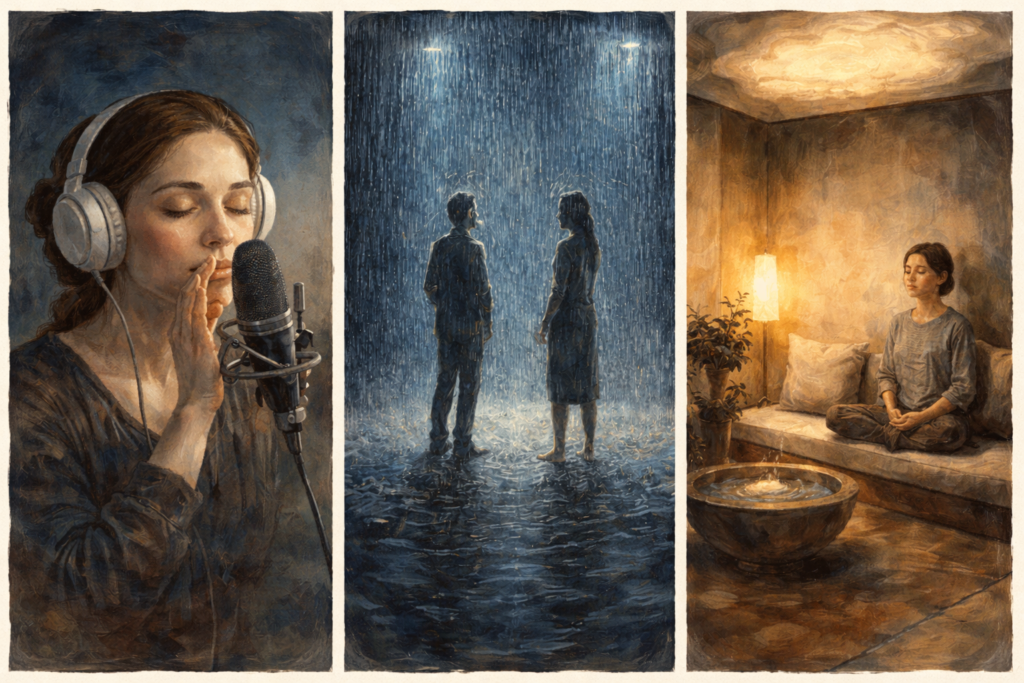

Calm on demand technology describes the growing ecosystem of media, spaces, and interfaces—ASMR videos, rain rooms, ambient apps, “comfort shows,” focus modes—engineered to deliver relaxation at the tap of a screen, blending psychology, sensory design, aesthetics, and software into portable, programmable tranquility.
Key Takeaways
- Calm is increasingly something we design, package, and access on demand.
- Comfort media regulates overstimulated nervous systems through predictable, gentle sensations.
- These tools can support inner wisdom—or quietly outsource our emotional self-regulation.
Hook: When Calm Becomes Something You Click
You put in your headphones. A whisper fills your ears: crisp, close, almost impossibly gentle. Fingertips tap on glass; towels fold in slow, exaggerated movements. Your shoulders drop.
Later, you step into a rain room. Water pours in sheets all around, yet your body stays dry. Sensors track your movement, parting the artificial storm. You’re walking through weather that obeys you.
At home, the loop continues: the same sitcom rerun, a cozy farming game, that “lofi beats to relax/study to” playlist. You are not just consuming stories or songs; you’re selecting a mood—an ecosystem of calm on demand technology.
Calm has become something we stream, queue up, and architect through headphones, screens, and immersive installations. The question is no longer only how we relax, but how relaxation itself is being designed.
Defining Comfort Culture and Calm on Demand
“Comfort culture” names now-familiar habits: rewatching the same series; curating “comfort playlists”; scrolling through satisfying videos of paint mixing, slime stretching, or towels being perfectly stacked; falling asleep to rainfall soundscapes and soft-spoken roleplays.
Calm on demand technology is the infrastructure that makes this possible:
- ASMR channels that deliver precise auditory triggers
- TikTok and Reels feeds full of soothing, repetitive visuals
- Immersive rain rooms and light installations that simulate weather without risk
- Ambient apps that provide ocean waves, brown noise, or “cozy café” sound at any hour
- Platform features like focus modes, dark themes, and “do not disturb” profiles
Instead of stumbling into rest, we orchestrate it. We choose our emotional state—especially calm—as if from a menu.
Beneath this lies a central question: What does it mean to design calm? When serenity is engineered, packaged, and delivered as a service, what does that reveal about our psychology, our aesthetics, and our technology-mediated inner lives?
The Sensory Design of Calm: ASMR, Rain, and Safety
ASMR (“autonomous sensory meridian response”) is often described as a tingling sensation that begins on the scalp and moves down the spine, triggered by certain sounds or scenarios. Whether you experience tingles or not, the form itself is revealing.
The Micro-Architecture of ASMR
Most ASMR videos share a subtle design grammar:
- Soft dynamics: whispers, gentle crinkles, light brushing that avoid sharp volume spikes
- Repetition: tapping, stroking, or word patterns that create predictable rhythms
- Close-up visuals: hands in frame, eyes meeting the camera, slow deliberate movements
- Simulated care: roleplays of haircuts, spa treatments, medical exams, or simple “I’m here with you” presence
The viewer is placed in a position of safe vulnerability: you are close to another human presence, yet fully in control. At any moment, you can pause, skip, or close the tab. Intimacy without risk becomes its own aesthetic.
Rain Rooms and Controlled Weather
Rain rooms, like well-known immersive installations where visitors walk through cascades of water that part around them, operate similarly, but at architectural scale.
They offer:
- Total sensory envelope: sound of rainfall, coolness of the air, visual shimmer of water
- Predictable responsiveness: sensors that reliably stop the rain above you as you move
- Contained wildness: the drama of a storm without the danger of getting soaked or struck
You inhabit what feels like the edge of chaos, yet the system remains obedient. Nature is translated into an interactive set piece, its unpredictability sanitized into a choreography of droplets and light.
Both ASMR and rain rooms are case studies in the sensory design of safety. They work by dialing down surprise, amplifying gentle variation, and surrounding you with a controlled, minimally risky environment.
Psychological and Nervous System Dimensions
Underneath the aesthetics is something more physiological: our nervous system’s constant calibration between alertness and rest.
- The sympathetic nervous system mobilizes us for action—vigilance, fight, flight.
- The parasympathetic system supports digestion, repair, and deep rest.
In a high-notification world, many of us live tilted toward alertness: always slightly braced, eyes flicking to the next ping.
Calm on demand technology does three crucial things for this overclocked system:
- Predictable input
Gentle, repetitive sounds—rainfall, tapping, rustling pages—reduce the need for constant scanning. Nothing sudden is coming; the pattern is clear. - Narrowed attentional field
Focusing on the small (hand movements, a single voice, the patter of rain) gives the mind a limited, manageable object. The world temporarily shrinks to a controllable channel. - Soft engagement
Unlike numbing out entirely, comfort media still offers mild stimulation. You’re not asleep, but you’re no longer flooded—a kind of “idle mode” for consciousness.
In this sense, comfort culture may be less about indulgence than about self-regulation in a system that offers few stable, shared rituals of rest. When the world doesn’t reliably slow down, we improvise micro-sanctuaries.
Calm as an Aesthetic: Historical and Cross-Cultural Echoes
Today’s minimalist bedrooms, soft-lit yoga studios, and pastel productivity apps are part of a longer story: calm has always had an aesthetic.
- Monastic cells offered bare walls, simple wooden furniture, and silence: a deliberate stripping away of sensory and social noise.
- Japanese tea ceremonies choreographed slowness, muted colors, and tactile attention to ceramic, steam, and seasonal surroundings.
- Romantic-era retreats into nature sought solitude in mountains, lakes, and forests—landscapes that dwarfed human urgency and offered a sense of timelessness.
Modern comfort culture echoes these traditions but routes them through screens and speakers. The minimalist “study with me” setup, the beige-and-linen wellness aesthetic, the simple interface of an ambient app—they all visually encode promises like:
- Here, time will slow.
- Here, nothing urgent will be asked of you.
- Here, you are allowed to be unproductive.
Where earlier practices were embedded in community or spiritual frameworks, our current versions are frequently individual and commercial. The monastery becomes noise-canceling headphones; the cloister garden becomes a wallpaper of a forest on your phone.
Glossary: Key Terms in Designed Calm
| Term | Brief Meaning |
|---|---|
| Comfort culture | Habits of returning to soothing media, spaces, and rituals for emotional ease |
| Calm on demand technology | Tools and interfaces that deliver relaxation or focus at the tap of a screen |
| ASMR | Media genre using gentle, precise sounds and visuals to induce relaxation |
| Rain room | Immersive art installation simulating rainfall that responds to visitors |
| Ambient app | Software that plays continuous soundscapes (rain, noise, music) for mood |
Technology, UX, and the Paradox of Digital Calm
Much of the anxiety we seek to soothe is generated or amplified by the very devices we now rely on for relief.
Operating systems and apps increasingly market their own forms of calm on demand:
- Focus modes: selectively silence notifications and gray out distracting apps.
- Dark themes: soften bright interfaces into cooler palettes to reduce visual strain.
- Wellness dashboards: track screen time, nudge breaks, and surface breathing exercises.
- Ambient apps: offer adjustable rain, café chatter, or generative soundscapes tailored to “deep work” or “sleep.”
Calm becomes a user experience pattern—another feature to toggle, another subscription tier. Technology begins to posture as a nervous system ally.
This raises questions:
- When a platform sells you both the stimulation and the silence, whose interests are being served?
- At what point does soothing keep us functional within an unhealthy pace, instead of inviting us to question that pace?
The paradox is familiar: we scroll through chaos to find the video that tells us to put our phones down.
Inner Wisdom vs Engineered Relief
Calm on demand technology is not inherently shallow. For many, these tools provide real relief, accessibility, even a first taste of safety.
The deeper question is relational: How do we relate to these tools? As extensions of our inner wisdom—or as substitutes for it?
One way to frame it:
- Supportive use: You notice you’re wired after work. You intentionally put on rainfall, dim the lights, and feel your breath soften. You treat the soundscape as a bridge into your body’s ability to settle.
- Outsourced regulation: You cannot fall asleep without a specific creator’s video. Silence feels unbearable. Calm becomes a product you must continually consume.
The same ASMR track can function as a tuning fork or as a crutch.
A reflective stance invites conscious curiosity:
- What sensations tell you that your system is calming, beyond the media you’re using?
- Do your comfort rituals leave you more present to your life—or more absent from it?
- Can you occasionally rest without any devices, noticing what that reveals?
In this way, calm on demand technology becomes an opportunity to practice noesis: you can understand, conceptually, how these tools work—and simultaneously feel, in your body, when they harmonize with your rhythms and when they override them.
Societal Signals: What Comfort Culture Is Telling Us
The popularity of comfort media is also a message about the world it inhabits.
When large numbers of people gravitate toward shows they already know the ending to, toward loops of rainfall and endless cozy playlists, we might infer:
- Widespread uncertainty: Predictable narratives and sounds offer an antidote to economic, social, and political unpredictability.
- Erosion of shared sanctuaries: If public spaces feel less safe or less accessible, we build private sanctuaries through headphones and screens.
- Perpetual productivity pressure: Calm marketed as a “performance enhancer” hints at a culture that struggles to justify rest for its own sake.
Comfort culture, in this reading, is less a trivial indulgence and more a collective coping strategy—a dispersed, improvised monastery for an age of precariousness.
The Future of Designed Tranquility
Looking ahead, calm on demand technology is likely to grow more personalized and immersive:
- VR calm environments: Forests, oceans, and temples rendered in high fidelity, responsive to your gaze and heart rate.
- AI-personalized soundscapes: Systems that learn which frequencies and patterns settle you, adapting in real time.
- Responsive smart rooms: Homes where lighting, temperature, scent, and sound subtly shift with your stress levels.
These possibilities carry both promise and risk. They could democratize access to restorative experiences once limited to certain geographies or classes, but also deepen dependence on engineered environments, making unmediated reality feel harsher.
A healthy future for designed tranquility might rest on a simple principle: technologies of calm should point back to our own capacity for calm. The best tools may be those that gradually make themselves less necessary.
Frequently Asked Questions
How does calm on demand technology affect the nervous system compared to traditional relaxation methods?
Calm on demand technology uses predictable, low-intensity sensory inputs—like soft sounds or repetitive visuals—to quickly reduce arousal in the nervous system. Unlike unstructured relaxation, it delivers pre-designed cues that guide the body toward a parasympathetic state, often requiring less mental effort but more reliance on external tools.
Why are ASMR and rain sounds so popular for on-demand calm?
ASMR and rain sounds provide predictable, non-threatening sensory input that signals safety to the nervous system. The gentle, repetitive nature of whispers, tapping, or steady rainfall can trigger soothing physical sensations, making them highly effective and popular components for engineered tranquility and comfort media.
How does “comfort culture” relate to calm on demand technology?
Comfort culture involves habits like rewatching familiar shows or looping cozy playlists for emotional regulation. Calm on demand technology powers these habits by making comforting content instantly accessible, algorithmically recommended, and personalized, turning self-soothing into a series of on-demand, streamable experiences.
Can relying on calm on demand technology weaken self-regulation skills?
Yes, frequent dependence on external tools can shift emotional regulation from internal skills to outsourced systems. Overreliance may reduce one’s practice in tolerating discomfort, interpreting bodily cues, and using inner strategies like mindful breathing, which are crucial for long-term emotional resilience.
What traditional aesthetics influence calm on demand technology?
Modern calm technology often draws from historical aesthetics like Japanese wabi-sabi minimalism, monastic stillness, and spa water rituals. Digital interfaces translate these concepts into muted color palettes, slow repetition, and nature-inspired soundscapes, packaging ancient calming principles for on-demand digital consumption.
Further reading & authoritative sources
Authoritative sources
- Rain rooms — Explore the immersive installation where technology allows visitors to walk through a downpour without getting wet.
- parasympathetic nervous system — Learn more about the body’s “rest and digest” system and its role in physiological regulation.