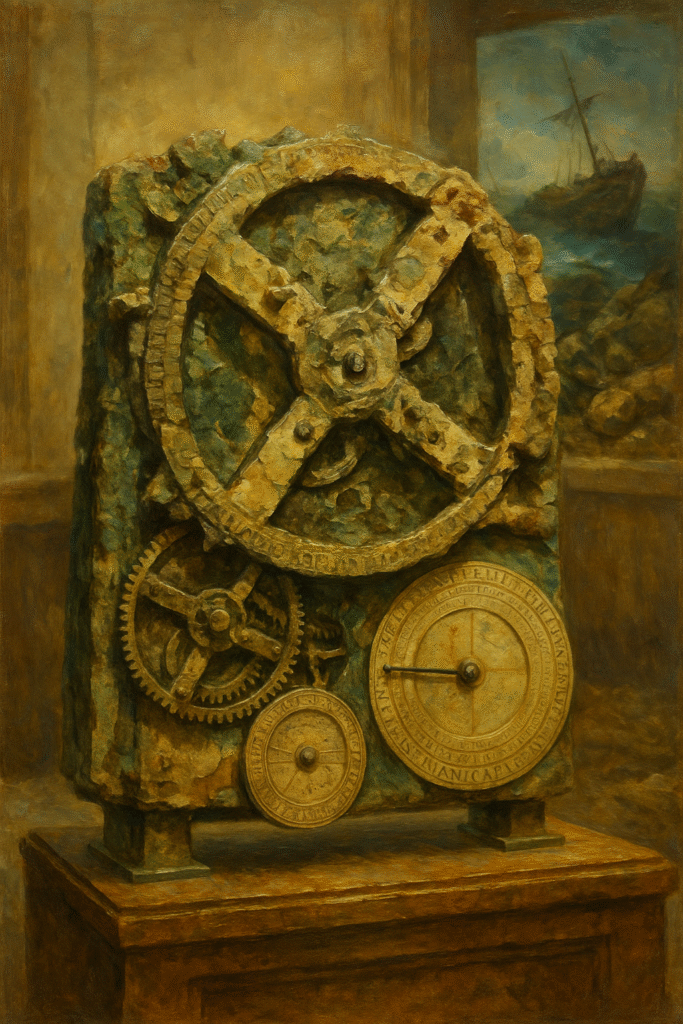

Subtitle: A compact masterpiece of Hellenistic engineering — the Antikythera Mechanism is an ancient Greek mechanical computer that modeled celestial cycles and still reshapes how we see antiquity.
Key takeaways
- The Antikythera Mechanism is an ancient Hellenistic geared instrument and the best-known example of an early mechanical computer.
- It modeled lunar and solar motion, encoded the Metonic and Callippic cycles, and used the Saros cycle to predict eclipses.
- Discovered in a shipwreck near Antikythera in 1900, modern CT scanning and reconstruction work have revealed its gear train and inscriptions.
- Its existence challenges assumptions about the technological capabilities and the transmission of mechanical knowledge in antiquity.
What is the Antikythera Mechanism?
The Antikythera Mechanism is a portable, hand-driven ancient astronomical calculator. Built in the Hellenistic era (roughly 2,000 years ago), this mechanical analog computer used a compact gear train to translate a single input rotation into multiple outputs: zodiacal position, lunar phase, Metonic-cycle year, and eclipse likelihood via the Saros cycle. In short, it is an extraordinary example of ancient Greek technology and precision craftsmanship.
Beyond its immediate function as an astronomical device, the Antikythera Mechanism demonstrates a conceptual leap: using gear trains not merely for mechanical advantage or timekeeping but to compute—mechanically—nonlinear motions derived from mathematical models of celestial mechanics. The presence of inscriptions with calendrical and instructional content further indicates that it was both a scientific instrument and an educational tool.
Antikythera Mechanism discovery and history
First, sponge divers recovered the wreck off the island of Antikythera in 1900. Among statues and luxury objects were corroded bronze fragments. For decades the parts were puzzling until mid-20th-century X-rays and later high-resolution X-ray tomography revealed interlocking gears. Derek de Solla Price first argued for a geared calculator, and 21st-century teams (Tony Freeth, Mike Edmunds, Michael Wright, and others) used CT scans and epigraphic study to reconstruct the mechanism’s functions.
A brief timeline that helps place discoveries in context:
- 1900: Shipwreck discovered; fragments brought to the National Archaeological Museum in Athens.
- 1950s–1970s: Derek de Solla Price publishes the first comprehensive mechanical analysis, proposing the geared nature of the object.
- 2002–2006: CT scanning and digital imaging reveal additional gear teeth and inscriptions, leading to a major Nature paper in 2006 refining the reconstruction.
- 2012–Present: Ongoing epigraphic and mechanical work continues to refine our understanding of its dials, inscriptions, and functions.
Scholars debate its place of manufacture; leading candidates include Rhodes and Alexandria—centers of observational astronomy and mechanical skill in the Hellenistic world.
How the Antikythera Mechanism works: an ancient mechanical computer
Imagine a tiny clock whose hands narrate the dance of Sun and Moon. The core is a gear train: one crank rotation drives outputs moving at different rates. Key mechanical features include:
Front dials and pointers
- Zodiac and calendar rings to show Sun and Moon positions.
- A lunar pointer that also indicates phase.
Back dials and astronomical cycles
- Metonic cycle (19 years / 235 lunar months) dial for calendar alignment.
- Saros cycle (223 lunar months) spiral for eclipse prediction.
- Callippic cycle steps for longer-term correction.
Mechanical ingenuity: simulating nonuniform motion
To model the Moon’s variable speed (the lunar anomaly), designers used an epicyclic or pin-and-slot arrangement — effectively an early form of programmed nonuniform motion in a mechanical computer. This combination of theory and craft illustrates how mechanical analog computation can encode astronomical models.
A practical explanation, step-by-step, of how a single input leads to multiple outputs:
- A user turns the input crank to represent a progression of days or months.
- The main drive gear transmits rotation across a train of interlocking gears with different tooth counts, converting the uniform input to a set of different angular speeds.
- Some outputs are directly proportional to the input (e.g., sun position around the zodiac), while others use compound gearing (or epicyclic systems) to produce nonuniform motion (e.g., lunar anomaly and phase).
- Back dials present aggregated or cyclical information: the Metonic dial tallies 19-year cycles, while the Saros spiral indexes eclipse risk.
- Inscribed instructions and labels allow the operator to interpret readouts in terms of calendar dates, eclipse predictions, and festival timings.
This stepwise functioning demonstrates why the term “mechanical computer” is apt: it transforms inputs into multiple computed outputs according to encoded mathematical relationships.
Modern reconstructions, replicas, and museum exhibits
Reconstruction work has been central to understanding the mechanism. CT imaging revealed hidden gears and inscriptions; 3D models and working replicas (from brass to 3D-printed kits) demonstrate the device in action. If you want a hands-on encounter, look for:
Antikythera Mechanism replica and model kits
Replica options range from museum-quality brass reconstructions to educational 3D-printed model kits that teach gear relationships and astronomical cycles. Building a replica is itself an educational case study: it forces modelers to make assumptions explicit (gear tooth counts, spacing, shaft placement) and to reconcile epigraphy with mechanics.
Example case study: the 2006 Nature reconstruction
The 2006 reconstruction by Tony Freeth and Mike Edmunds used advanced imaging to identify previously hidden teeth and inscriptions. By converting CT data into a mechanical model, they showed how a 30-gear train could reproduce observed functions. The paper’s approach—combining archaeology, imaging, mathematics, and engineering—has become a model for interdisciplinary reconstruction.
Where to see the original and trusted reconstructions
The main fragments are conserved at the National Archaeological Museum in Athens (museum exhibit). Several science centers and research groups provide animations and working models that illustrate how this ancient astronomical calculator functioned. Traveling exhibitions and online interactive models extend public access worldwide.
Why the Antikythera Mechanism matters for ancient Greek technology
The device forces a re-evaluation of technological timelines. Rather than a simple linear progress, the mechanism suggests advanced Hellenistic mechanical engineering and a culture where mathematical astronomy and precision workshop practice met. The implications are twofold: a lost tradition of instrument-making may have existed, and science and craft were deeply integrated in antiquity.
Comparative analysis: Antikythera Mechanism vs. medieval astronomical clocks and modern computers
- Complexity: The mechanism matches or exceeds the gearing complexity of medieval clocks in its density and the way it encodes astronomical cycles.
- Purpose: Like medieval clocks, it combined practical calendar functions with social and religious scheduling. Unlike electronic computers, it computes mechanically without programmability beyond its fixed gear train.
- Legacy: While mechanical thinking resurged during the medieval and early modern periods, the Antikythera Mechanism indicates that such complexity existed far earlier than previously assumed.
Practical applications and relevance today
Although the Antikythera Mechanism no longer drives calendars or eclipses, its relevance is multifold:
- Education: Replica kits and demonstrations teach gear ratios, historical methodology, and the history of computation.
- Museums and public engagement: The device is a compelling entry point into conversations about lost technologies and the social context of science.
- Engineering inspiration: Its compact epicyclic solutions and elegant use of mechanical constraints influence designers interested in mechanical computation and low-energy devices.
- Digital humanities and archaeology: The methods used to study the mechanism—CT scanning, 3D modeling, and interdisciplinary collaboration—provide templates for other artifacts.
Practical recommendation: educators and museum curators can develop modular lesson plans where students both assemble parts of a 3D-printed replica and analyze the inscription panel to learn how ancient notation encoded scientific concepts.
Expert insights and quotes
- Derek de Solla Price (paraphrase): Price described the Antikythera Mechanism as a “device of philosophical and technical sophistication that foreshadows later developments in clockwork and instrumentation.” His early work set the foundation for mechanical interpretation.
- Tony Freeth (paraphrase from publications): Freeth and colleagues emphasize that “the mechanism reflects a sophisticated blend of observational astronomy, mathematics and skilled metalworking that challenges assumptions about ancient technological capabilities.” Their imaging work revealed functions previously obscured by corrosion.
- Mike Edmunds (paraphrase): Edmunds has noted that the mechanism is “a technical object designed to be used—its design includes clear interfaces for a human operator, inscriptions, and readable dials—suggesting it served a living educational and practical role.”
Including expert perspectives underscores that the Antikythera Mechanism is not just a curiosity but a scientific artifact central to debates about technology, transmission, and innovation in antiquity.
Further reading, resources, and authoritative sources
For technical details and peer-reviewed reconstructions, consult the Antikythera Mechanism Research Project and the landmark research published in Nature. For museum context and visiting information, consult the National Archaeological Museum in Athens. Additional resources include specialized monographs on Hellenistic astronomy and mechanical engineering.
Future trends and research directions
Several promising directions could deepen knowledge about the Antikythera Mechanism and its context:
- Machine learning for epigraphy: Using AI to enhance legibility of worn inscriptions could reveal new labeling or operating instructions.
- Underwater archaeology: Improved remote sensing and excavation techniques may locate additional fragments or related artifacts in the Antikythera shipwreck site.
- Comparative artifact studies: Searching museum collections and excavation records for similar fragments could identify other machines or tools from the same tradition.
- Public digital twins: High-resolution, interactive models hosted online (with annotated gear trains and simulated operation) will broaden access for teaching and research.
Predictions: Within a decade, expect more refined reconstructions integrating dynamic simulations of gear wear, friction, and tolerances that will better constrain hypotheses about how precisely the device could predict astronomical events.
Quick reflection (Noetik):
Two thousand years ago, hands and mind joined to make the heavens turn on a dial. That union of intellect and craft is, simply, human. Keep wondering.