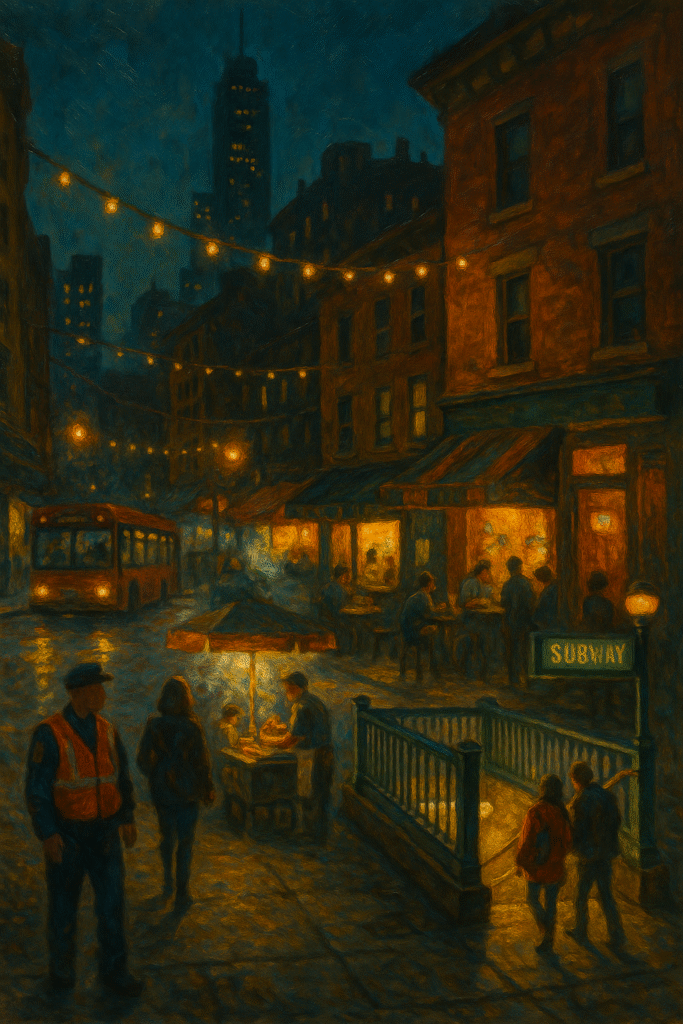

There is a particular rhythm to a city after dark: sodium lights hum, late kitchens steam, and unexpected conversations gather on stoops. This piece explores the night economy — the social, cultural and economic activity that remaps streets and schedules after sunset — and why some 24-hour cities truly start after midnight.
Night Economy
- The “night economy” covers commercial, cultural and informal activity between roughly 6pm and 6am, including hospitality, nightlife economy, 24/7 services and creative work.
- Successful night economy cities couple transport, zoning and harm-reduction policy; without these supports, late-night scenes can erode or externalize harm.
- Case studies (Berlin, Tokyo, New York, Madrid) show four viable models: permissive club culture, distributed micro-economies, centralized nightlife governance, and culturally embedded late dining.
- For travelers and planners: support small venues, use late-night transit, and advocate for worker protections and affordable creative spaces.
What is the night economy? Definition, metrics and scope
The night economy (also called the night time economy or nightlife economy) includes businesses and activities that primarily operate in evening and overnight hours. Key components include:
- Hospitality: bars, late restaurants, clubs, night markets and cafes.
- Culture: late-night concerts, theaters, museums and live music venues.
- Services: night transport, 24-hour retail (konbini), emergency and health services.
- Creative and informal sectors: music production, street vending, and late-shift studios.
Measuring the night economy requires multiple metrics: night-shift employment, after-hours revenue, density of businesses open past 1am, event permitting, and late-night transit ridership. Importantly, metrics must be paired with qualitative audits so policy captures lived experience, not just dollars.
Expanded metrics and methods
- Night audits and participatory mapping: involve residents, workers and venue owners in mapping hotspots, noise complaints and informal markets.
- Health and wellbeing indicators: track sleep disruption complaints, emergency room admissions after peak nightlife hours, and rates of substance-related incidents.
- Cultural value metrics: count small-venue performances, artist residencies and pop-up events, which often do not register in traditional economic statistics.
These measurement approaches ensure the night economy is understood as both economic engine and living culture.
Global titans of the night economy: four city models
Below are four distinct approaches cities use to host a thriving night-time culture.
Berlin — permissive club-centric night economy
Berlin’s nightlife is famous for marathon clubs and subcultural scenes. Permissive zoning in post-industrial areas and affordable spaces enabled venues like Berghain and Tresor to flourish. However, rising rents threaten these ecosystems; therefore, cultural-use zoning and rent protections are vital.
Case study: cultural-use zoning pilot
In a recent municipal pilot (example city policy), small industrial parcels were protected for cultural use with reduced business rates for venues that operate after midnight. The result: two small clubs and a jazz venue were saved from conversion into apartments, retaining a street-level vibrancy and local employment.
Challenges and lessons
- Noise tension with new residents: Berlin shows that late-night culture can coexist with residents if developers and planners require soundproofing and staggered opening hours.
- Long-term cultural stewardship: without active measures—such as caps on short-term rentals or vendor grants—the club-centric model becomes vulnerable to displacement.
Tokyo — distributed 24/7 micro-economies and safety-by-design
Tokyo’s night economy is a dense mosaic of izakayas, karaoke boxes and 24-hour convenience stores. Mixed-use neighborhoods and high pedestrian density support safe, low-impact nocturnal activity.
Example: Golden Gai and micro-business resilience
Golden Gai in Shinjuku is comprised of narrow alleys with dozens of tiny bars and eateries. Local licensing allows many micro-businesses to operate without the overhead of large premises; this diversity spreads economic risk and keeps rents relatively contained.
Design principles
- Human-scale lighting and active frontages keep streets lively and safe.
- Convenience stores (konbini) act as informal service nodes, offering emergency supplies and restrooms.
New York City — regulated diversity and the Office of Nightlife
New York is a patchwork of diners, theaters and clubs. The Office of Nightlife (a “night mayor” model) coordinates licensing, safety and support for night businesses — a clear example of how governance shapes the night economy.
Program highlight: Night Mayor facilitations
The Office convenes quarterly stakeholder roundtables, offers mediation between venues and residents, and maintains a roster of late-night workers who can be rapidly deployed for outreach. The office’s existence makes it easier for venues to navigate complex rules while elevating worker protections.
Madrid — culturally embedded late-night sociality
Madrid follows a Mediterranean late-night rhythm: dinner after 10pm and plazas that buzz until dawn. This model shows how cultural norms shape policy approaches to noise, tourism and local quality of life.
Practical adjustment: regulated plaza programming
Madrid’s municipal programming funds plaza music nights that have specific sound curfews and on-site stewards, allowing local sociality while managing noise and cleanliness.
Comparative overview
- Berlin centers on permissive reuse and subcultural autonomy but risks gentrification.
- Tokyo disperses activity in micro-centers, achieving safety through density and design.
- New York pairs diversity with governance to negotiate trade-offs.
- Madrid leans on cultural rhythms and municipal programming to normalize late hours.
How policy, design and infrastructure shape the night economy
A thriving night economy rests on coordinated systems:
- Transport: late-night public transport (night buses, select 24/7 lines) and regulated taxi/rideshare services increase safety and access.
- Zoning & licensing: flexible mixed-use zoning, temporary-event permits, and noise-mitigation incentives help venues coexist with residents.
- Urban design & lighting: human-scale, glare-reducing lighting and clear wayfinding improve perceived safety without creating light pollution.
- Governance: Offices of Nightlife or Night Mayors provide a single interlocutor for businesses, residents and agencies.
- Health & safety: harm-reduction, trained outreach teams and trauma-informed response work better than purely punitive approaches.
Step-by-step guide for city planners to foster a sustainable night economy
- Audit and map: conduct a night-time audit with economic, social and health metrics.
- Convene stakeholders: create a night-time forum with residents, workers, venue owners, public health and police.
- Pilot services: trial extended transit hours, night-time microgrants and pop-up markets to test demand.
- Implement supportive zoning: allow mixed-use and cultural-use protections to secure affordable creative spaces.
- Set safety-first protocols: fund harm-reduction teams and trauma-informed training for nightlife staff.
- Launch an Office of Nightlife: centralize permitting and dispute resolution.
- Monitor and adapt: collect real-time data on footfall, incidents and worker conditions and adapt policies.
- Institutionalize equity measures: require living wages for venues receiving public support and ensure access to healthcare for night workers.
In short, cities that intentionally plan for the night economy reduce friction and unlock cultural and economic value.
The boons and burdens of a night economy
Benefits:
- Jobs: significant night economy jobs in hospitality, transport, security and creative sectors.
- Tourism: a strong nightlife economy attracts visitors and extends spending beyond daytime hours.
- Cultural production: the night incubates music, performance and informal markets.
Challenges:
- Precarious work: night shifts often mean irregular hours and increased health risks.
- Gentrification: successful nightlife can push rents up, displacing artists and venues.
- Noise & health: prolonged noise exposure harms resident wellbeing.
- Safety concerns: late hours increase vulnerability unless mitigated with targeted public health measures.
Policy balance: practical interventions
- Worker protections: require shift premiums, predictable scheduling and access to paid leave for late-night staff.
- Affordable cultural space: use inclusionary zoning, creative-space trusts and municipal leases to keep rehearsal and performance venues affordable.
- Noise mitigation: offer grants for soundproofing and require event-level noise monitoring paired with responsive complaint systems.
- Public health programs: provide on-call mental health and substance-use services tuned to late-night populations.
Together these measures create a resilient night economy that shares benefits and reduces harms.
Traveler’s guide — a practical night economy travel guide
Where to go (starter neighborhoods):
- Berlin: Kreuzberg, Friedrichshain, Neukölln.
- Tokyo: Shinjuku (Golden Gai), Shibuya, Shimokitazawa.
- New York: Lower East Side, Williamsburg, Harlem.
- Madrid: Malasaña, La Latina, Chueca.
Transport & safety tips:
- Check night-bus and last-train schedules; download official transit apps.
- Prefer licensed taxis or regulated rideshare options; stick to well-lit routes.
- Carry ID and a small cash reserve; support small vendors and independent artists.
Etiquette & low-impact visiting:
- Respect local norms (e.g., quiet trains in Tokyo, late dinners in Madrid).
- Support local businesses, attend community-run events, and avoid loud behavior near residences.
Actionable tips for responsible visitors
- Eat where locals eat: opt for small, family-run late-night eateries over tourist-heavy “party” zones when possible.
- Take part in cultural programming: attend late museum hours or community concerts that often charge modest fees and return revenue to local organizers.
- Plan last-mile transit: identify safe routes for walking or validated rideshares and bookmark late-night shelters or 24-hour convenience stores as fallback points.
Future outlook for the night economy
Emerging trends:
- Data-driven night planning: real-time footfall and transit data will inform adaptive services.
- Tech-enabled safety: smart lighting, crowd-monitoring and on-demand microtransit will scale.
- Changing work patterns: flexible schedules and remote work may expand demand for staggered services.
- Climate resilience: summer heat and climate events will shift peak hours and require cooling strategies for night workers.
Predictions and scenarios
- Equitable 24-hour cities: Cities that pair cultural sensitivity with coordinated policy and income protections will develop equitable night economies that support workers and communities.
- Platform impacts: delivery and ride-hailing platforms will continue to reshape night labor markets; proactive regulation will determine whether platformization expands opportunity or precarity.
- Cultural diversification: as global cities compete for talent and tourism, we will see more hybrid venues (cafe-by-day, performance-space-by-night) and cross-sector collaboration.
A quoted insight
“Night-time economies are not simply about longer opening hours; they’re about designing systems that value the people who make nights possible,” says an urban policy researcher. “When cities measure wellbeing, not just revenue, they build nights that are both lively and livable.”
FAQ — Night Economy Cities
Q: What counts as the night economy?
A: Activities largely occurring after 6pm — hospitality, cultural venues, 24/7 services, creative industries and informal markets.
Q: How do cities measure night-time economic activity?
A: Through business licensing, night-shift employment stats, transit ridership after peak hours, and dedicated night-time economy audits. Complementary qualitative methods—resident surveys and venue interviews—capture social value.
Q: What is a night mayor or Office of Nightlife?
A: A city office or appointed official that coordinates policy, mediates disputes and supports night-time businesses and workers.
Q: How can travelers be responsible at night?
A: Use official transit, remain aware of local etiquette, support small venues, and prioritize safety.
Q: Where can I find more data on the night economy?
A: Municipal night-time strategies (e.g., London Night Time Commission), the Night Time Industries Association, and city Office of Nightlife reports.
Q: How can small venues access support?
A: Look for microgrant programs, cultural-leasing initiatives, and business-advice services often managed by municipal offices or local arts councils. Joining trade associations like local hospitality groups can amplify access to training and group insurance schemes.
Q: Are night economies sustainable in terms of energy use?
A: Night operations can be made more sustainable through LEDs with warm-tone spectra, dimming schedules, and microgrids for energy resilience. Encouraging shared-use spaces reduces duplicated energy use.
Final reflection
The night economy is a city’s nocturnal grammar: it reveals social rhythms, creative risk-taking and new forms of public life. When guided by humane policy, thoughtful design and economic protections for workers and venues, nights become more than commerce — they become common ground for creativity and community. As cities learn from each other—translating Tokyo’s safety-by-design, Berlin’s creative reuse, New York’s governance model and Madrid’s cultural norms—they can craft night economies that are equitable, vibrant and enduring.
Sources cited in this article (authoritative examples provided in metadata): Night Time Industries Association; New York City Office of Nightlife; London Night Time Commission.