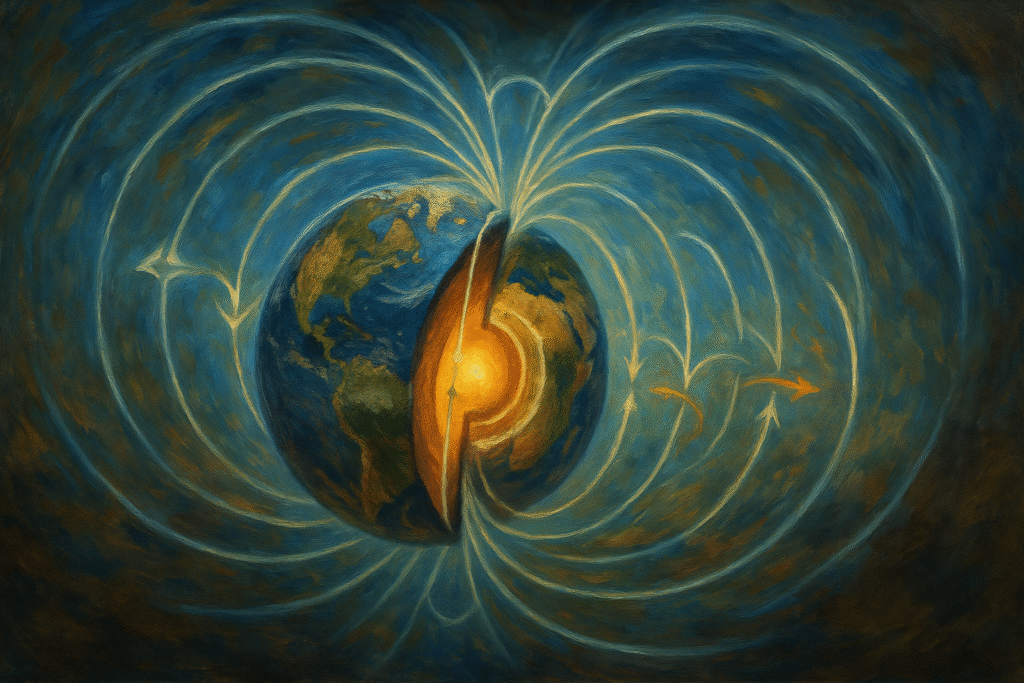

Lede: The idea of an earth magnetic field flip sparks both fascination and concern. This short guide explains what a geomagnetic reversal is, why the magnetic poles change, what the paleomagnetic record shows, whether the poles are reversing now, and the realistic magnetic field reversal effects on technology, life, and society.
Key takeaways: A geomagnetic reversal (an earth magnetic field flip) is a natural, slow process driven by the geodynamo in Earth’s outer core. Reversals unfold over centuries to millennia. While a weaker field during transitions can raise radiation and technology risks, dramatic doomsday scenarios are unsupported by evidence.
What is an earth magnetic field flip? A simple primer
An earth magnetic field flip (geomagnetic reversal) occurs when the planet’s large-scale dipole reverses polarity so that the location we call magnetic north becomes magnetic south, and vice versa. These flips are recorded in rocks and sediments worldwide.
- The field is produced by the geodynamo: convecting, electrically conductive molten iron in the outer core that creates self-sustaining electric currents.
- The dipole (north and south) dominates the large-scale field, but non-dipolar features and secular variation (year-to-decade changes) are always present.
In short, the earth magnetic field flip is a deep‑time reorganization of the planet’s magnetic cloak, not an instantaneous event.
Expanders and context: The geological record shows that reversals are neither rare nor unique — they have occurred hundreds of times over the last 160 million years. These reversals are identified by magnetic minerals in lava flows and sediments that lock in the orientation of the field as the rocks cool. That record is the foundation for the geomagnetic polarity timescale used by geologists and paleomagnetists.
How Earth’s geodynamo works (why the flip can happen)
Earth’s magnetic field is born in the liquid outer core. Heat-driven convection, the Coriolis effect from planetary rotation, and electrical conductivity combine to drive the geodynamo. Over long times, that dynamo can reorganize, weaken, and then re-establish in the opposite polarity.
Analogy: imagine stirring a conductive fluid while electricity flows through it—flow patterns can create, change, or even reverse a global magnetic pattern.
Detailed explanation: The geodynamo depends on three ingredients: a conductive fluid (liquid iron alloy), a source of energy (cooling of the core, radioactive decay, compositional convection as inner core crystallizes), and rotation. Small changes in heat flow at the core–mantle boundary or in the pattern of convection can nudge the dynamo toward instability, producing fluctuations that may culminate in an earth magnetic field flip.
Are the poles reversing now? When will Earth’s magnetic field flip?
Current measurements show that the magnetic north pole has drifted from northern Canada toward Siberia and that the global dipole strength has declined by roughly 9–15% over the last ~170 years. However, these trends are not definitive proof of an imminent earth magnetic field flip.
- Scientists monitor the field with ground observatories (INTERMAGNET, national observatories) and satellite missions (ESA’s Swarm).
- Declines in dipole strength and pole drift can be precursors, part of secular variation, or signs of an excursion rather than a full reversal.
Case study — The Laschamp excursion (about 41,000 years ago): During the Laschamp event a significant weakening and partial polarity change occurred for a few hundred years. Ice-core and sediment records show a spike in cosmogenic isotopes (e.g., 10Be) indicating increased cosmic-ray flux when the field was weaker — a useful real-world example of the kinds of effects that can accompany excursions.
Conclusion: there is no conclusive evidence that a full earth magnetic field flip is underway now.
Magnetic pole flip timeline: How long does an earth magnetic field flip take?
The magnetic pole flip timeline is long:
- Full geomagnetic reversals commonly unfold over thousands to tens of thousands of years.
- Some local records show faster local changes (centuries), but globally the process is slow and chaotic.
- Excursions (short-lived departures from normal polarity) typically last hundreds to a few thousand years.
Therefore, an earth magnetic field flip gives us centuries to millennia to observe and adapt.
Step-by-step view of a typical reversal timeline:
- Secular variation increases and the dipole weakens compared to its long-term average.
- Non-dipolar components grow, producing complex field geometries and local anomalies.
- The dipole may collapse to a low value; regional patches of reversed polarity appear in the field recorded by sediments and lavas.
- Over centuries to millennia the dynamo reorganizes and a new, stable dipole emerges with opposite polarity.
This stepwise explanation helps illustrate why abrupt, overnight flips are not geophysically plausible.
Magnetic field reversal effects: consequences for technology and life
The most realistic magnetic field reversal effects are moderate and manageable. Below are plausible impacts and unlikely myths.
Plausible impacts
- Increased surface and aviation radiation: a weaker field allows more cosmic rays into the atmosphere, modestly raising doses at high altitudes and for astronauts. Airline crew and frequent flyers could see slightly higher exposures during prolonged low-field periods.
- Satellite risks: more single-event upsets and potential anomalies; operators already design for space‑weather risk and can increase shielding and fault tolerance. CubeSat missions and low-cost satellites are particularly vulnerable unless designed with resilience in mind.
- Power grid vulnerability: geomagnetically induced currents (GICs) from solar storms can damage transformers; changes in field configuration could alter regional GIC risk. Grid hardening and monitoring mitigate this.
- Navigation and ecology: compass readings can become erratic during transitions; migratory species that use magnetic cues — birds, sea turtles, some insects — may experience disruptions. Ecologists study behavioral adaptations and alternative navigational cues (sun, stars, olfaction) that can compensate.
Detailed example — Aviation: High-latitude polar routes rely on accurate magnetics and space‑weather forecasting. During reduced field strength, increased radiation risk leads to operational adjustments: rerouting flights, altitude changes, and crew radiation tracking.
Unlikely or unsupported consequences
- Mass extinctions directly caused by reversals: the geological record does not show a consistent link. While excursions like Laschamp produced measurable environmental signals, they did not trigger global die-offs.
- Overnight global catastrophe: reversals are slow; the atmosphere and climate are controlled by other dominant processes.
Comparative analysis: Mars lost its global magnetic field billions of years ago; the result was a gradual stripping of its atmosphere by the solar wind, contributing to its current cold, thin atmosphere. Earth’s magnetosphere, even when weakened, is still far more protective than Mars’ present state, and our atmosphere acts as an additional shield.
Geomagnetic reversal research: how scientists monitor and model reversals
Researchers combine observations and models:
- Paleomagnetism (lava flows, marine magnetic anomalies, sediment records) preserves a timeline of past reversals such as the Brunhes–Matuyama reversal (~780,000 years ago) and shorter excursions like the Laschamp event (~41,000 years ago).
- Satellite missions (ESA Swarm) and ground observatories track secular variation and dipole strength in real time.
- Numerical geodynamo models on supercomputers reproduce reversals under certain parameter regimes and test hypotheses about core flow changes and core–mantle boundary conditions.
Expert insight: Agencies like NOAA and USGS emphasize that long-term monitoring, improved paleomagnetic sampling, and higher-resolution modeling are key to distinguishing normal secular variation from true reversal behavior. Improved computing power and data assimilation techniques are enabling models that better capture the statistical properties of reversals.
Methodological case study: Combining lava-flow records from Iceland and Hawaii with marine magnetic anomalies has allowed researchers to refine the timing of past reversals and to evaluate how synchronous changes were globally. This multi-proxy approach reduces local biases and strengthens inferences about global field behavior.
How to prepare for a magnetic pole reversal (practical guidance)
For most individuals, no special preparations for an earth magnetic field flip are necessary. Reasonable actions focus on general infrastructure resilience:
- For citizens: stay informed via authoritative sources (NOAA, USGS). No household-level survival kit is required specifically for a magnetic flip.
- For operators: spacecraft should maintain radiation-hardened designs and operational contingencies; power utilities should continue GIC monitoring, transformer protections, and emergency planning; aviation and communications should integrate space‑weather advisories.
Actionable checklist for organizations:
- Review contingency plans for extended elevated radiation periods.
- Ensure redundancy and protective measures for critical transformers in power grids.
- Integrate space‑weather alerts into aviation and satellite operation protocols.
- Support continued geomagnetic monitoring (fund observatories and data-sharing initiatives).
These measures are sensible today and useful whether or not a future reversal occurs.
Myths vs Facts — quick FAQ
- Will compasses stop working? Not permanently; during a complete flip needles would eventually point to the opposite pole, but during transitions they may be erratic.
- Will a flip cause mass extinction? No strong evidence supports that claim.
- Could the flip happen overnight? No; reversals are slow.
- Should I buy a “magnetic reversal survival kit”? No; focus on credible space‑weather and infrastructure resilience measures instead.
Closing reflection
An earth magnetic field flip invites humility: it is a reminder of planetary processes that operate on deep time yet intersect with modern technology. Studying reversals blends curiosity, scientific rigor, and practical resilience. As researchers continue geomagnetic reversal research, we gain both better forecasts and a broader perspective on Earth’s dynamic nature.
Future trends and predictions: Over the next decades expect denser satellite constellations for field monitoring, improved near-real-time assimilation of paleomagnetic data, and machine-learning-enhanced dynamo models that can better quantify reversal probabilities. Increased interdisciplinary collaboration — between geophysicists, space-weather forecasters, power engineers, and ecologists — will translate scientific understanding of an earth magnetic field flip into concrete resilience measures.
Visual suggestions
- Map: magnetic north wander path (last 200 years).
- Timeline: polarity timescale highlighting Brunhes–Matuyama and Laschamp events.
- Diagram: Earth cross-section showing geodynamo (inner core, outer core convection, magnetic field lines).
Suggested further reading
- NOAA geomagnetism pages (authoritative monitoring and basics).
- USGS Geomagnetism Program (paleomagnetism and observatory data).
- ESA Swarm mission pages (satellite monitoring of the magnetic field).