
Few episodes in Scottish history combine ritual, power and moral outrage like the Black Dinner feast. In late 1440 two young Douglas heirs were invited to a banquet at Edinburgh Castle and, shortly thereafter, arrested and executed. This piece reconstructs the event, separates fact from legend, and explains why The Black Dinner feast still matters for students of medieval politics and memory.
The Black Dinner feast — Scotland in the 1430s–1440s
Scotland in the 1430s and 1440s was governed through fragile balances. After James I’s assassination (1437) his son James II was a child, and regents and guardians—most notably William Crichton and Sir Alexander Livingston—vied with the powerful Douglas family for influence. The concentration of Douglas lands and military force made the young 6th Earl of Douglas a central actor in a volatile landscape.
More broadly, the decade was shaped by the twin pressures of internal aristocratic rivalry and the international consequences of the Hundred Years’ War. Nobles like the Douglases had networks that extended into England and continental courts; their loyalties could tilt the balance of power. The governance of a child king was particularly precarious, because formal institutions were weak and informal patronage determined appointments, land grants and military command.
The Black Dinner feast: Timeline and facts (Black Dinner 1440)
- Invitation: In late 1440 William Douglas, 6th Earl of Douglas, and his younger brother were summoned to Edinburgh Castle and invited to dine with the king’s household.
- The Feast: They ate with the royal party; the banquet acted as a public display of reconciliation and trust.
- Arrest and trial: Soon after the meal the brothers were seized, given a swift and arguably sham trial, and condemned for treason.
- Execution: They were led out to Castle Hill and executed; later accounts describe the display of their heads as a symbolic assertion of authority.
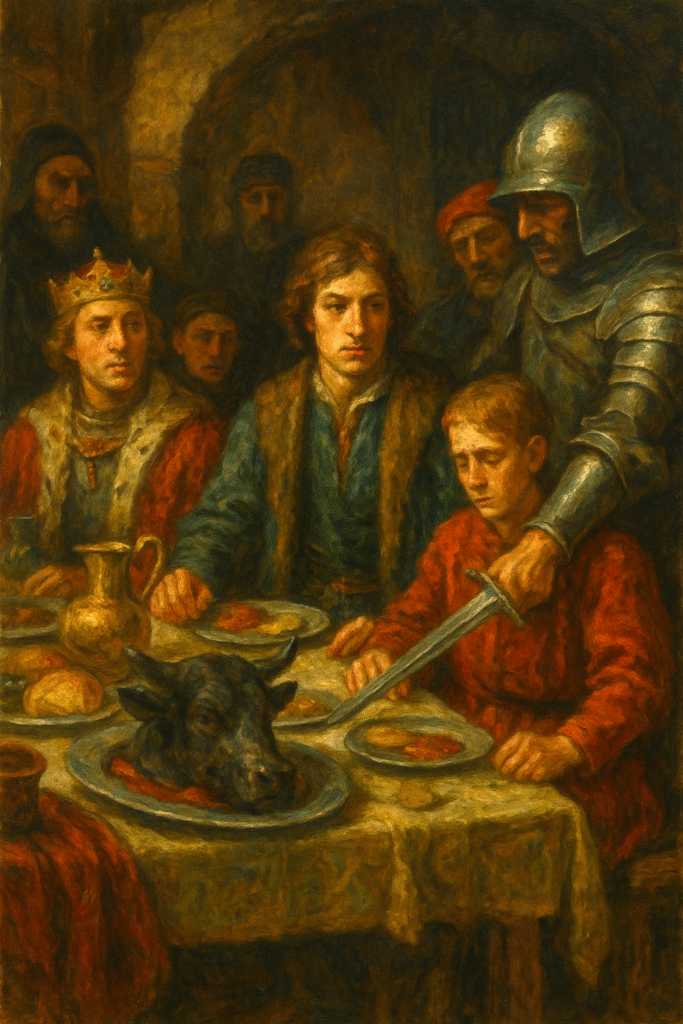
Primary chronicle evidence (Walter Bower; Andrew of Wyntoun) confirms the core sequence, though later retellings added theatrical details—such as the black bull’s head—that are debated by historians.
A step-by-step reconstruction helps clarify what most scholars accept: first the invitation and public banquet; then the isolation of the youths for the ostensible trial; then the arrest and rapid execution. This sequence underscores the calculated use of ritual—the banquet—to lower suspicion and then convert hospitality into a mechanism of elimination.
Key figures in The Black Dinner feast
- William Douglas, 6th Earl of Douglas (d. 1440): a teenage magnate whose inheritance made him a focal point for rivals.
- David Douglas: often identified as the younger brother executed alongside William.
- James II of Scotland (b. 1430): the child king whose minority framed the conflict.
- Sir William Crichton: Lord Chancellor and custodian of Edinburgh Castle, widely implicated in the plot.
- Sir Alexander Livingston: another guardian of the king and Crichton’s ally in curbing Douglas influence.
Adding personal detail helps: William Douglas was immensely wealthy for his age, holding lands and vassals that could raise dozens of men-at-arms. Contemporary sources portray him as adolescent but dangerously well-positioned. Crichton and Livingston, by contrast, had administrative control over the king’s household and the mechanics of royal patronage.
Motives behind the Black Dinner massacre (Douglas clan history & royal politics)
The available evidence suggests a political calculus: Crichton and Livingston likely perceived the Douglas heirs as an immediate threat to their guardianship and to the stability of their own networks. Eliminating the Douglas leaders—or at least neutralizing them—was a brutal but rational tactic in a polity where force and patronage often determined outcomes. Furthermore, staging violence inside a feast amplified its symbolic power: it turned hospitality into a demonstration of dominance.
Case study: comparing this episode to the later Massacre of Glencoe (1692) highlights a recurring Scottish pattern where hospitality was exploited for political ends. In both cases, perpetrators weaponized norms of welcome to achieve military-political objectives while attempting to minimize open civil war.
Consequences and legacy: Why The Black Dinner feast matters
Short-term consequences included intensified feuding and retaliation from remaining Douglas kin. In the longer term, the episode contributed to the weakening of the Black Douglases and the gradual assertion of royal authority under the adult James II. Culturally, the event endured as a potent tale of ritual betrayal and informed later memory and literature (it also inspired elements in modern fiction, notably George R. R. Martin).
A concrete consequence: the removal of the teenage earl allowed a reconfiguration of landholdings and patronage, which facilitated the consolidation of regental power. The Douglas family continued to be a force, but their status shifted from near-peer of the crown to a more contained noble lineage.
Visiting the site: Black Dinner tours Edinburgh and Edinburgh Castle history
Edinburgh Castle stands over Castle Hill where these events unfolded. While the precise chamber of the 1440 banquet is uncertain, most castle tours address the Black Dinner 1440 within the wider story of medieval Scottish politics. If you plan to visit, look for tours that discuss the Douglas-Stewart rivalry and the castle’s role during minority kingship.
Step-by-step visitor guide:
- Start at the castle entrance and request materials on the medieval period.
- Visit the Great Hall and imagine how a banquet would have appeared—note the layout, windows and access points mentioned in sources.
- Seek out interpretive panels that explain guardianship and the role of the chancellor.
- Finish at Castle Hill and the Scottish regalia exhibits for context on royal authority.
Practical tip: specialized guides and small-group tours that highlight political history will give more nuanced explanations than generalist tours focused on military or architectural features.
Sources and further reading
Contemporary chronicles and modern scholarship anchor our understanding: the Scotichronicon and Wyntoun remain essential primary witnesses, and modern works by Michael Brown, Ranald Nicholson, and A. A. M. Duncan provide careful, evidence-led interpretations. For public-facing context, consult authoritative heritage and academic resources listed below.
Expert insight: historian Michael Brown emphasizes that the Black Dinner feast should be read through the lens of regency politics—where legal forms were used opportunistically to provide a veneer of legitimacy to violent acts. Ranald Nicholson highlights how documentary silences (lost letters, missing charters) complicate our ability to assign motive precisely, encouraging cautious interpretation.
FAQ — The Black Dinner feast (common questions)
Q: What was the Black Dinner?
A: The Black Dinner feast refers to the 1440 episode at Edinburgh Castle in which William Douglas, 6th Earl of Douglas, and his brother were invited to a banquet and then arrested and executed.
Q: Is The Black Dinner feast a true story?
A: Yes. Chronicles confirm the core events, though some grisly or theatrical details are likely later embellishments.
Q: Who organized the Black Dinner?
A: Contemporary accounts implicate William Crichton and Alexander Livingston; modern historians see a factional coalition acting to check Douglas power.
Q: Can I visit the site?
A: Yes—Edinburgh Castle displays and tours discuss the episode; specialized “Black Dinner tours Edinburgh” are offered by some guides.
Q: Why is it called the “Black” Dinner?
A: The epithet likely comes from later traditions and narrative color—some chronicles mention a black bull’s head or a black symbol placed at the table as a grim sign—but this detail remains debated. The adjective captures the moral darkness ascribed to the event by later memory.
Q: How reliable are the chronicles?
A: Chronicles mix eyewitness reporting, hearsay and literary shaping. Historians triangulate these sources with charters, parliamentary records and forensic reading of land transfers to test claims.
Q: What lessons does the Black Dinner offer for students of history?
A: It is a case study in how ritual can be used to legitimize violence, the fragility of minority kingship, and the interplay between law and force. For medievalists, it also demonstrates the need to read narrative sources critically.
Note: this article uses standard chronicle sources and modern scholarship; see external links below for authoritative heritage and reference material.