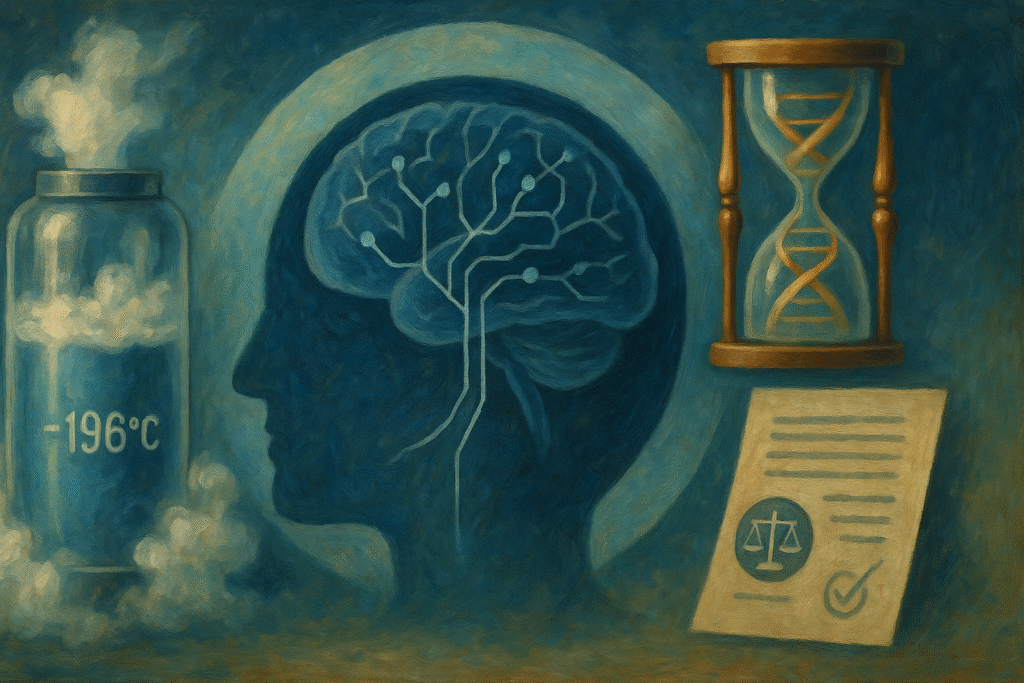

If tomorrow’s medicine could reawaken a life frozen today, what would we owe the living and the revived? Cryonics sits between careful science and speculative hope. Below, we offer a concise, balanced primer on cryonics—its techniques, realistic limits, costs, legal status, and ethical questions—so readers can reflect with clarity and care.
What is cryonics? A short science primer
Cryonics is the low-temperature preservation of a legally dead person with the aim that future medicine might repair damage and restore life. In practical terms, cryonics is about preserving the brain’s information content (synaptic patterns, circuits) rather than promising immediate revival. Importantly, preservation differs from proven revival: the latter remains hypothetical and depends on future advances in molecular repair, nanomedicine, and regenerative biology.
A useful way to frame cryonics is to think of it as information preservation. If identity and memory are encoded in the fine structure of brain tissue, then halting further decay and preserving that structure could, in principle, allow future technologies to read and repair it. That is the central claim—and the central uncertainty—behind cryonics.
Cryonics techniques: vitrification and biostasis
Modern human cryopreservation mainly uses vitrification—a process that replaces intracellular water with cryoprotectants so tissue solidifies into a glass-like state at roughly −196°C, thereby reducing ice-crystal damage. However, vitrification introduces toxicity and thermal stresses, and fracturing during cooling or warming remains a technical hurdle. In short, vitrification improves structural preservation but does not guarantee functional recovery.
Biostasis is an associated concept: stabilizing a patient in the hours immediately following legal death (or clinical death) to minimize ischemic damage and allow better eventual vitrification. Biostasis protocols often include rapid cooling, cardiopulmonary support, and infusion of protective agents. These are practical steps aimed at preserving the brain’s informational structure as soon as possible after circulatory arrest.
Related terms
- vitrification process
- cryopreservation
- biostasis
Is cryonics legal? Consent and regulation
In most jurisdictions, cryonics is legal because procedures begin after a person is declared legally dead. Yet legal gray areas persist: definitions of death (brain death vs. circulatory death), enforceability of long-term contracts, estate implications, and the need for robust informed-consent procedures. Therefore, better consumer protections and standards for facility governance are widely recommended.
Practical legal issues that often arise include who controls the remains and associated funds decades from now, how contracts are enforced if a facility closes, and how revived persons might be treated under inheritance and citizenship laws. These are not purely hypothetical—several organizations have had to adapt governance documents to address dissolution, fund shortfalls, or shifting regulatory environments.
How much does cryonics cost? Practical answers
Costs vary by provider and plan. Typically:
- Neuropreservation (head/brain): often in the tens of thousands of dollars.
- Whole-body preservation: commonly higher, sometimes exceeding six figures.
Many members use life insurance to fund arrangements, and organizations maintain membership plans and annual dues to support long-term storage. Still, long-term cryonic storage cost and financial provisioning deserve careful scrutiny.
Case study (illustrative): a neuropreservation plan with a reputable provider might list an initial fee of $80,000, annual dues of $150–$400 for maintenance, and recommended life-insurance policies to guarantee funds upon death. A whole-body plan could push initial costs well over $150,000. Potential members should review trust language and ask providers about contingency plans and independent audits to ensure funds are ring-fenced for storage.
Ethics of cryonics: identity, justice, and resurrection ethics
Ethically, cryonics raises multiple questions. First, identity and continuity: if future repair reconstructs memory and personality, is the revived person the same individual? Philosophers debate psychological continuity versus biological continuity, and cryonics intersects classic puzzles (Ship of Theseus, teleportation thought experiments).
Second, justice and equity: because cryonics is currently affordable mainly to wealthier people, it risks deepening intergenerational inequality if access to revival becomes real. Third, resource and environmental stewardship: maintaining facilities requires energy and institutional continuity, which creates obligations for future communities.
A further ethical layer involves consent. People who sign up when healthy may later change their views; ensuring that consent is informed about scientific uncertainty is ethically necessary. There are also concerns about social consequences—what would it mean culturally and politically if revived individuals returned to societies different from those they left?
Should we freeze the future? Policy and public deliberation
Rather than a binary yes/no, policy should be adaptive: require clear informed consent, financial transparency, independent audits of facilities, public support for cryobiology research, and equity measures to avoid exclusive future benefits. Moreover, public dialogue that includes ethicists, scientists, faith leaders, and affected communities can help shape norms that are both prudent and humane.
Policymakers might consider registry requirements, minimum financial-reserve standards, and mandatory reporting on adverse events to build public trust and accountability. International collaboration could help preserve institutional knowledge and protect long-term contracts across changing national borders.
Practical step-by-step: what happens in a cryonics case?
- Pronouncement of legal death. A physician or certified professional declares death per local law (typically after circulation and respiration cease).
- Immediate stabilization (if possible). The cryonics team aims to restore basic circulation using external support and cooled perfusion to limit ischemic injury.
- Cooling and transport. The body or head is cooled toward near-freezing temperatures and transported to the cryonics facility using expedited logistics.
- Vitrification perfusion. Cryoprotectants are perfused through the vascular system to replace water and reduce ice formation.
- Controlled cooling to storage temperature. The specimen is cooled slowly and transferred to long-term storage in liquid nitrogen at about −196°C.
- Long-term maintenance. The organization maintains the specimen in a secure cryostorage facility and manages member records and financial reserves.
This simplified sequence glosses over many technical and legal details, but it shows why rapid response, specialized equipment, and careful legal planning matter.
Comparative analysis: cryonics vs. related fields
- Cryonics vs. organ cryopreservation: Organs such as kidneys and livers are preserved for much shorter periods using optimized protocols. These are clinically proven in transplantation contexts, unlike whole-body or neuropreservation revival.
- Cryonics vs. embryo/sperm freezing: Reproductive cryopreservation is routine and successful because embryos and gametes are small, relatively homogeneous, and tolerate freezing well. The brain’s complexity makes cryonics orders of magnitude more difficult.
- Cryonics vs. suspended animation research: Emergency medicine and research into induced hypothermia for trauma patients show that controlled cooling can extend the window for treatment. These are promising adjacent fields but do not imply that long-term revival is possible.
Comparing these fields helps clarify where cryonics sits on a spectrum from established clinical practice to speculative future rescue.
Case studies and historical context
Historically, early cryonics experiments in the mid-20th century focused on animal models and rudimentary cooling techniques. Over time, advances in cryobiology, cryoprotectant chemistry, and storage logistics improved outcomes for small tissues and cells. However, attempts to preserve whole brains with minimal structural disruption are more recent and still imperfect.
Illustrative case: a well-documented neuropreservation from the 1990s showed improved ultrastructural preservation compared with older freezing methods, yet post-thaw cellular viability remained unknown. These incremental advances matter: they document improved protocols and reveal where scientific work remains.
Expert insights
“As a field, cryonics is about preserving what we currently consider the essential informational substrate of personhood,” says a senior cryobiologist who has worked on tissue vitrification protocols. “The crucial scientific gap is repair—how to reverse the chemical and mechanical damage that occurs even with excellent preservation.”
Another researcher adds: “We should view cryonics as a research frontier. Investments in basic cryobiology and long-term ethical oversight are likely to be more productive than unregulated commercialization.” These sentiments reflect mainstream cryobiological caution: preservation is increasingly sophisticated, but revival remains speculative.
Future trends and predictions
- Nanomedicine and molecular repair: Many pro-cryonics arguments hinge on the future development of nanoscale repair systems that could operate atom-by-atom to restore damaged tissue.
- Improved vitrification chemistries: Safer, less toxic cryoprotectants could reduce damage and increase the fidelity of preserved structures.
- Legal frameworks and portability: Expect more robust international contracts, escrow funds, and possibly supranational registries to secure long-term commitments.
- Public research initiatives: Calls for publicly funded research into cryobiology and reversible suspended animation may grow, shifting some work from private to public spheres.
These are predictions, not promises. The pace and feasibility of each trend remain uncertain.
Practical tips and recommendations for readers
- Research providers thoroughly: ask about financial reserves, audit reports, mortality-response timelines, and contingency plans.
- Read and understand consent documents: ensure the language acknowledges uncertainty about revival and outlines what happens if a facility dissolves.
- Consider funding mechanisms carefully: life insurance is common, but beneficiaries and trust structures should be vetted by a lawyer.
- Engage in family conversations: make your wishes clear to avoid disputes at critical moments.
- Stay informed about science: follow peer-reviewed cryobiology literature rather than marketing materials.
These steps help manage expectations and reduce risks associated with long-term commitments.
Conclusion — a reflective prompt
Cryonics invites both wonder and caution. As you reflect, ask: if revival became possible, what criteria should decide who is revived? And personally, imagine leaving a short message to your future self—what would you say?
Further reading and authoritative resources are available (see external links). For balanced peer-reviewed context, consult cryobiology journals and bioethics literature to weigh science and values together.