
North Sentinel Island sits at the intersection of geography, ethics, and epistemology. Visible on maps yet intentionally unreadable, it is home to the Sentinelese—an uncontacted people whose choice of seclusion forces us to rethink assumptions about contact, progress, and the limits of knowledge. This short guide explains what is verifiable, why non-contact is required, and what this case teaches us about human diversity and autonomy.
- North Sentinel Island is legally and ethically off-limits; Indian law protects the Sentinelese and their immunity.
- The Sentinelese are one of the world’s most isolated peoples; reliable public estimates place their population roughly between 50–150 individuals.
- Documented history includes colonial encounters, mid-20th-century “friendly contact” missions, resilience after the 2004 tsunami, and violent incidents in 2006 and 2018.
- Ethical anthropology emphasizes restraint: absence of access is not absence of worth. We should prioritize indigenous autonomy and precautionary public-health policies.
An Ethical Approach to North Sentinel Island
We begin with a rule: do no harm. All discussion here uses publicly available, reputable sources and avoids speculation about private cultural practices. Contact attempts are illegal and dangerous; beyond that, they risk catastrophic disease spread and cultural disruption. International norms, including the UN Declaration on the Rights of Indigenous Peoples, and Indian regulations support this non-contact stance.
Expanding ethical thinking into practice requires concrete protocols. For scholars and policy-makers, ethical engagement with North Sentinel Island is about restraint combined with protective governance: respecting zone restrictions, ensuring fisheries enforcement, and investing in remote monitoring that avoids direct interference. One practical model used in other contexts is a “buffer zone” approach—clearly demarcated no-approach distances, accompanied by community education for nearby populations about risks and legal penalties for breach. Such measures, when informed by epidemiologists and anthropologists, form a layered defense against inadvertent harm.
North Sentinel Island’s Geography: A Natural Fortress of Isolation
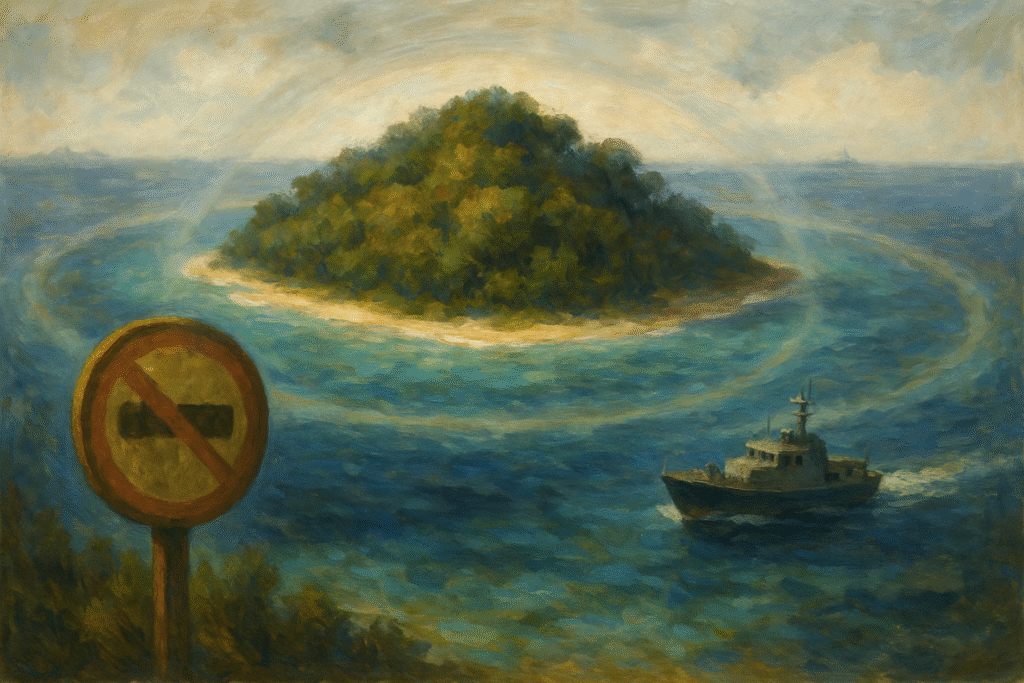
North Sentinel Island is a small, forested landmass in the Andaman and Nicobar archipelago of the Bay of Bengal. Coral reefs and a lack of safe harbors make landings difficult. The island’s littoral and forest resources likely sustain Sentinelese subsistence: seafood, foraging, and locally produced tools and boats. In short, the island’s ecology enables sustained seclusion.
A focused geographic case study helps illustrate this. Satellite imagery and maritime charts show a ring of reef that keeps many motorized vessels at a distance, while the island’s dense vegetation conceals interior activity. This combination—physical barriers and resource sufficiency—creates a natural environment where a small human group can survive without agricultural intensification or reliance on global supply chains. Climate change, rising sea levels, and coral degradation are potential future threats, however, and they could alter this equilibrium; monitoring reef health and coastal erosion without intrusive contact is an important conservation priority.
Timeline of Contact: The Documented History of North Sentinel Island
- Colonial-era sightings and occasional landings produced early contact narratives, some violent and exploitative.
- Mid-to-late 20th century: Indian anthropologists (notably T.N. Pandit) led limited “friendly contact” missions involving gift exchanges; sustained engagement was never achieved and was later abandoned.
- 2004 tsunami: aerial surveys showed the community survived the disaster, underscoring resilience.
- January 2006: two fishermen were killed after entering restricted waters.
- November 2018: an American missionary who attempted illegal landings was killed, prompting global debate about contact ethics.
All of the above are documented in government reports and reputable journalism; they form the verifiable public record we may ethically discuss.
To deepen understanding, consider two comparative case studies: the catastrophic outcomes of contact with the Tasmanian Aboriginals in the 19th century, and the mixed results of controlled contact programs among Amazonian groups. The Tasmanian case illustrates how disease, dispossession, and violent colonial policies can lead to cultural collapse. In contrast, carefully managed, consent-based collaborations in the Amazon—where communities initiated contact and set terms—show that when indigenous agency is central, outcomes differ. North Sentinel Island occupies a position on this spectrum where the expressed preference is complete non-engagement, and the legal framework reflects that choice.
Who Are the Sentinelese People? What Anthropology Can (and Can’t) Tell Us
Anthropologists infer from distant observation that the Sentinelese are small-scale maritime foragers with woodworking and boat-building skills and a deep local ecological knowledge. Population estimates vary because the group avoids enumeration. Crucially, we lack reliable data on language, social structures, religious beliefs, and intimate cultural practices—areas where ethical restraint is mandatory.
Expert insights emphasize the limits of inference: while material remains such as wooden tools and bamboo boats are visible from a distance, those artifacts do not reveal norms, kinship systems, or cosmologies. For responsible scholarship, this means shifting from an extractive desire to know toward supporting protective policies that recognize the Sentinelese as autonomous agents. Anthropologists often recommend non-invasive research investments—funding for remote sensing, archival research into historical encounters, and community-driven documentation in neighboring islands that can inform regional history without violating Sentinelese autonomy.
Why is North Sentinel Island Off-Limits? Laws and Public-Health Reasons
There are two interlocking reasons for the ban on approaches to North Sentinel Island:
- Immunological vulnerability: isolated peoples are often immunologically naive. Simple pathogens carried by outsiders can cause deadly outbreaks.
- Right to self-determination: the Sentinelese have repeatedly signaled a desire to be left alone. Indian law—the Andaman and Nicobar Islands (Protection of Aboriginal Tribes) Regulation and other administrative measures—prohibits travel near the island and enforces non-contact.
These legal protections align with international human-rights standards and best-practice anthropology.
A step-by-step explanation for policy-makers helps clarify how those protections are implemented:
- Risk assessment: identify public-health and cultural risks associated with contact.
- Legal designation: enshrine protections in local and national law (buffer zones, penalties).
- Enforcement: allocate naval and coast guard assets to patrol restricted waters.
- Education: run outreach for local fishermen and tourists about contamination risks and legal boundaries.
- Monitoring and review: use non-intrusive satellite data and environmental monitoring to assess island conditions and revise protections as needed.
This procedural framework balances defensive measures with adaptability to changing ecological and political contexts.
What North Sentinel Island Teaches Us About Humanity
- Human adaptability: the Sentinelese demonstrate that human societies can maintain cultural continuity in extreme isolation.
- Autonomy as dignity: respecting the Sentinelese choice not to engage is a form of political recognition, resisting colonial assumptions that contact equals improvement.
- Diversity as a horizon of possibility: their way of life is an alternative, not a deficit. It prompts humility about teleologies that equate technological assimilation with moral progress.
Practical applications of these lessons extend to broader policy debates. For example, when governments design development programs for indigenous regions, the North Sentinel Island ethic suggests centering consent and cultural preservation rather than imposing uniform models of “progress.” In humanitarian crises, it encourages restraint and consultation with representative indigenous organizations before intervention. In education, the case can be used to teach students about pluralism, ethics, and the limits of empirical inquiry.
Myths vs. Reality: Guarding Against Exoticism
- Myth: “Stone-age relics.” Reality: such labels are derogatory and inaccurate; the Sentinelese have adaptive, contemporary knowledge.
- Myth: inevitable disappearance if left alone. Reality: resilience (e.g., surviving the 2004 tsunami) indicates persistence unless external disruption occurs.
- Myth: benevolent contact is possible if done right. Reality: historical contact attempts worldwide often brought disease and cultural collapse; the precautionary principle supports non-contact.
Comparative analysis underscores why myths persist: outsiders tend to simplify complex societies into familiar tropes. Corrective strategies include promoting nuanced media coverage, funding anthropological literacy programs, and elevating indigenous-rights organizations in global discussions.
Further Reading & Media: Ethical Sources on North Sentinel Island
If you want to learn responsibly, prefer authoritative sources and avoid sensationalist content. Recommended categories:
- Official Government pages: Andaman & Nicobar administration and Indian policy documents on protected tribes.
- Reputable journalism: long-form reporting from outlets such as BBC, National Geographic, and major investigative pieces that focus on facts and ethics.
- Indigenous-rights organizations: Survival International and similar groups that advocate for non-interference.
- Academic anthologies on uncontacted peoples and Andaman tribal studies (peer-reviewed journals and university presses).
Practical application: when consuming media about North Sentinel Island, practice a simple checklist—verify the source, check for sensational language, and avoid content that reveals landing locations or encourages visits. This checklist helps curb the harmful spread of information that can inspire intrusive behavior.
Practical Reflection: Questions for Thought (Noesis in Practice)
- How does the Sentinelese claim to seclusion complicate modern assumptions about consent and progress?
- Where should the boundary lie between scientific curiosity and ethical obligation?
These short prompts aim to foster inward reflection rather than outward curiosity that could harm.
Actionable recommendations for readers who care about the Sentinelese:
- Do not share or promote photos or coordinates that pinpoint the island.
- Support indigenous-rights groups advocating non-interference.
- If you are a traveler near the Andamans, follow official guidance and respect buffer zones.
FAQ — Quick Answers on North Sentinel Island
Q: Who are the Sentinelese and how many people live on North Sentinel Island?
A: The Sentinelese are the island’s indigenous inhabitants. Reliable population estimates are limited but often cited around 50–150 people.
Q: Is travel to North Sentinel Island banned?
A: Yes. Indian law prohibits travel within a specified distance of the island to protect both the Sentinelese and visitors.
Q: Why is contact prohibited?
A: To prevent disease transmission and to respect the Sentinelese right to remain uncontacted under international human-rights norms.
Q: What happened in 2018?
A: An American attempted illegal landings and was killed; the incident reinforced the legal and ethical necessity of non-contact.
Q: Can researchers ever ethically study the Sentinelese directly?
A: Current consensus among many anthropologists and indigenous-rights advocates is no—direct study is unethical without free, informed consent. Ethical research instead focuses on non-intrusive methods and support for policy that protects the Sentinelese.
Q: How did the Sentinelese fare in the 2004 tsunami?
A: Aerial surveys after the tsunami showed survival of many Sentinelese, demonstrating resilience; however, such events remain a major risk for small island communities and underscore the need for non-invasive monitoring.
Q: What should local communities and tourists do to help?
A: Respect legal bans, educate others about the dangers of approaching the island, and report any illegal attempts to authorities. Supporting local conservation and healthcare efforts indirectly benefits regional stability.
Q: Are there environmental or climate threats to North Sentinel Island?
A: Yes. Climate change, coral reef degradation, and sea-level rise could affect resources and habitability. These threats are best monitored remotely and addressed through regional conservation policies that do not force contact.
For factual inquiries consult official government resources and reputable journalism; for ethical context consult the UN Declaration on the Rights of Indigenous Peoples and peer-reviewed anthropology. (See external links below.)