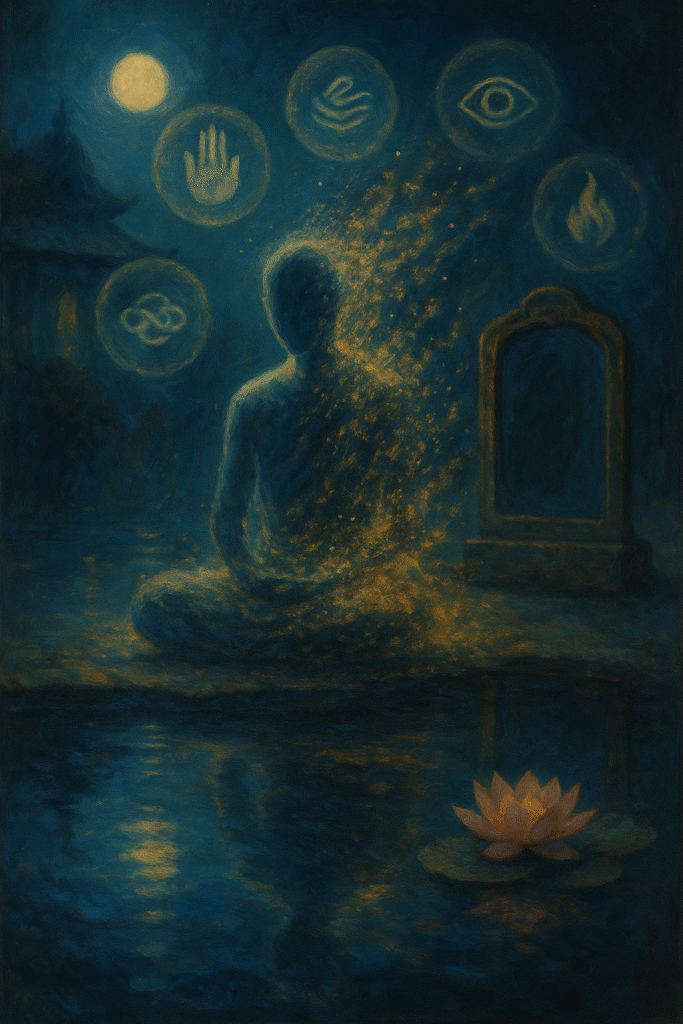

Illusion of self in Buddhism — The paradox you already know
You wake up annoyed: someone cut you off in traffic, your inbox is full, your chest tightens. Immediately, a narrator says, “I am upset; I must act.” This felt “me” seems solid. Yet, on reflection, it dissolves into a stream of sensations, thoughts, and memories. In other words, the sense of a permanent owner of experience is persuasive, but unstable. Buddhism calls this cognitive and existential phenomenon the illusion of self Buddhism aims to clarify through the teaching of anatta (Pali; Sanskrit: anatman).
Briefly, anatta is not a denial of experience. Instead, it is a pragmatic re-description: what we habitually call “I” is a changing process, not an unchanging substance. Below, we explain what that means, why it matters, and how you can test it in short practices.
What is the self in Buddhism? — Anatta meaning and the five skandhas
In Buddhist doctrine, the self is analyzed into five aggregates (five skandhas):
- Form (the body)
- Feeling (pleasant, unpleasant, neutral)
- Perception (recognition and labeling)
- Mental formations (intentions, habits)
- Consciousness (awareness)
The Anatta-lakkhana Sutta asks whether any aggregate can be claimed as a stable, controllable self. Since each is impermanent and conditioned, the conclusion is pragmatic: belief in a permanent self leads to clinging and suffering. Thus, anatta (no-self) functions as a soteriological tool — it weakens attachment so one can act with less reactivity.
To illustrate: imagine a ship made from many planks. We call it “the ship” for convenience, but there is no single plank that is the ship’s essence. Similarly, “I” is a convenient label for a changing collection of processes.
Historical context: the Buddha taught anatta against contemporaneous Indian views that posited an eternal atman (self). This was radical in its implication that liberation could be attained by seeing through the reification of selfhood.
How Buddhism challenges the idea of ‘me’ with philosophy and science
Philosophically, Buddhism’s anatta echoes Western thinkers such as David Hume (bundle theory) and modern reductionists like Derek Parfit, who downplay intrinsic personal identity. Yet Buddhism pairs this analysis with a practical path.
Scientifically, neuroscience finds no central homunculus. Instead, networks and predictive models construct self-related experience. For example, the Default Mode Network (DMN) reliably supports self-referential thought, and experienced meditators often show altered DMN activity (see Brewer et al., 2011). Moreover, theorists like Anil Seth propose that the self is an adaptive model — a “controlled hallucination” — that helps organisms predict and act.
Taken together, these perspectives make the claim plausible: the “I” is emergent and functional rather than metaphysically primary.
Comparative analysis: while Western psychology sometimes treats the self as a center of narrative and continuity, Buddhism reframes continuity as a causal chain of moments without invoking a permanent substratum. This moves the debate from metaphysics to practice: what explanatory model reduces suffering and improves action?
Expert insight: Neuroscientist Willoughby Britton notes, “Meditation doesn’t remove the self; it changes its dynamics — decreasing narrative-self dominance and enhancing present-moment embodiment.” Such shifts align with the idea that the sense of self is plastic and responsive to training.
‘No-self’ meditation guide — short practices to investigate the self
Buddhist insight is experiential. Try these micro-practices with curiosity and gentle attention, not to force an outcome.
- Body-scan (3–7 minutes)
- Sit comfortably and breathe.
- Move attention to sensations in the feet and then slowly upward.
- When thoughts like “I feel this” arise, note “thinking” and return to raw sensation.
- Reflect: did you encounter a single, unchanging owner, or only changing events?
- Noting thoughts and emotions (5–10 minutes)
- Watch the stream of thoughts. Label briefly: “planning,” “anger,” “remembering.”
- Notice how thoughts arise and pass; the sense of “I” often rides on them.
- Observe whether identification loosens when you do not feed the narrative.
- Self-as-process visualization (5 minutes)
- Visualize mental events like beads sliding along a string.
- Each bead is a sensation, memory, or judgment; no bead is the string-maker.
- See how continuity is a pattern rather than an owning agent.
Step-by-step extended practice (15–30 minutes)
- Begin with five minutes of settling breath awareness.
- Move into a body-scan, staying with sensations without naming a proprietor.
- Transition to noting thoughts for ten minutes, allowing descriptions but avoiding story elaboration.
- Finish with two to five minutes of open awareness, noticing any emergent sense of self and how it fluctuates.
Case study: A teacher I know, after six months of daily 20-minute insight practice, reported that old anxieties no longer “felt like me” but like visiting weather. This change reduced compulsive reactivity and improved relationships.
Practical implications: mental health, relationships, and ethics
Understanding the illusion of self in Buddhism highlights has concrete benefits. For instance, mindfulness-based therapies reduce rumination and depressive relapse by weakening identification with negative self-narratives. In relationships, reduced ego-defensiveness fosters empathy. Ethically, anatta does not remove responsibility; rather, it reframes action within dependent origination (pratityasamutpada) so one sees causes and conditions more clearly.
Practical applications in therapy and daily life:
- Cognitive behavioral therapy supplements: clinicians can help clients externalize intrusive thoughts, reducing self-referential entanglement.
- Conflict resolution: recognizing that identity is not fixed can make it easier to apologize and to adapt.
- Leadership: leaders trained in contemplative practices often report less reactive decision-making and greater capacity for perspective-taking.
Policy and community: when social systems recognize the constructed nature of identity, policies can better support rehabilitative and restorative approaches rather than punitive ones. This is one reason some prisons and schools have piloted mindfulness programs with promising social results.
FAQ — quick answers to common questions (anatta, continuity, and responsibility)
Q: Does Buddhism say people do not exist?
A: No. There is conventional existence: bodies, names, histories matter. Anatta denies an independent, permanent soul.
Q: If there’s no self, am I not responsible?
A: Responsibility remains. Buddhism affirms causal consequences (kamma/karma) on the conventional level.
Q: Can neuroscience prove anatta?
A: Neuroscience supports a process view of selfhood, which complements anatta, but it does not by itself settle philosophical claims.
Q: How do different Buddhist traditions treat anatta?
A: Early Theravada texts emphasize direct investigation of the five skandhas. Mahayana traditions extend this into the doctrine of emptiness (shunyata), arguing that all phenomena lack intrinsic nature. Tibetan schools combine analytic and meditative techniques to deconstruct self-identity more experientially.
Q: Are there ethical risks to misunderstanding anatta?
A: Yes. Misread as nihilism, anatta can be used to dismiss accountability or compassion. Traditional teachings stress that insight into no-self is meant to increase compassion and ethical engagement, not undermine them.
Q: How quickly can meditation reveal no-self?
A: Experiences vary. Some notice fleeting changes within weeks; for many it requires sustained practice over months or years. The point is gradual reduction of clinging rather than dramatic annihilation of identity.
Q: Can technology or AI inform our understanding of self?
A: Emerging work in AI and cognitive science models self-representations as system states. While metaphysical questions remain, such models help clarify mechanisms of self-construction and may inform therapeutic tools.
Where to read more and two authoritative sources
- Read the Anatta-lakkhana Sutta (SN 22.59) to see the earliest textual account of no-self.
- For neuroscience, see research linking meditation and the Default Mode Network (Brewer et al., 2011), and accessible theory by Anil Seth on predictive self-models.
Further reading and recommended voices:
- Rupert Gethin, The Foundations of Buddhism — clear historical and doctrinal framing.
- Thomas Metzinger, Being No One — philosophical treatment of self-model theory.
- Anil Seth, Being You — accessible neuroscience of selfhood.
Concluding invitation
The illusion of self in Buddhism describes is an experiment you can run on your own experience. Try a two-minute body scan now, and notice whether the feeling of “I” tightens or dissolves. Then, reflect: did something change in how you respond? If so, you have begun the contemplative path that Buddhism pairs with careful philosophy and modern science.
For those curious about long-term effects, consider keeping a short journal noting when you feel identified with particular thoughts or emotions and when you experience a loosened sense of ownership. Over months this record can reveal meaningful shifts that mirror neuroscientific reports of reduced DMN activity and increased emotional regulation.
Suggested resources
- Primary text: Anatta-lakkhana Sutta (SN 22.59) — see canonical translations.
- Intro books: Rupert Gethin, The Foundations of Buddhism; Bhikkhu Bodhi translations.
- Neuroscience and philosophy: Anil Seth, Being You; Thomas Metzinger, Being No One; Brewer et al., PNAS (2011).
Acknowledgments: Many contemporary teachers and scientists have helped translate ancient insights into modern practice. Their interdisciplinary work makes the study of illusion of self Buddhism both intellectually robust and practically useful.