
Why do people collect things? Explore collecting psychology from ancient relics to digital NFTs — nostalgia, provenance and market trends
From a shadowed tomb in the Valley of the Kings to a glowing NFT on a marketplace, why do people collect things? In the first 50 words this question matters: collecting anchors memory, shapes identity, and creates social meaning. Therefore, this essay traces psychology, history, and the digital turn — offering practical advice for starting a mindful collection.
Why do people collect things: Core Motivations
Collecting answers persistent human needs. Below are the main drivers drawn from collecting psychology and cultural studies:
- Memory & nostalgia: Objects act as external memory devices, storing lived stories and mnemonic cues. A child’s first drawing framed on a wall will often be kept not for monetary value but to preserve a moment of development.
- Identity & the extended self: Collections narrate who we are and signal belonging. Hobbyists use collections to align themselves with cultural narratives (e.g., punk vinyl collectors, sci‑fi memorabilia seekers).
- Control & mastery: Curating a collection imposes order and rewards skillful pursuit. Completing a series — whether stamps or rare book editions — provides a measurable sense of competence.
- Aesthetic appreciation & play: The hunt, discovery, and display provide intrinsic pleasure. The visual arrangement of objects can become an artistic practice in itself.
- Social connection & status: Collectibles create communities and signal cultural capital. Shared collecting practices form clubs, conventions, and online guilds.
Noetik insight: collecting is a disciplined attention practice — it organizes inner meaning into public forms of care. As a collecting psychologist might say: “The artifact stands in for the experience we want to keep alive.”
Expert perspective
A museum curator or cultural historian often frames collecting as “active remembering”: collections are curated narratives. Likewise, behavioral researchers emphasize that the dopamine of discovery drives the repeat behavior of collecting — the reward of finding a sought item reinforces future searches.
Why do people collect things: Historical Roots & Provenance
Collecting is nearly as old as culture. From ritual grave goods to Renaissance cabinets of curiosity, societies have gathered items to preserve continuity and express values. Over time, private cabinets matured into public museums, where provenance research and ethical stewardship became central to what is preserved.
- Ancient relics: votive offerings and funerary objects functioned as anchors between generations. Burial goods in many ancient cultures were curated to accompany identity into the afterlife, a form of collecting at community scale.
- Cabinets of curiosity: heterogeneous troves that signaled knowledge and status. Early modern European collectors combined natural history specimens with artworks and technological novelties, creating microcosms of the known world.
- Public museums: private collections (e.g., Sir Hans Sloane) became civic resources and shaped national narratives. The move from private bounty to public institution introduced professional documentation, cataloguing, and questions of rightful ownership.
Historical case study: The Benin Bronzes debate illustrates how objects collected during colonial encounters later require complex ethical responses — provenance research, repatriation requests, and negotiated stewardship between museums and originating communities.
See authoritative histories on museum formation and collecting practices at the British Museum and Smithsonian resources for provenance and public collections (external links below).
Collecting psychology: Memory, identity, and nostalgia
Collecting psychology explains many behaviors we observe in collectors and the collectibles market. Research shows that objects create narrative continuity: they help people maintain autobiographical memory and social identity. However, psychology also warns of overlap with hoarding when collecting becomes compulsive rather than intentional.
- Nostalgia and collecting: sentimental value often outstrips market value. A souvenir from a trip or a ticket stub can function as a mnemonic cue that re‑evokes entire social episodes.
- Collecting vs. hoarding: structured collecting is purposeful; hoarding is marked by distress and functional impairment. Clinical criteria for hoarding disorder include significant distress and impairment in functioning, while collecting typically enriches life without causing harm.
Transitioning from theory to practice, collectors benefit from reflection: ask what story the object tells and whether it aligns with ethical stewardship.
Case study (everyday): A family photograph album
A modest album functions like sacred archival practice for a family: it organizes memory, builds lineage, and invites communal storytelling — an everyday example of collecting as meaning-making. Over generations, such albums can become family archives, used by historians or genealogists to reconstruct social histories.
How to start collecting: Practical checklist for collectors
Whether you’re interested in antique collecting or NFT trends, begin with clarity and care. Below is a step-by-step guide that expands the checklist into actionable practice:
- Define purpose & budget: Are you collecting for memory, aesthetics, community, or possible returns? Write a one-paragraph mission for your collection to keep focus.
- Select a scope: Narrowing to a type (e.g., early 20th-century postcards) helps you learn standards and market language quickly.
- Research provenance & authenticity: For antiques, request documentation and expert appraisal; for NFTs, verify token metadata and creator identity. Use library archives, auction databases, and marketplace histories.
- Choose marketplaces: Compare fees, buyer protections, and reputations. Antique dealers, auction houses, and niche forums differ substantially from mass platforms like eBay or OpenSea.
- Inspect and verify: For physical items, examine condition, maker’s marks, and restoration work. For digital items, confirm smart contract addresses and token provenance.
- Storage & conservation: climate control, acid-free archival materials, and proper framing preserve physical pieces; use hardware wallets, multi-factor backups, and cold storage for digital assets.
- Insurance and valuation: Obtain appraisals when necessary and insure high-value items. For digital assets, maintain secure, documented ownership records that insurers will accept.
- Document everything: receipts, condition reports, token IDs, smart contract addresses, and ownership records. Maintain a searchable digital catalogue (spreadsheet or collection management software).
- Community and learning: Join forums, attend conventions, and follow specialist blogs. Communities offer sourcing tips and help prevent scams.
- Periodic review and curation: Re-assess your collection annually to refine focus, donate duplicates, and update provenance research.
Tip: prioritize provenance and stewardship over speculation. If you act with curiosity and restraint, the collection will have deeper cultural value.
Comparative analysis: Physical vs. Digital collecting
Both physical and digital collecting satisfy similar psychological needs, but they differ materially:
- Tangibility: Physical objects offer tactile experience and sensory presence; digital items rely on representation and display technologies.
- Conservation: Physical objects need climate control and material conservation; digital assets require digital preservation strategies (file formats, backups, migration plans).
- Provenance tools: Traditional provenance uses paper trails and institutional records; blockchains provide immutable ledgers, though they do not solve questions about how items were acquired originally.
- Accessibility: Digital collections can be displayed globally through virtual galleries; physical collections may be locally constrained but can offer experiential depth.
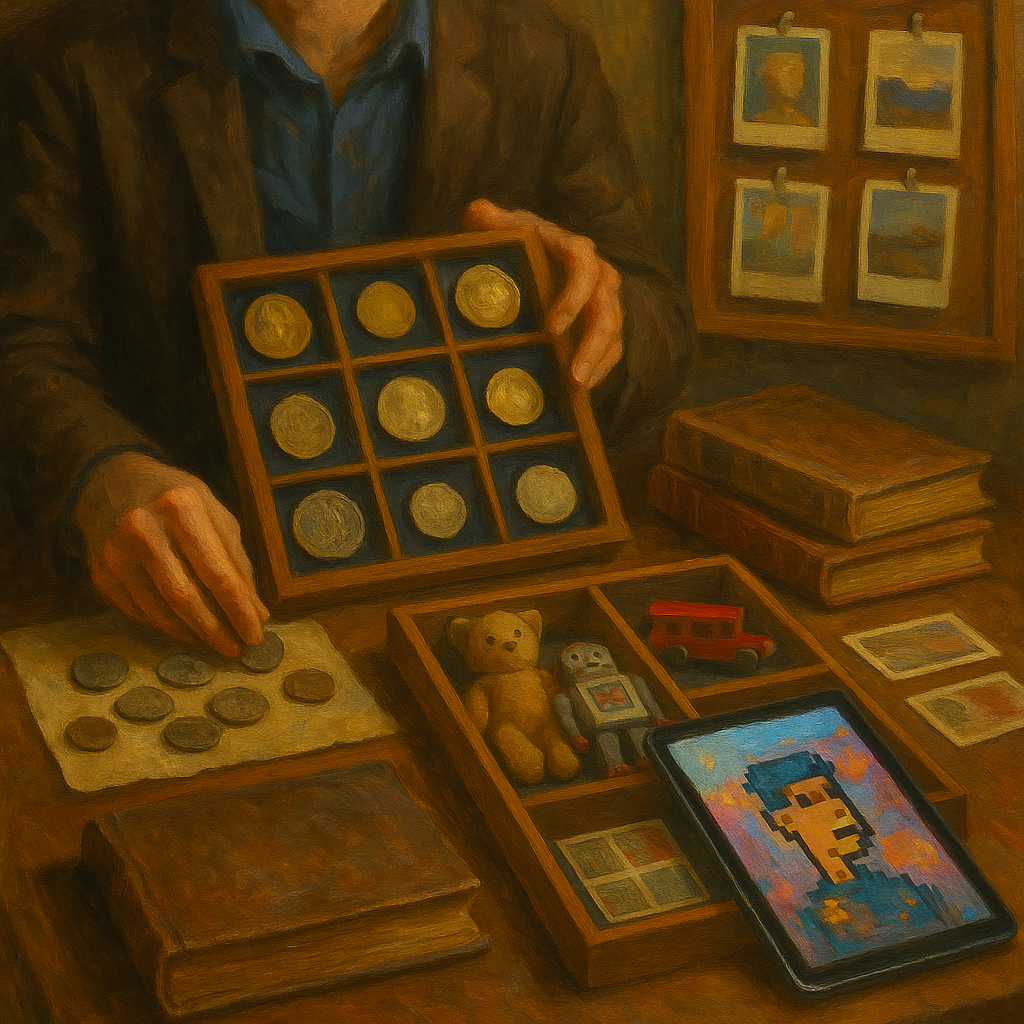
Example: A collector might keep a rare print in a climate-controlled portfolio while also owning a limited-edition NFT of the same work — the two items provide complementary types of value.
NFT trends & digital collectibles: What changes and what remains
NFT collectibles reframe provenance: blockchains write immutable ownership histories and enable digitally enforced scarcity. Yet the psychological drivers remain the same: identity, belonging, and aesthetic appreciation.
- Digital provenance: tokenized records automate ownership trails, but human verification remains important for creator identity and IP claims.
- Rarity and editioning: creators can mint single tokens or limited runs, shaping market dynamics. Collectors often value first-edition or “one-of-one” tokens more highly.
- Ownership vs. copyright: owning a token typically does not transfer IP rights unless explicitly stated. Understand license terms before assuming broad usage rights.
Future trend: expect greater hybridization — tokenization of physical objects, fractional ownership, AR/VR exhibition spaces, and AI-curated collections that suggest acquisitions based on taste profiling.
A practical note: Ethereum’s 2022 Merge shifted the chain to proof-of-stake, lowering energy use dramatically, but network choice still matters for sustainability. For deeper technical context, consult the Ethereum foundation and museum guidance on digital stewardship (external links below).
Collectibles market & collectibles as investment
Collectibles can appreciate, yet they are high-risk and often illiquid. If considering investment:
- Learn appraisal basics and market history (auction results, grading services).
- Diversify: treat collectibles as a smaller portion of a broader portfolio.
- Beware hype: community sentiment and trends drive short-term prices, especially in NFT markets.
Practical example: Vintage comic books and graded sports cards have established secondary markets and grading standards (e.g., numerical grading), which often make valuation more transparent than nascent NFT markets.
Collectible appraisal and authentication remain core to long-term value. Use certified appraisers for antiques and trusted grading services for collectibles like coins, comics, or sports memorabilia.
Ethics, repatriation, and stewardship
Collecting raises ethical questions: repatriation debates (e.g., Benin Bronzes, Elgin Marbles), colonial acquisition contexts, and authenticity concerns. Museums and collectors must balance access with accountability. Blockchain can help track provenance forward but cannot retroactively remedy undocumented histories; therefore, institutions and collectors should commit to transparent provenance research and community consultation.
Actionable recommendations:
- Prioritize transparent acquisition: always seek documentation and full ownership histories.
- Engage communities: consult originating communities and stakeholders about display and repatriation.
- Use technology wisely: employ databases and registries to share provenance data openly.
Future trends and predictions
- Tokenized physical ownership: expect more services that link a physical object to a token, enabling easier transfer and fractional investment.
- Curated virtual museums: AR/VR spaces where collectors curate immersive exhibitions will grow, allowing global audiences to experience collections.
- AI-assisted curation: algorithms will suggest acquisitions and detect forgeries by pattern analysis, augmenting human experts.
- Sustainability focus: collectors and platforms will increasingly favor low-energy blockchains and carbon-offset practices.
These trends mean the question “why do people collect things” will remain relevant as the forms and logistics of collecting evolve.
FAQ — Quick answers
Q: Is collecting a psychological disorder?
A: No. Collecting is usually healthy when intentional. Hoarding disorder is a clinical condition defined by distress and impairment. Collecting becomes problematic when it interferes with daily life or causes significant distress.
Q: Do NFTs give legal ownership of artwork?
A: Buying an NFT gives token ownership on a ledger; copyright usually remains with the creator unless transferred explicitly. Always read the license terms attached to a token.
Q: How do I verify provenance?
A: For physical items, request invoices, condition reports, and institutional records; for NFTs, inspect token IDs, smart contracts, and creator verification. Cross-check auction records and consult experts when in doubt.
Q: Are NFTs environmentally harmful?
A: It depends on the blockchain. The shift to proof-of-stake reduced energy use for major chains, but collectors should consider network impacts and choose platforms that align with their values.
Q: How should a beginner start collecting?
A: Define purpose and budget, research provenance, prioritize authenticity, secure storage, document records, and join collecting communities. Focus on meaning and stewardship rather than rapid speculation.
Q: What are some quick tips for preserving physical vs. digital items?
A: For physical: control humidity and light, use archival materials, and avoid adhesives. For digital: maintain multiple backups, update file formats as standards change, and keep keys/wallets secure.
Conclusion — Collecting as a practice of attention
Why do people collect things? Because collecting externalizes meaning: it preserves memory, builds identity, and creates communal frameworks for care. From ancient relics to digital NFTs, the forms change but the impulse persists. Collecting can be a civic practice when guided by sound provenance research and ethical stewardship. Finally, ask: what story are you telling through the things you keep?