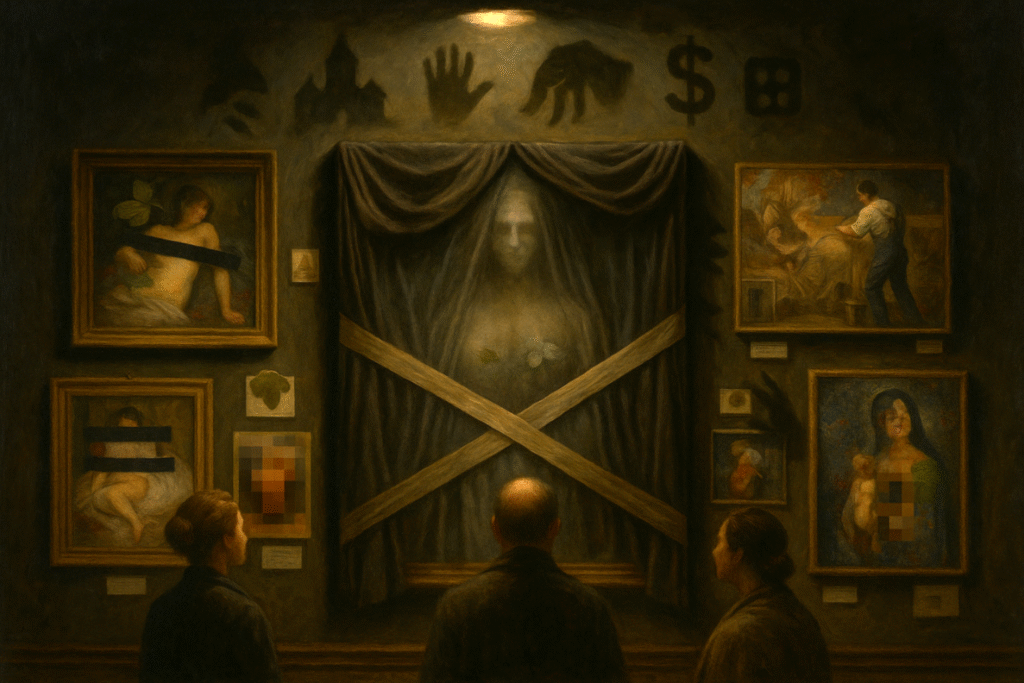

Art asks us to look more closely. Censored paintings are not merely scandalous objects; they are mirrors of power, identity, and collective anxiety. In this Noetik reflection I survey emblematic censored paintings, explain why they were suppressed, and show why they still matter for cultural memory and free expression. I also explore how museums, educators, collectors, and citizens can engage responsibly with these charged works.
Key Takeaways about censored paintings
- Censorship is driven by religious, moral, political, or racial concerns.
- The act of censorship often amplifies a painting’s cultural significance.
- Institutions must balance legal risk, ethical framing, and public dialogue when exhibiting forbidden art.
- Engaging with censored paintings reveals shifting norms across time and cultures and offers practical lessons for contemporary curatorial practice.
6 Case Studies of Censored Paintings
Michelangelo, The Last Judgment (1536–1541)
Context: Painted on the Sistine Chapel altar wall, the fresco’s extensive nudity alarmed Counter-Reformation authorities. Action: Daniele da Volterra added draperies and fig leaves after clerical demands. Reflection: This case exemplifies historical religious censorship and ongoing debates about restoration and authenticity.
Expanded detail and interpretation: The controversy over The Last Judgment also highlights how censorship can become part of a work’s material history. Conservators and scholars today weigh the ethics of restoring Michelangelo’s original intentions versus respecting later historical interventions. The patched-on fig leaves are historical artifacts in their own right: they tell a story about Church power and shifting attitudes toward the body.
Édouard Manet, Le Déjeuner sur l’herbe (1863)
Context: Rejected by the Paris Salon and shown at the Salon des Refusés. Controversy stemmed from placing nude figurehood in a modern, everyday setting. Reflection: Manet’s challenge to academic decorum helped open the door to modernism and more honest representations of contemporary life.
Expanded detail and case study: Contemporary reviews of the Salon des Refusés show critics split between moral outrage and praise for modernity. For students of art history, Manet’s painting serves as a case study in how institutional gatekeeping shapes taste and canon formation. Reproductions of the work proliferated, which paradoxically increased its public familiarity and hastened acceptance of new pictorial languages.
Gustave Courbet, L’Origine du monde (1866)
Context: A frank, close-up depiction of female anatomy that circulated privately for decades and was widely deemed obscene. Reflection: Courbet’s confrontational realism forced institutions to confront their own boundaries about nudity, privacy, and display.
Provenance and legal incidents: L’Origine du monde spent long periods in private collections precisely because public display invited legal risk. When it entered public view in the 20th century, curators staged contextualizing materials to mitigate shock and invite scholarly dialogue about gaze, objectification, and realism.
Diego Rivera, Man at the Crossroads (1933)
Context: Commissioned for Rockefeller Center, the mural included a likeness of Lenin. Action: Rockefeller Center destroyed the mural when Rivera refused to remove it. Reflection: A paradigmatic example of political censorship under corporate patronage.
Comparative angle: Rivera’s mural is a useful foil to state censorship: here private corporate interests exercised removal for reputational protection. The decision illuminated tensions between artistic autonomy and patronage obligations, a discussion that continues when museums accept sponsorship from contested donors.
Pablo Picasso, Guernica (1937)
Context: A monumental anti-war painting that exposed fascist violence. Action: Under Franco, Guernica could not be exhibited in Spain for decades. Reflection: Political bans often aim to erase memory; Guernica shows how art resists forgetting.
Long-term cultural impact: Guernica became an emblem of transnational resistance and a rallying artifact for human-rights discourse. Its exile and eventual return to Spain encapsulate how censorship attempts to control historical narrative but often strengthens the artwork’s symbolic power.
Chris Ofili, The Holy Virgin Mary (1996)
Context: Ofili’s mixed-media Madonna provoked religious outrage when shown at the Brooklyn Museum. Action: Political pressure threatened municipal funding; courts later protected the museum. Reflection: The case highlights contemporary legal battles over public funding and freedom of expression.
Legal precedent and museum practice: The Brooklyn Museum case is a modern test of indemnity, public subsidy, and curatorial discretion. It clarified that political displeasure alone cannot be used as a basis for withdrawing public support, setting a precedent that reverberates through museum administration.
Additional Case Studies and Examples
Beyond these canonical works, lesser-known instances show how censorship functions across cultures. For example, certain colonial-era portraits were hidden or defaced during independence movements as a symbolic rejection of imperial power. In recent years, digital platforms have taken on gatekeeping roles: social-media removals of images of paintings deemed offensive complicate previously local debates, making censorship a transnational phenomenon.
Why Censored Paintings Are Banned
Common rationales behind bans include religious blasphemy, perceived obscenity or nudity, political dissent, and cultural or racial offense. Importantly, form intensifies reaction: confrontational realism, monumental scale, or unconventional materials often make a work more likely to be attacked.
Sociopolitical context matters. A painting that shocks in one era may be didactic or historical in another. The direction of power—who controls museums, funding, and legal systems—shapes which works are vulnerable to suppression.
Who Censors Art? Mechanisms of Suppression
Censorship is distributed. Actors include religious authorities, states and courts, corporate patrons, museums and curators, and the press. Tools range from legal bans and funding withdrawal to alteration, removal, or outright destruction.
Mechanisms have evolved: in earlier centuries, physical removal or overpainting were common. Today, the internet, social media moderation policies, and publicity campaigns are powerful levers. Legal mechanisms vary by jurisdiction, from obscenity statutes to emergency decrees in authoritarian states.
Where to View and Buy Prints of Controversial Paintings
For public-domain works consult museum open-access collections, such as Musée d’Orsay or Museo Reina Sofía. For contemporary works, seek images and reproductions through the owning museum or authorized galleries. If you plan to reproduce images, verify rights and permissions first.
Practical tip: request image-use agreements early and budget for licensing fees. When exhibiting or selling reproductions of censored paintings, prepare interpretive labels that contextualize controversy and provide trigger warnings when appropriate.
Practical Applications: Museums, Educators, and Collectors
- Museums: Develop a step-by-step exhibition protocol (see next section). Establish legal counsel and community advisory boards. Create layered interpretation—wall texts, audio guides, symposiums—to situate contested works historically and ethically.
- Educators: Use censored paintings as primary sources for teaching about power, censorship, and visual rhetoric. Assign students to research provenance, reception history, and legal outcomes as class projects.
- Collectors: Maintain provenance documentation and consider reputational risk if lending to public exhibitions. Engage conservators early to understand any past alterations caused by censorship.
Step-by-Step Guide for Exhibiting a Controversial Painting
- Risk assessment: Evaluate legal, financial, and reputational exposure.
- Contextual research: Assemble a dossier on reception history, censorship incidents, and provenance.
- Stakeholder consultation: Talk with community leaders, legal counsel, and donors.
- Curatorial framing: Draft interpretive text that explains controversy without sensationalizing.
- Programmatic support: Plan talks, panels, and educational materials to encourage constructive dialogue.
- Security and insurance: Confirm coverage for damage and protest-related incidents.
- Communication strategy: Prepare press statements and an online FAQ.
- Evaluation: Gather visitor feedback and document lessons for future exhibitions.
Comparative Analysis: Religious vs Political Censorship
Religious censorship often focuses on perceived blasphemy or indecency, relying on moral suasion and ecclesiastical authority. Political censorship usually aims to suppress dissent or historical memory and often involves legal sanctions or direct removal. Corporate censorship, by contrast, is primarily reputational and financial.
Each form leaves different traces: religious interventions may result in added drapery or overpainting; political suppression may create gaps in public archives; corporate censorship can lead to self-censorship among artists and institutions.
Expert Insights
Art historians and curators generally agree that censorship produces a rich historical record. As one curator observed, censored paintings function as barometers of social anxiety and change. Conservators add that material interventions—overpainting, destruction, or careful conservation—help tell the story of a painting’s contested life. Legal scholars note that case law around public funding and free expression continues to evolve and will be decisive for future exhibitions.
Future Trends and Predictions
- Digitization and distributed archives will make suppressed works more accessible, but platform moderation will create new limits.
- Decolonization efforts will prompt re-evaluation of colonial-era omissions and may produce new instances of contestation.
- Legal frameworks for cultural expression will likely grow more complex, balancing hate-speech concerns with artistic freedom.
- Museums will increasingly adopt participatory models—community advisory committees, public programming—to anticipate controversies and diffuse conflict.
Further reading and sources
- Vatican Museums on the Sistine Chapel
- Musée d’Orsay collection entries for Courbet and Manet
- Museo Reina Sofía resources on Picasso’s Guernica
- Brooklyn Museum archives on the Sensation exhibition
Frequently Asked Questions (FAQ)
Q: What counts as a censored painting?
A: Any painted work that was suppressed, altered, removed, banned, destroyed, or otherwise restricted from public display by a religious, civic, institutional, or legal authority, or suppressed by public pressure.
Q: Were any of these works legally prosecuted for obscenity?
A: Some faced legal scrutiny under obscenity or decency laws. Modern controversies more often involve funding disputes and constitutional challenges, such as the Brooklyn Museum case. Local libel, blasphemy, and decency laws have also been used historically in different jurisdictions.
Q: Can museums legally refuse to display controversial art?
A: Yes, museums generally control their exhibitions. However, withdrawal of public funds as punishment for content can violate free-expression protections in some jurisdictions.
Q: How can I legally view images of censored paintings?
A: Use museum websites, scholarly archives, or Wikimedia Commons for public-domain works. For contemporary pieces, consult the owning institution or obtain permission from rights holders.
Q: How should a museum prepare before exhibiting a provocative work?
A: Prepare explanatory materials, consult stakeholders, review insurance and legal implications, and design public programming to foster dialogue. Include trigger warnings when appropriate and consider multilingual materials to reach diverse audiences.
Q: Are reproductions of censored paintings safe to sell?
A: Reproductions may require licensing. Determine whether the work is in the public domain and secure image rights for recent works. Also be mindful of cultural sensitivities that could affect sales or exhibition.
Q: Do censored paintings lose value if altered?
A: Alterations like overpainting or added drapery can complicate valuation. Sometimes these interventions become historically valuable; other times they diminish market value. Each case requires expert appraisal.
Conclusion
Censored paintings are crucial historical and philosophical objects: they reveal who controlled narratives and why certain images threatened prevailing norms. By preserving, contextualizing, and discussing forbidden art, we strengthen cultural literacy and protect the fragile space for dissenting vision. Engaging responsibly with censored paintings—through careful research, community engagement, and transparent curatorial practice—turns controversy into a pedagogical opportunity and preserves the pluralistic function of visual culture.